Share your requirements and target market. We’ll suggest the right configuration, sampling path, and production plan.
During business hours, we can usually send an initial quote within .
: workflow-based setups to improve efficiency and keep corridors tidy
: easier bag changes and maintenance, built for daily facility use
: 1–3 stream options with clear icon/label systems to reduce contamination
: materials, finishes, branding & packaging locked for consistent reorders
Your info is used only for quoting and communication.
Hotel Housekeeping Cart Buying Guide: How to Choose by Property Size
Most buyers choose a hotel housekeeping cart by shelf count and regret it later. This guide breaks the decision down by property size, labor pressure, hallway geometry, and real operational risk.
I’ve watched purchasing teams buy the same hotel housekeeping cart for a 78-room select-service property and a 420-key resort, then act surprised when one cart blocks half the corridor and the other forces attendants into constant refill runs, because they bought a silhouette, not a workflow, and in this business the wrong silhouette bleeds labor every single day.
Why are we still pretending a cart is just a cart?
And the injury math is uglier than many procurement decks admit. A 2024 systematic review in PubMed found musculoskeletal disorder prevalence at 53.9% for low back, 41.4% for shoulders, and 40.1% for wrists and hands among hotel housekeepers and cleaners. That is exactly why I do not treat caster resistance, handle position, shelf accessibility, or bag placement as cosmetic details. They are operational controls disguised as hardware.
California saw this years ago, and buyers should pay attention even if they operate outside the state. Title 8, Section 3345 explicitly frames hotel housekeeping around musculoskeletal risk, including pushing and pulling, forceful exertions, awkward postures, excessive work-rate, and inadequate recovery time; OSHA guidance also tells employers to use rolling carts with large, low-resistance wheels, keep them maintained, and push rather than pull. That is not theory. That is procurement guidance wearing legal clothes.
So I start somewhere unfashionable: corridor physics. In a small hotel, the best hotel housekeeping cart is usually the one that stays out of the way, turns cleanly into elevators, and carries only what one attendant can use before the next refill. In a big resort, the best commercial housekeeping cart is often the opposite—wider, deeper, more zoned, less elegant, more productive. The buyer who ignores that distinction usually ends up paying twice: once in unit cost, then again in wasted minutes.
I break the purchase into four questions. First, how much inventory must one cart carry for one floor run? Second, how visible will the cart be to guests? Third, how tight are your corridors, service vestibules, and elevator thresholds? Fourth, what deserves separation—clean linen, chemicals, amenities, trash, soiled linen, or all of it? If you cannot answer those four, you are not ready to compare models.
Here is the framework I actually trust.
Property size
What usually works best
Recommended cart direction
What to prioritize
What to avoid
Small hotel / boutique / limited service (roughly under 100 rooms)
A narrow, agile housekeeping cart for hotels with fast refills
Repeatable spec, branding consistency, replacement planning, packaging and reorder control
Mixing unrelated SKUs by property manager preference
My unpopular view? Small properties overbuy capacity. Large properties underbuy control. The first group buys a giant cart because it “feels professional,” then parks it halfway into the corridor like a roadblock. The second buys a small cart to save money, then burns labor on repeat trips, messy restocking, and improvised overflow bags hanging off the side like an afterthought.
For small hotels, I lean hard toward compactness. A small hotel housekeeping cart should carry one attendant’s live working set, not half the floor’s weekly life support. That makes the compact maid cart for tight corridors a smarter pattern than a bloated trolley, especially where elevators are shallow and guest traffic is constant. Facility Project Solutions positions that model around dedicated linen storage, zoned compartments, adjustable shelving, non-marking casters, and protective bumpers; those are exactly the features that matter when every turn is visible and every scuff ends up on a manager’s morning walk.
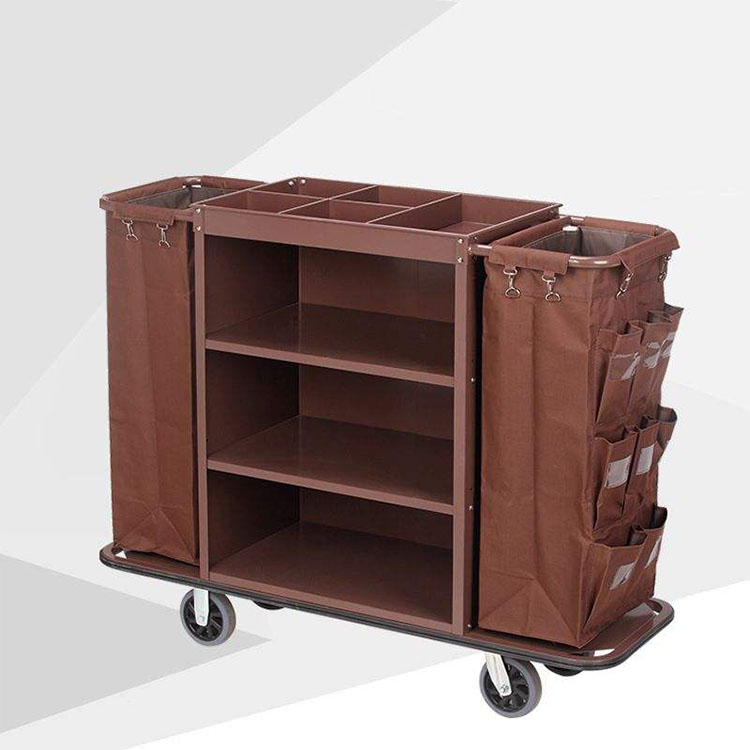
Mid-size properties need balance, not extremes. This is where a hotel housekeeping cart with bag holder earns its keep, because the integrated bag holder solves a problem many buyers pretend is minor: dirty flow. Clean linen and amenities should not mingle with soiled linen or waste, and once attendants start improvising that separation with hanging sacks and overstuffed corners, the cart has already failed. The site’s product copy also gets one thing right: non-marking casters, bumpers, and visible zoning are not bells and whistles; they are how you keep pace without making the floor look like a back alley.
Luxury and mixed-use properties are where I get stricter. If the cart will sit outside suites, near meeting rooms, or along polished guest corridors, use a lockable housekeeping cart. Not because locks are glamorous. Because exposed amenities, chemicals, and loose supplies make the operation look sloppy, and sometimes unsafe, even when the staff is doing heroic work. Lockable cabinet doors, adjustable shelving, easy-clean surfaces, and a more controlled visual profile make sense in properties where presentation and access control are part of the same problem.
Large properties are different beasts. A large hotel housekeeping trolley is not there to look neat in a catalog. It is there to reduce refill frequency, standardize floor runs, and keep attendants from wasting steps. The large housekeeping trolley with multiple shelves is the right direction when room count, par stock, and route length are big enough to justify more onboard inventory, but only if your service elevators, corridor widths, and parking spots can actually handle it. Bigger helps only when the building can absorb bigger. Otherwise, you just bought a more expensive bottleneck.
And I would not separate cart buying from brand standardization. The site’s OEM/ODM program is useful in one very specific scenario: multi-property groups that are tired of random replenishment buys, inconsistent finishes, and signage or branding that changes by site. I like that angle because the hidden cost in hospitality is not only the purchase order. It is the chaos that comes after reorders begin.
One more hard truth. Buyers love to compare shelves. I compare force. The cart that saves 90 seconds per room but adds daily pushing strain is not efficient; it is deferred injury. And the evidence is not subtle. That 2024 PubMed review found low-back pain affecting up to one in two workers, while California’s housekeeper-specific rule requires employers to evaluate pushing, pulling, forceful exertions, work-rate, and recovery time. So yes, I care about wheel quality, handle height, bumper placement, and how often staff must reach or bend for stock. I care more about those than a polished side panel.
What I would buy by property type
If I ran a 60-room boutique, I would buy the compact cart and standardize refill discipline. If I ran a 180-room full-service hotel, I would buy the bag-holder model and tighten separation between clean and dirty streams. If I ran an upscale urban property with high guest visibility, I would pay for lockable doors. And if I ran a 350-room resort, I would buy a large hotel housekeeping cart only after physically checking service elevators, corridor pinch points, and floor-side staging spots.
That last part matters.
Procurement teams love PDFs. Operations teams live with door frames.
FAQs
What size housekeeping cart is best for a small hotel?
A small hotel housekeeping cart is a narrow, corridor-friendly cart designed to carry one attendant’s active linen, amenity, and waste load for short refill cycles, prioritizing maneuverability, low wall contact, and clean visual presentation over maximum storage volume. In practice, that usually means buying smaller than your instincts want, then backing it with better closet discipline.
What is the difference between a hotel housekeeping cart and a hotel housekeeping trolley?
A hotel housekeeping trolley is generally a broader term for a wheeled service unit used to move linen, amenities, waste, and cleaning tools, while a hotel housekeeping cart usually implies the room-attendant-focused version optimized for guest-floor servicing, parking, and faster access to supplies. Buyers often use the terms interchangeably, but I care more about footprint, zoning, and wheel behavior than the label.
Is a lockable housekeeping cart worth it?
A lockable housekeeping cart is a guest-floor service cart with enclosed storage that protects amenities, chemicals, and tools from exposure or unauthorized access while also improving visual order in public corridors, premium floors, and mixed-use hospitality environments. I would not buy it for every hotel, but I would absolutely buy it where guest visibility and supply security are constant issues.
What features matter most in the best hotel housekeeping cart?
The best hotel housekeeping cart is the model whose storage volume, separation zones, wheel performance, visibility control, and corridor footprint match the property’s room count, refill cadence, staffing pattern, and guest-facing expectations better than competing options. If forced to rank features, I start with maneuverability, dirty-clean separation, shelf access, bumpers, and serviceability.
How many housekeeping carts does a hotel need?
The number of housekeeping carts a hotel needs is the quantity required to support each active attendant or floor team during peak room-turn periods without causing refill bottlenecks, idle labor, or corridor congestion, which means the answer depends on staffing model more than room count alone. I would calculate from live shift coverage, not from a static rooms-per-cart guess copied from another property.