Share your requirements and target market. We’ll suggest the right configuration, sampling path, and production plan.
During business hours, We can usually provide a preliminary quote within two hours.
: workflow-based setups to improve efficiency and keep corridors tidy
: easier bag changes and maintenance, built for daily facility use
: 1–3 stream options with clear icon/label systems to reduce contamination
: materials, finishes, branding & packaging locked for consistent reorders
Your info is used only for quoting and communication.
Housekeeping Cart Accessories Checklist: Bag Frames, Trays, Shelves, and Tool Holders
Most hotels do not have a cart problem. They have a specification problem. This checklist explains which housekeeping cart accessories earn their space, which ones create hidden labor, and how to link the page into a real buying path.
Table of Contents
Most hotels do not have a cart problem
Most buyers guess.
They compare cart bodies, shelf counts, and color finishes as if the cart itself were the decision, when the harder truth is that labor friction lives in the attachments: where the dirty stream sits, where gloves land, where microfiber hangs, how far a bag frame sticks into the corridor, and whether an attendant can reach high-frequency stock without bending, reshuffling, or blocking traffic every eight minutes. Why are we still pretending accessories are decorative? According to AHLA’s June 2024 workforce survey, 76% of surveyed hotels reported staffing shortages, 79% still could not fill open positions, and housekeeping ranked as the top hiring need for 50% of respondents. Reuters then gave the labor story teeth in September 2024, reporting that more than 10,000 hotel workers struck across 25 hotels in nine U.S. cities, with fair workloads and staffing cuts at the center of the dispute.
I do not buy the catalog fantasy.
The U.S. Bureau of Labor Statistics counted 854,910 maids and housekeeping cleaners in May 2024, with an annual mean wage of $36,180, which means most operators are running a huge, low-margin labor system where every wasted reach, every extra closet trip, and every badly placed bracket compounds fast. And the physical cost is not theoretical: a 2024 systematic review indexed by PubMed found musculoskeletal disorders are highly prevalent among hotel housekeepers and cleaners, with low back pain affecting up to one of two workers. That is why I treat housekeeping cart accessories as workflow controls first and product extras second.
Facility Project Solutions, to its credit, already hints at the right frame.
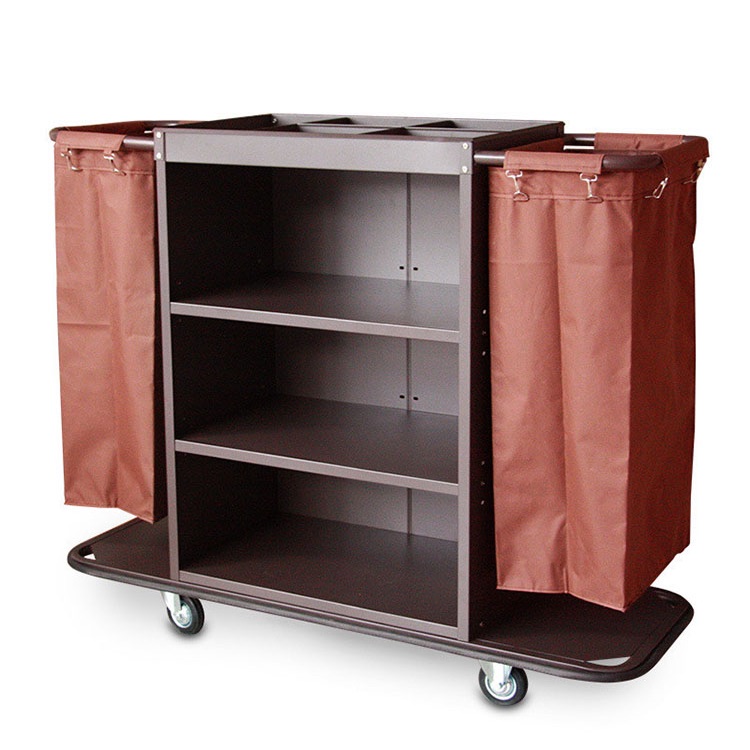
Its homepage talks about housekeeping carts configured around shelves, top trays, bag frames, bumpers, and non-marking wheels, while the category and product pages split the buyer journey into compact carts, bag-holder carts, lockable carts, and custom configurations rather than one bloated catch-all SKU. That architecture is smarter than most suppliers manage because it mirrors how operations teams actually think: corridor width, guest visibility, clean-vs-dirty separation, then repeatability.
The accessories that actually change the shift
Bag frames are not optional if you care about separation
Dirty flow matters.
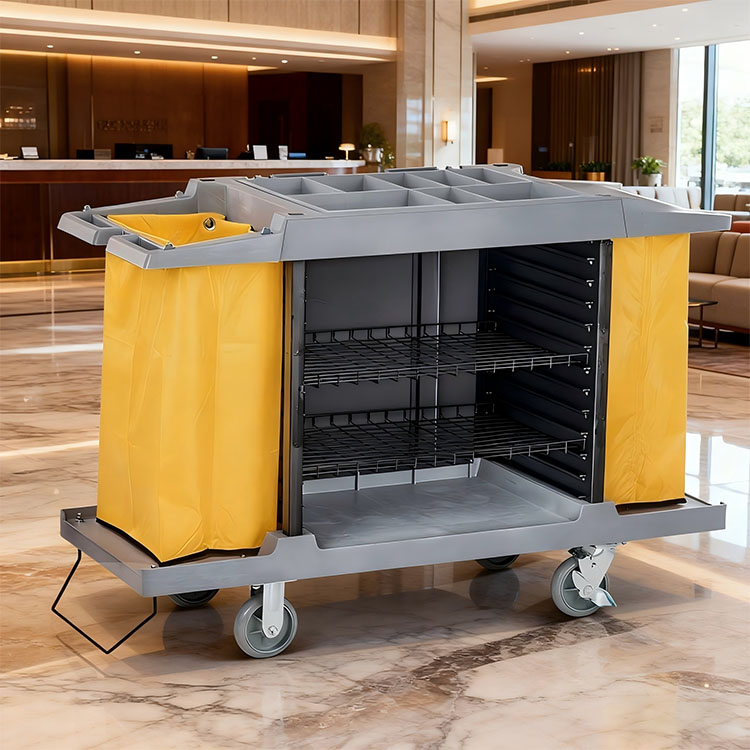
A proper bag frame is a fixed collection point that keeps soiled linen or waste away from clean towels, boxed amenities, and refill stock; without it, attendants improvise, and once they improvise, the cart is already lying to you about being “organized.” The hotel housekeeping cart with bag holder page gets this right: integrated bag holding, zoned shelving, non-marking casters, and bumper protection are presented as one working system, not as isolated features. I agree with that logic. Loose side sacks look cheap, swing into walls, and usually widen the live footprint more than buyers admit.
And here is the legal edge.
If a bag frame turns a “slim” cart into a corridor obstruction, the problem is no longer merchandising. The ADA’s accessible-route baseline is 36 inches wide continuously, with 32 inches allowed only at a brief pinch point, which is why I care more about loaded side profile than brochure width. Does your bag frame still behave once the cart is fully stocked and parked outside Room 1218?
Top trays should handle frequency, not volume
Top trays earn money.
A tray is not there to carry everything; it is there to hold the items attendants touch constantly, such as gloves, cloths, spray bottles, guest amenities, pens, room-status slips, or keycard paperwork, at standing height and in a repeatable pattern. Facility Project Solutions repeatedly ties top organizers and compartmentalized access to faster handling on both its homepage and custom cart pages, and that is the right call because the worst tray design is the deep, noisy, catch-all bin that turns a fast-access zone into a rummage box.
I like shallow logic.
A good tray should be wipe-friendly, segmented, quiet in motion, and narrow enough that it does not create a higher center of visual clutter than the cart body itself. If attendants have to lift half the tray contents to find a spray trigger, the tray is not helping. It is just sitting on top of the problem.
Shelves should be adjustable, because room mixes are messy
Static shelves waste space.
Hotels love standardization in theory, then ask one cart to serve king rooms, double-queen departures, stayover refreshes, and extended-stay kitchenette trash pulls as if storage demand were identical across all of them; it is not. The compact maid cart with linen storage and custom linen & amenity cart for hotels both emphasize adjustable shelving, zoned compartments, and dedicated linen sections, which is exactly how shelves should be sold: as par-level control, not as furniture.
My rule is blunt.
One shelf should support fast-pick stock, one should hold linen or boxed refill volume, and one should stay flexible for property-specific loadouts. More shelves do not automatically mean more productivity. Sometimes they just mean smaller mistakes repeated more neatly.
Tool holders are the accessory lazy specs forget
This one stings.
Tool holders, vacuum brackets, bottle holsters, glove hooks, and bracketed storage for long-handle cleaning tools are often missing from buyer checklists because they are not glamorous, yet they are what stop tools from riding sideways across shelves, contaminating linen zones, or getting “temporarily” leaned against walls in guest corridors. Facility Project Solutions explicitly references vacuum and tool brackets in its spec framework, and that matters because tools without parking positions migrate, rattle, fall, and slow the route.
I would go further.
If your team is moving quaternary ammonium cleaners, glass cleaner, microfiber, and trash tools on the same cart, then holder placement is a hygiene and sequence issue, not just a convenience issue. Why would anyone spend on a better frame and then let the tools float loose like a garage shelf?
The checklist procurement teams should actually use
The wrong accessory set creates hidden labor, and hidden labor is the line item buyers almost always miss.
Accessory
What it fixes
What usually goes wrong
My verdict
Bag frame / integrated bag holder
Separates soiled flow from clean stock; reduces awkward transfers
Buyers ignore live side projection and create corridor interference
Buy it, but measure loaded width, not naked frame width
Top tray
Speeds access to high-frequency items
Deep trays become junk bins and rattle carts noisy on guest floors
Keep it shallow, segmented, and wipeable
Adjustable shelves
Matches par levels to room mix and shift type
Fixed shelves create dead air or overstacked linen
Worth it on almost every hotel floor
Tool holders / brackets
Keeps spray bottles, vac tools, and long items parked and visible
Teams skip them, then tools migrate onto shelves or walls
Cheap, high-return accessory
Lockable cabinet zone
Hides chemicals and protects amenities in guest-facing areas
Operators treat enclosure as luxury instead of risk control
Strong buy on premium, mixed-use, or public corridors
Non-marking casters + bumpers
Protects floors, walls, and door frames; improves steering
Buyers treat them as base hardware, then regret the scuffs
Mandatory, not premium
That table is not theory. It lines up with the site’s own product logic: the housekeeping carts category clusters compact, bag-holder, lockable, and large multi-shelf formats; the compact maid cart focuses on linen zoning and adjustable shelving; the bag-holder cart is built around separation; and the lockable cart leans into concealed storage, controlled access, and guest-floor presentation. That is the right accessory story to tell because each page solves a different operating pain, not just a different aesthetic taste.
Someone searching “housekeeping cart accessories checklist” is not looking for philosophy. They are usually trying to choose, compare, or justify. So the page should answer the checklist question fast, then hand off to pages with sharper intent instead of dumping readers into a generic homepage. Facility Project Solutions already has those destination pages. The missed opportunity is simply not connecting them hard enough.
The accessory mistakes that cost more than the accessory
Cheap specs bite.
A flimsy bag frame bends, sags, widens the cart under load, and turns every doorway into a contact event. A badly placed tray creates noise on quiet floors. Too many shelves create dead volume no one can reach cleanly. Missing tool holders turn the cart into a drift zone. None of this looks dramatic in a PDF. It looks dramatic at 4:40 p.m. when a short-staffed floor still has nine departures open.
I think the market still underprices fatigue.
When BLS wage data tells you this labor pool is paid modestly, when AHLA tells you staffing is tight, and when recent reporting shows workload has become a strike issue, the adult response is not to squeeze another eight towels onto shelf three. It is to specify a cart that reduces pointless motion. That is what a serious housekeeping cart accessories checklist is really for.
FAQs
What are housekeeping cart accessories?
Housekeeping cart accessories are the functional add-ons and built-in storage elements—bag frames, top trays, adjustable shelves, tool holders, bumpers, casters, and lockable compartments—that determine how a cart separates clean from dirty flow, protects guest areas, and reduces wasted motion during room servicing. On a good cart, these parts create sequence. On a bad cart, they create clutter.
What is the best housekeeping cart accessory for hotel operations?
The best housekeeping cart accessory is usually the one that fixes the biggest workflow failure on the floor, which for many hotels is an integrated bag holder or bag frame because it controls dirty collection, protects clean stock, and stops attendants from improvising waste or linen storage in the middle of the shift. I would rank bag separation first, shelf flexibility second, and tool parking third for most properties.
Are bag frames better than loose hanging bags?
Bag frames are a fixed, controlled collection system that keeps soiled linen or waste in a defined zone, while loose hanging bags tend to swing, widen the cart’s live footprint, and create more contact risk with walls, door frames, and corridor traffic during loaded runs. Yes, in most hotel settings they are better. But only if you measure the cart fully loaded, not empty on a product sheet.
How should trays and shelves be organized on a hotel housekeeping cart?
Trays and shelves should be organized by touch frequency and contamination logic, with top trays reserved for high-frequency items used every few minutes, middle shelves zoned for linen and amenities, and lower or enclosed areas assigned to bulk stock, chemicals, or tools that should not drift into the clean-pick zone. I prefer a cart that makes the correct behavior obvious even on a tired shift.
Do tool holders really matter on janitorial cart accessories checklists?
Tool holders matter because they give bottles, vac attachments, long-handle tools, and other cleaning gear a fixed parking position, which reduces shelf contamination, lowers noise, and prevents the small but constant time loss that comes from searching, lifting, and re-staging loose tools throughout a shift. They are usually ignored because they look minor. That is exactly why they are worth specifying.
Your next steps
Measure first.
Take one real floor, not a conference-room fantasy, and record five things: corridor width, parked-cart depth, elevator lip behavior, daily dirty-vs-clean split, and the five items attendants touch most often. Then rewrite the page around those realities, link it into the housekeeping carts category, and push readers toward the specific product page that matches their pain point instead of asking them to do the site architecture work themselves. If the operation spans multiple properties, stop buying carts one unit at a time and move the conversation to the OEM/ODM program, because by then you are not choosing accessories anymore. You are choosing whether the next thousand room turns run cleaner than the last thousand.