Share your requirements and target market. We’ll suggest the right configuration, sampling path, and production plan.
During business hours, We can usually provide a preliminary quote within two hours.
: workflow-based setups to improve efficiency and keep corridors tidy
: easier bag changes and maintenance, built for daily facility use
: 1–3 stream options with clear icon/label systems to reduce contamination
: materials, finishes, branding & packaging locked for consistent reorders
Your info is used only for quoting and communication.
How to Choose Heavy-Duty Luggage Carts for Resorts
Resorts do not need prettier luggage carts. They need carts that survive wet entries, tight elevator turns, wedding-weekend surges, and understaffed bell desks without beating up walls, floors, or payroll.
Most resort buyers start in the wrong place
Looks can lie.
I keep seeing buyers treat a hotel luggage cart like lobby décor with wheels, when the smarter move is to treat it like front-of-house mechanical handling equipment that must survive wet thresholds, narrow elevators, family-resort baggage piles, wedding wardrobe bags, and bell teams that are moving fast because the desk is short-staffed again. Why spend good money on brass polish if the cart starts fishtailing the first time a group check-in hits?
According to the BLS 2023–2024 injury release, overexertion, repetitive motion, and bodily conditions produced 946,290 DART cases across private industry over the two-year period, while contact incidents produced 860,050, and overexertion cases carried a median 24 DART days. In plain English: when a resort buys the wrong cart, it is not just buying inconvenience; it is buying strain, collisions, missed shifts, and slower turns.
And the labor cushion is thin.
The AHLA’s February 2024 staffing survey found 67% of surveyed hotels reporting staffing shortages, 12% saying they were severely understaffed, and 48% naming housekeeping as the top hiring need, while 72% still could not fill open positions. So no, I would not spec a cart that requires a second employee every time it hits a carpet seam or elevator lip.
Resorts feel this faster.
In its 2024 Global Hotels Outlook, CBRE said beach resorts such as Riviera Maya, Los Cabos, and Cancun were expected to keep above-average occupancy in 2024. That matters because high-occupancy resort operations compress arrivals into ugly peaks, and ugly peaks expose weak caster setups, bad deck sizing, and fake “heavy-duty” claims in about one weekend.
Table of Contents
The specs that actually matter
Start with load rating, not finish
Buy for weight.
OSHA’s materials handling guidance says mechanically moved equipment has rated capacities that determine the maximum weight it can safely handle and that employers must ensure the rated capacity is displayed and not exceeded, except for load testing. That is why I start with the number nobody wants to talk about in sales calls: load rating. If the supplier cannot show a clear rated capacity, I assume the “heavy-duty hotel luggage cart” label is marketing fog.
My own buying rule is blunt.
For most resorts, I would not even entertain a primary front-drive cart below a real-world 700 lb to 1,000 lb operating target, and I say “real-world” because brochure load capacity and stable corridor load are not the same thing once you add soft-sided bags, hanging garments, sloped porte-cochère surfaces, and a staff member pushing one-handed while greeting a guest. Sounds harsh? Good. That is how you avoid replacing carts every high season.
The Heavy Duty Bellman Luggage Cart, Carpeted Deck is the right internal reference point when your core problem is simple: lots of bags, frequent front-drive use, and a need for a deck surface that steadies luggage instead of letting it skate. Carpet is not a luxury flourish here; it is a load-control decision.
Casters decide more than buyers admit
Specs decide.
OSHA’s 29 CFR 1910.176 says sufficient safe clearances must be allowed where mechanical handling equipment passes through aisles, doorways, turns, and passage points, and aisles must stay clear and in good repair. Pair that with the U.S. Access Board’s ADA route guidance, which sets a 36-inch continuous clear width for accessible routes, reducible to 32 inches only at short pinch points such as doorways, and the message is obvious: cart width, turning behavior, and wheel quality are operations issues, not afterthoughts. Why buy a wide, flashy bellman cart if it turns every service corridor into a liability experiment?
I care about wheels more than finish.
Give me non-marking commercial casters with predictable tracking, decent bearing quality, and a wheel material matched to the property surface mix. On polished stone, cheap hard wheels chatter and drift. On carpet and thresholds, undersized wheels feel heroic in the catalog and miserable in the building. For resorts with long corridors, elevator transitions, and outdoor-to-indoor movement, I usually want at least a 5-inch or 6-inch commercial caster, full stop.
The OEM Birdcage Hotel Luggage Cart with Bumper gets this right conceptually because the site emphasizes wrap-around bumper protection and non-marking wheels for lobby, elevator, and corridor use. That tells me the product is being framed around real route conditions, not just showroom angles.
Bumpers, rails, and finish are not cosmetic details
Walls remember.
The difference between a good resort cart and a bad one is often the stuff finance tries to cut first: perimeter bumpers, containment rails, non-marking wheels, and the deck geometry that keeps the load from shifting when the cart hits the elevator sill at speed. Then everyone wonders why the wall protection budget exploded.
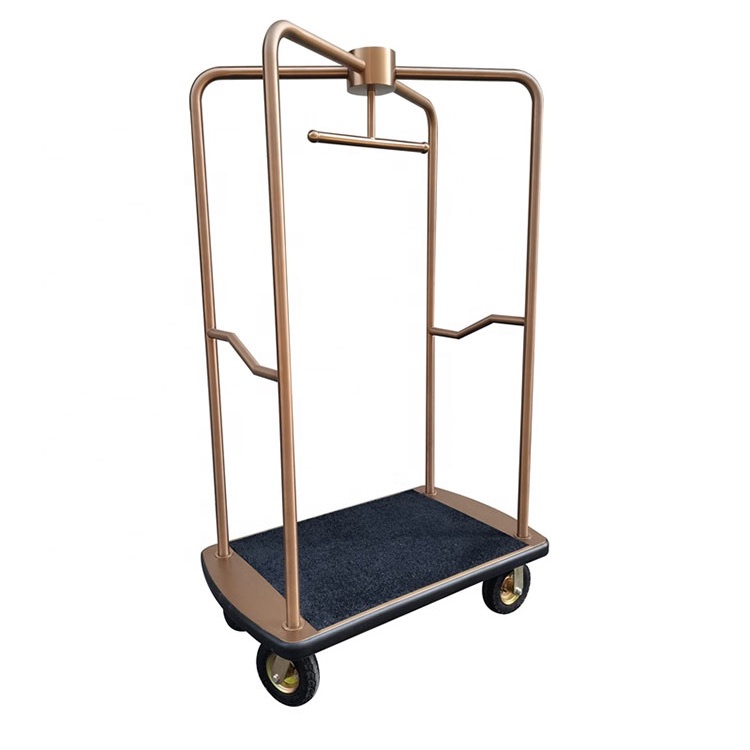
If your property has expensive millwork, narrow elevator jambs, or a lobby that is photographed more than it is cleaned, the OEM Birdcage Hotel Luggage Cart with Bumper makes operational sense because the bumper is doing real asset-protection work. If your property prioritizes wipe-down speed, corrosion resistance, and a more clinical-looking front-of-house tool, the Stainless Steel Hotel Luggage Trolley with Safety Rails is the cleaner answer. If you handle weddings, garment bags, and premium suite arrivals, the Gold Brass Bellhop Luggage Cart with Hanging Bar earns its space because the hanging bar separates dress bags and suits from the deck load.
And yes, finish matters.
But not in the way sales decks pretend. Gold or brass finishes sell a luxury cue. Stainless steel sells hygiene, easy wipe-downs, and coastal sanity. In humid resorts, I would take a 304 stainless build with sensible weld quality over decorative shine that starts looking tired after salt air, wet umbrellas, and sunscreen-coated luggage handles. Pretty is easy. Durable is the hard part.
Which cart fits which resort reality?
Resort operating reality
Best-fit cart choice
Why I’d choose it
What to watch
High-volume family resort with constant suitcase turnover
Easier side-by-side shortlist by route, finish, and use case
Standardize spare wheels, bumper parts, and finish policy
That comparison is not guesswork pulled from thin air; it follows the way Facility Project Solutions has structured its luggage-cart category and how each product page frames the use case—corridors, elevators, bumpers, rails, garment handling, and front-of-house presentation.
The mistakes I would not excuse
Too tall. Too wide. Too vague.
The dumbest buying mistake is skipping a route audit. Measure the service elevator interior, the lobby-to-lift turn, the guestroom wing choke points, and the porte-cochère entry lip before you approve any cart. OSHA requires safe clearance where mechanical handling equipment turns and passes, and ADA route guidance still expects accessible circulation widths to stay usable. If your cart turns a 36-inch continuous route into a rolling obstacle, you bought the wrong unit, even if it photographs beautifully.
Second mistake: buying “heavy-duty” with no wheel specification.
I do not care how thick the tubing looks if the caster assembly is cheap, undersized, or impossible to replace quickly. Resorts kill carts from the ground up. The frame usually survives. The wheels, bearings, axles, deck trim, and bumper line do not. Ask for spare-caster availability at quote stage, not after the first peak-season breakdown.
Third mistake: ignoring the cost of wall damage.
A bumper ring feels optional until a bell team clips elevator interiors and corridor corners for six months. Then the repair invoices show up, and suddenly the cheaper cart was not cheaper. Funny how that works.
Fourth mistake: choosing carpeted decks without a deck-service plan.
I like carpeted decks when load control matters. I dislike them when the buyer has no answer for replacement intervals, stain resistance, or how the deck looks after wet suitcases, pool gear, sand, and sunscreen leaks. Resorts are not city-center business hotels. The abuse pattern is rougher and stranger.
What I would ask a supplier before signing off
The five questions that separate operators from browsers
I would ask for the rated load capacity in writing, the exact caster diameter and wheel material, the outer width and turning envelope, the bumper construction, and the spare-parts plan for wheels, deck trim, and finish touch-up. Then I would ask one more thing sellers hate: “What fails first on this cart after 12 months in a busy resort?” If the answer gets slippery, I move on.
And I would make the supplier talk route logic.
Facility Project Solutions repeatedly frames these units around corridors, elevators, non-marking wheels, bumpers, and front-of-house presentation on its product pages and across the site’s procurement-oriented content themes. That is the right frame. Resort buyers should think in route logic, not product glamour.
FAQs
What is a heavy-duty hotel luggage cart?
A heavy-duty hotel luggage cart is a front-of-house baggage trolley built with a reinforced frame, commercial-grade casters, a stable deck or rail system, and protective features that let staff move multiple bags through lobbies, corridors, and elevators without excessive strain, wall damage, or repeated re-handling.
That is the definition. In practice, I also want a visible load rating, replaceable wear parts, and a design that matches the property’s actual traffic pattern rather than the brand team’s mood board.
What load capacity should a resort luggage cart have?
A sensible resort luggage cart capacity is usually in the 700-to-1,000-pound class on paper, but the right buying decision depends on real operating load, floor friction, threshold transitions, ramp exposure, and whether one employee can control the cart safely during compressed check-in periods.
I care less about the headline number than I do about whether that number is documented, displayed, and believable under daily resort abuse. OSHA’s guidance on rated capacities backs that mindset.
Are brass bellman carts better than stainless steel luggage trolleys?
A brass bellman cart is better when presentation, garment handling, and premium-arrival optics matter most, while a stainless-steel luggage trolley is better when the property prioritizes fast wipe-downs, corrosion resistance, cleaner-looking surfaces, and a more utilitarian operating style in humid or high-turnover resort environments.
So the answer is not “better.” It is “better for what?” Wedding resorts, villa resorts, and coastal resorts can land on three different answers and all be right.
How many luggage carts does a resort need?
A practical resort baseline is one front-of-house luggage cart for roughly every 75 to 125 keys, then adjusted upward for building spread, group arrivals, wedding business, valet load, and whether bell coverage is centralized or split across towers, villas, or separate elevator banks.
I would rather own one extra cart than force staff into delay, double-handling, or improvised baggage staging at the lobby edge. Understaffed teams do not need heroic workarounds; they need enough equipment.
Your next move
Do the audit first.
Measure the route. Count the real baggage profile. Decide whether your resort problem is weight, wall damage, sanitation, or garment handling. Then shortlist two or three models instead of pretending one “best hotel luggage cart” fits every property.