Share your requirements and target market. We’ll suggest the right configuration, sampling path, and production plan.
During business hours, We can usually provide a preliminary quote within two hours.
: workflow-based setups to improve efficiency and keep corridors tidy
: easier bag changes and maintenance, built for daily facility use
: 1–3 stream options with clear icon/label systems to reduce contamination
: materials, finishes, branding & packaging locked for consistent reorders
Your info is used only for quoting and communication.
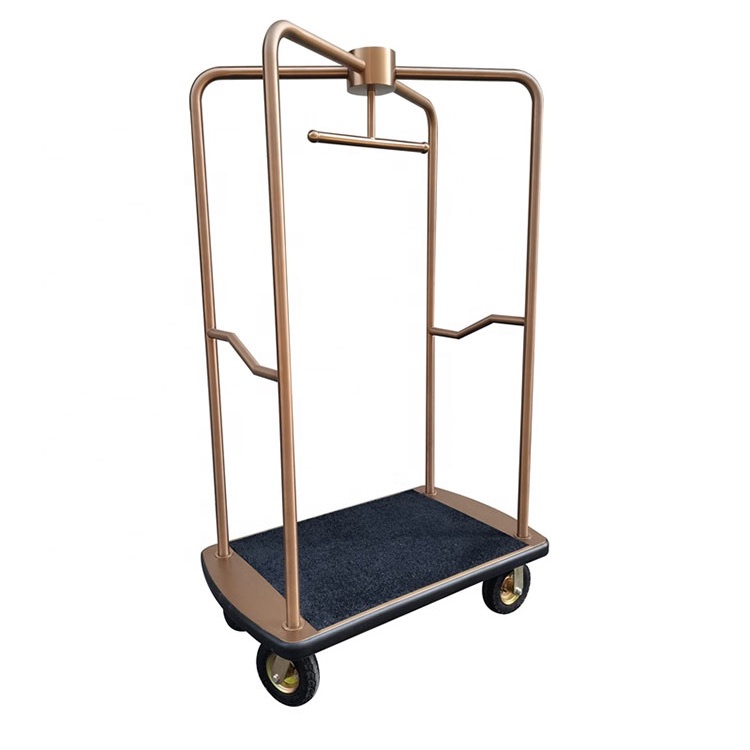
Most hotels do not face a neat federal sentence that says every bellman cart must have brakes. But once you look at slopes, polished stone, elevator staging, staffing pressure, and injury data, the operational answer gets blunt fast: on many properties, brakes stop being optional long before procurement admits it.
Most hotels should.
After reviewing OSHA guidance, Cal/OSHA’s hotel-housekeeping rule, 2024 BLS injury data, and hand-cart braking guidance, I do not see a tidy U.S. hotel-specific federal rule that says every manual bellman cart must ship with a brake system, but I do see repeated warnings about push-pull hazards, slopes, slick floors, clearance failures, and uncontrolled cart movement—the exact conditions front-of-house teams deal with every day in porte-cochères, elevator lobbies, and polished arrival halls. Why pretend that distinction is academic?
My answer is not diplomatic. If your bellman cart ever waits on an incline, pauses at an elevator threshold, stages near a valet lane, or carries a stacked load that one person cannot confidently stop with body control alone, then yes, the bellman cart needs brakes in practice, whether legal says “must” in one sentence or not.
I have sat in too many hotel equipment meetings where people spent longer arguing over brass versus stainless than over stopping control. That is backwards. A shiny birdcage frame never prevented a drift event.
Table of Contents
The law is thinner than buyers want, and the risk is fatter than they admit
Here is the uncomfortable truth.
Federal OSHA does not hand you a hotel-bellman-cart rulebook with a checkbox marked “brake system required,” which is exactly why weak buyers hide behind compliance language instead of thinking like operators, but hotel and housekeeping regulations do keep circling the same risk pattern: slips, trips, falls, forceful pushing and pulling, awkward control, and route conditions that turn carts into strain machines. Isn’t that the real argument?
California is especially revealing. Cal/OSHA Title 8, Section 3345 explicitly treats loading, unloading, pushing, and pulling carts as hotel-housekeeping risk tasks, and the state’s July 2023 fact sheet calls out slips, trips, falls, pushing and pulling, excessive work rate, and inadequate recovery time. That is not a bellman-cart brake mandate, no. It is something more annoying for cheap procurement people: a legal framework that forces employers to identify and control the very conditions that make brake systems matter.
And OSHA’s own ergonomics guidance is not subtle either. In its housekeeping eTool, OSHA warns about pushing and pulling heavy carts and recommends rolling carts with large, low-resistance wheels, while broader manual-material-handling guidance flags situations where brakes for hand carts are needed but missing. That is the kind of language I pay attention to because it tells you where the liability story goes after the incident, not before it.
The data does not scream “bellman cart,” but it absolutely screams “control your equipment”
Numbers matter here.
The U.S. Bureau of Labor Statistics says accommodation and food services recorded 234,800 injury and illness cases in 2024, with a rate of 2.6 cases per 100 full-time workers; the broader accommodation and food services industry also recorded 186 fatalities in 2024, while the accommodation subsector alone recorded 42 fatalities. Are all of those luggage-cart incidents? Of course not. But anybody serious about hotel operations should be alarmed by how much risk still sits inside ordinary guest-service work.
It gets sharper. The BLS chart on detailed illnesses shows the accommodation subsector logged 2,800 nonfatal work illnesses in 2024 at a rate of 18.7 per 10,000 full-time workers. Meanwhile, OSHA’s April 18, 2024 release said it had published 2023 injury-and-illness data from more than 375,000 establishments and partial records from more than 850,000 OSHA logs and incident reports. The data universe is large, current, and ugly enough that “we’ve never had a serious problem” is not an argument; it is usually just a confession that nobody looked carefully.
And one more piece that hotel operators ignore at their own expense: guidance updated by the Canadian Centre for Occupational Health and Safety in September 2024 says carts on ramps should include a hand or foot brake to help the operator control heavy loads. That is not U.S. hotel law, but it is common-sense engineering guidance from a serious occupational authority, and it lines up perfectly with what any experienced bell desk already knows.
When a bellman cart brake system stops being optional
Route first. Always.
The brake question is not really about the cart in isolation; it is about the cart, the floor finish, the load inertia, the stopping zone, the staffing level, and whether a front-desk worker is going to leave that unit unattended for six seconds while a guest asks for a room-key correction. What happens in those six seconds?
Here is the way I would spec it:
Hotel condition
My take on brakes
What I’d specify
Why
Flat interior lobby, short runs, supervised handoff
Advisable, not absolute
2 swivel bellman cart casters with brake
Cheap insurance against drift during pause points
Polished stone, marble, or wet entry transition
Strong yes
Total-lock brake casters
Slick floors reduce forgiveness fast
Sloped porte-cochère, valet apron, or ramp
Yes, full stop
Bellman cart brake system or central brake
Control on descents is a worker-safety issue
Elevator staging, threshold lips, frequent stops
Strong yes
Brake casters plus large low-resistance wheels
Stops unwanted roll during door waits and load shifts
Heavy group arrivals, wedding loads, garment bags, 700-1,000 lb real-world loads
Yes
Higher-grade bellman trolley brakes, not bargain pedals
More mass means more stopping force and more chaos when it drifts
Outdoor-to-indoor resort routes
Yes
Corrosion-resistant brake hardware on 5″ to 8″ commercial casters
Wet wheels, grit, and grade changes multiply risk
That table is my operating view, not catalog poetry. And I will say this plainly: if your hotel has a sloped arrival zone and you still buy a bellman cart with no brake control, you are not being cost-conscious. You are passing risk downstream to the employee with the weakest leverage position.
The insider mistake: hotels buy glamour, but damage comes from motion
What I like about the current site is that it keeps coming back to the same adult concerns: corridors, elevators, non-marking wheels, bumpers, load rating, and route logic. The heavy-duty resort guide says the quiet part out loud—buyers should stop treating a hotel luggage cart like lobby décor and start treating it like front-of-house mechanical handling equipment, with real-world load targets in the 700 lb to 1,000 lb range and caster specs that match mixed flooring. That is the right tone.
The corridor piece makes the same point from a different angle: a cart that cannot stop cleanly outside a room or elevator becomes a choke point, not a tool. And the TCO article is even blunter, arguing that caster failure, wall damage, and compliance exposure are part of the real cost base, not background noise. I agree with that entirely. Cheap carts lie.
So, do hotel bellman carts need brakes?
Usually, yes.
Not because every property faces the same code sentence, and not because every bellman cart brake system has to be fancy, but because modern hotels operate under thinner staffing, faster arrival peaks, more polished finishes, more mixed-use circulation, and less tolerance for guest-facing equipment mistakes than the industry likes to admit. Why would you bet against control?
If I were writing the spec tomorrow, I would say it this way: flat boutique property with short indoor runs and constant supervision, brakes are still smart; resort, convention, or luxury property with slopes, staging, polished stone, elevator waits, or heavy bell loads, brakes move into the “should have been in the quote from day one” category.
And no, I would not let a supplier dodge this by saying the cart has “smooth mobility.” Smooth mobility without controlled stopping is how hotels end up with rolled ankles, chipped millwork, and those embarrassing front-of-house near-misses everyone remembers and nobody writes down.
FAQs
Are hotel luggage cart brakes legally required?
Hotel luggage cart brakes are not universally mandated by one simple U.S. federal hotel rule, but they become a defensible safety control whenever the route includes ramps, sloped entry aprons, polished flooring, elevator staging zones, or any operating condition where an unattended cart can roll, drift, or strike a guest, worker, wall, or door frame.
That is the clean answer. If your route creates roll risk, arguing over whether the rule says “bellman cart brake system” word-for-word is missing the operational point.
What is the best bellman cart brake system for most hotels?
The best bellman cart brake system is the one staff will actually use during fast arrivals, which usually means either two high-quality total-lock swivel brake casters for standard indoor service or a central braking system for heavier carts, steeper approaches, and properties where carts are staged outside elevators, valet stands, or porte-cochère lanes.
I do not love decorative hardware with awkward pedals. I love brake control that works when the cart is loaded, wet-wheeled, and slightly rushed.
Do bellman cart casters with brake slow staff down?
Bellman cart casters with brake slow staff down only when they are badly specified, badly positioned, or require awkward force to engage, because on a well-built cart the tiny time cost of braking is trivial compared with the delay, strain, guest embarrassment, and property damage that comes from a drifting or runaway luggage cart.
That is the hard trade-off buyers need to face. Friction in the brake pedal is cheaper than friction in an injury claim.
Can existing bellman trolleys be retrofitted with brakes?
Existing bellman trolleys can often be retrofitted with brake casters or, on higher-end projects, a central braking setup, but the retrofit works only when wheel diameter, fork dimensions, deck height, load rating, and turning geometry are checked first so the cart does not become harder to steer, less stable, or too tall for elevator and doorway clearances.
I would never approve a retrofit from a photo alone. Measure first, then buy hardware.
What matters more than finish when comparing the best hotel luggage carts with brakes?
The specs that matter more than finish are load rating, caster diameter, wheel material, brake usability, bumper coverage, deck stability, rail or hanging-bar containment, route width, and corrosion resistance, because a bellman cart usually fails in service from bad route fit and bad motion control long before it fails from looking unattractive in the lobby.
Brass sells. Control saves. That is the order I use.
Your Next Step
Start with a route audit, not a brochure.
Measure the lobby-to-elevator turn, the elevator sill, the porte-cochère slope, the floor finish change, and the real loaded stopping zone; then use the hotel luggage trolley collection for the category view, the heavy-duty resort buying guide for route logic, the corridor cart guide for maneuverability thinking, and the custom OEM/ODM proposal page when you are ready to lock a brake spec, caster spec, finish, and replacement-parts policy across the property or portfolio. Facility Project Solutions positions itself as a B2B OEM/private-label supplier for hotel service carts, which means this topic should end in a spec conversation, not another vague debate about whether brakes “feel necessary.”