Share your requirements and target market. We’ll suggest the right configuration, sampling path, and production plan.
During business hours, We can usually provide a preliminary quote within two hours.
: workflow-based setups to improve efficiency and keep corridors tidy
: easier bag changes and maintenance, built for daily facility use
: 1–3 stream options with clear icon/label systems to reduce contamination
: materials, finishes, branding & packaging locked for consistent reorders
Your info is used only for quoting and communication.
Eco-Friendly Trash Bins for Public Spaces: Is Durability More Important Than Recycled Material?
Recycled content looks good in a procurement document, but it doesn’t guarantee a sustainable public-space bin. This analysis explains why service life, repairability, weather resistance, and recycled material must be evaluated together.
A trash bin splits beside a bus stop. Rain gets inside, the liner snags on a jagged edge, and within a week somebody from maintenance has wrapped silver duct tape around the body.
Not very green.
So, which matters more: recycled material or durability?
My blunt answer is durability. Usually.
A public-space bin that survives twelve or fifteen years will often make more environmental sense than a high-recycled-content unit replaced every four years. But recycled content still matters. The mistake—and I see this buried in procurement scorecards far too often—is treating these two attributes as if one automatically proves the other.
It doesn’t.
The best eco-friendly trash bins combine a long field life, repairable parts, sensible material use, verified recycled content, low-effort servicing, and a realistic recovery route after retirement. Miss two or three of those items and “eco-friendly” becomes a loose marketing phrase.
The Recycled-Content Number Can Hide a Lot
“Made with recycled material” sounds precise. It isn’t.
Does the percentage refer to the plastic body, or the complete product? Is the feedstock post-consumer plastic collected after use, or clean factory scrap counted as pre-consumer content? Does the number include the steel liner, concrete ballast, locks, fasteners, feet, and powder coating?
Ask. Then ask again.
A recycled plastic waste receptacle commonly uses HDPE, or high-density polyethylene, with the repeating chemical structure ((C_2H_4)_n). HDPE can be a solid choice outdoors. It handles moisture well and won’t rust. Still, its actual field behavior depends on polymer contamination, melt history, wall thickness, rib design, pigment, UV stabilizer package, and the quality of the molding run.
That’s shop-floor stuff. It matters.
Poorly sorted recycled resin may contain polypropylene, labels, adhesives, fillers, or degraded polymer chains. Sometimes manufacturers blend recycled resin with virgin material to stabilize impact strength and processing behavior. I don’t regard that as cheating—assuming the supplier states the blend honestly. A slightly lower recycled percentage in a bin that remains tough after years of UV exposure beats a brittle, nominally greener shell that cracks around its mounting bolts.
The U.S. Environmental Protection Agency takes a similarly broad view. Its 2024 National Strategy to Prevent Plastic Pollution calls for government purchasing criteria that reduce lifecycle impacts, not merely virgin-material inputs.
Public Spaces Are Rougher Than Catalog Photos Suggest
Ever watched how people treat a street bin?
They sit on it. Kick it. Jam pizza boxes through a narrow aperture. Stub cigarettes into the powder coat. Dump household rubbish beside it because the door won’t open. Cleaning crews attack graffiti with aggressive solvents; winter crews throw around sodium chloride; coastal air supplies its own steady dose of salt.
Pretty brutal, really.
Public space waste bins must tolerate ultraviolet radiation, freeze-thaw cycling, rainwater, acidic residue, dog urine, wheeled-cart impact, liner abrasion, and the occasional vehicle nudge. A supplier describing a product as “weather-resistant” tells me almost nothing. I want to know what was tested, for how long, and by which method.
Metal grade matters here. Grade 304 stainless steel offers good general corrosion resistance. Grade 316 adds roughly 2–3% molybdenum, which improves resistance in chloride-heavy environments. That extra protection can be worthwhile on a seafront promenade.
In a covered inland walkway? Maybe not.
This is where buyers overcook specifications. They order expensive 316 stainless for a dry lobby, then accept thin-gauge painted steel at an exposed transit stop. The material budget lands in precisely the wrong place.
And scale magnifies every mistake. The 2024 Zero Waste Report says New York City’s Department of Sanitation maintains about 21,000 public litter baskets. Those baskets represent less than 3% of DSNY’s curbside and containerized waste, but every one still needs emptying, cleaning, repair, and—eventually—replacement.
Cut a bin’s average life from twelve years to six and you effectively double replacement demand over the same period. More bodies molded or fabricated. More liners. More packaging. More truck movements. More old units entering the waste stream.
Recycled or not, that’s a lousy result.
Durability Isn’t Just a Thick Outer Shell
I’ve seen buyers knock on the side of a bin, hear a satisfying metallic thud, and decide it must be heavy-duty.
That’s not an inspection.
The usual failure points are smaller and less glamorous: hinge pins, door latches, bag-retaining rings, weld toes, base plates, anchor holes, coating edges, and the lip around the waste aperture. The main body can look nearly new while a proprietary lock turns the entire unit into an awkward steel box nobody can service.
Here’s the ugly truth: a bin without available spares isn’t genuinely durable.
It’s merely sturdy until something breaks.
That’s why replaceable doors, lids, liners, hinges, locks, feet, and ashtray inserts deserve their own line in the purchasing specification. I’d ask the supplier to guarantee availability for at least seven to ten years. And I’d ask for current spare-part prices—because “available on request” can mean expensive enough that nobody actually orders them.
The liner deserves special suspicion. A powder-coated or stainless outer body may last a decade, while its thin galvanized liner rusts through after eighteen months because trapped liquid has nowhere to drain.
Tiny detail. Big headache.
Recycled Material Still Has a Serious Job to Do
But don’t swing too far the other way. Buying virgin resin forever because it performs predictably isn’t a defensible sustainability strategy either.
Reuters reported in August 2024 that worldwide plastic production reached about 390 million tonnes in 2021, while less than 10% of plastic waste was recycled. That’s the uncomfortable backdrop to every recycled-content discussion.
Markets need demand. Public procurement can provide it.
If cities, hotels, campuses, airports, and commercial estates consistently require independently verified post-consumer content, recyclers have a better reason to invest in sorting, washing, compounding, and quality control. Without buyers, collected plastic has nowhere useful to go.
Paris provided a high-profile example. Organizers installed around 11,000 stadium seats made from recycled plastic at two venues for the 2024 Olympic Games.
That wasn’t a decorative pilot hidden backstage. It put recycled polymer into a public, load-bearing application where dimensional consistency and physical performance mattered.
Still, the seat had to function as a seat.
Same rule for bins.
Recycled content should earn points in a tender. It just shouldn’t excuse weak hinges, poor UV retention, a flimsy liner, or a vague one-year warranty.
Durability Versus Recycled Content: What the Specification Should Measure
Procurement factor
Weak specification
Better evidence to request
Why it matters
Recycled content
“Made from recycled material”
Percentage by weight, post-consumer versus pre-consumer content, and third-party verification
Stops vague environmental claims
Service life
“Heavy-duty construction”
Written design-life declaration and comparable installed references
Converts durability from an adjective into a testable claim
UV resistance
“Suitable for outdoors”
Accelerated weathering data, color-change rating, and impact retention after exposure
Low-grade polymers can fade and embrittle
Corrosion protection
“Powder-coated steel”
Coating thickness, substrate preparation, salt-spray method, and repair instructions
Small coating failures can spread underneath the finish
Repairability
No spare-parts schedule
Replaceable doors, hinges, locks, liners, feet, and lids available for 7–10 years
A damaged component shouldn’t condemn the entire bin
Collection efficiency
Capacity alone
Bag access, liner removal time, drainage, opening size, and compatible liner dimensions
Labor often outweighs purchase price
End of life
“Recyclable”
Polymer or alloy identification and a documented take-back or local recovery route
Technically recyclable doesn’t mean locally recycled
Warranty
One-year general warranty
Separate structural, coating, hardware, and corrosion terms
Exposes what the supplier genuinely expects to last
I’d reject a procurement model that gives ten points for recycled content and none for service life.
Frankly, it’s backwards.
Try the Replacement-Cycle Test Before Buying
Suppose you’re comparing two 100-liter weather-resistant outdoor bins.
Bin A costs $480. Its plastic body contains 80% recycled material, but the estimated service life is five years.
Bin B costs $720. It contains 30% recycled material, uses replaceable hardware, and carries an estimated fifteen-year life.
Over fifteen years, you may need three units of Bin A. Purchase cost alone reaches $1,440, before anyone adds removal, freight, installation, broken anchors, procurement time, or disposal.
Bin B needs one initial purchase at $720—assuming its field-life claim is credible and the parts remain available.
Is that a complete life-cycle assessment? No. It’s a rough screening exercise. But it catches nonsense early, which is more than many tender documents manage.
If a badly designed door adds just 20 seconds to each collection and staff empty the bin twice per day, one receptacle consumes roughly four additional labor hours annually. Across 250 bins, the portfolio loses about 1,000 hours each year to an irritating latch, cramped liner, or bag-retaining ring that fights back.
The facilities crew will know. Procurement may never hear about it.
Litter Volume Changes the Sustainability Equation
A bin is only environmentally useful when people can use it.
Obvious? Apparently not.
Washington State’s Department of Ecology reported in 2024 that nearly 38 million pounds of litter are dropped on the state’s roads, highways, and public areas each year—about five pounds per person.
Now picture a bin with a jammed door. Or one overflowing because its decorative top cuts the usable capacity by a third. Perhaps rainwater pools inside, making the bag too heavy to lift safely.
Its material pedigree won’t save it.
For busy sites, aperture size, liner volume, collection route, bag access, and emptying speed can have more operational impact than the recycled percentage molded into the rear panel. That opinion won’t look glamorous in a sustainability brochure, but facilities managers know it’s true.
Match the Receptacle to the Abuse Profile
What’s the best material? Wrong first question.
Where will the bin sit?
An exposed park, waterfront, transport platform, covered entrance, office corridor, and smoking zone each present a different abuse profile. Weather, waste type, user behavior, cleaning method, and collection frequency should drive the specification.
For an open public plaza, durable commercial trash cans may need a weighted or anchored base, shielded hinges, rain protection, UV-stabilized surfaces, and apertures that discourage household dumping. Coastal exposure pushes corrosion resistance higher up the list.
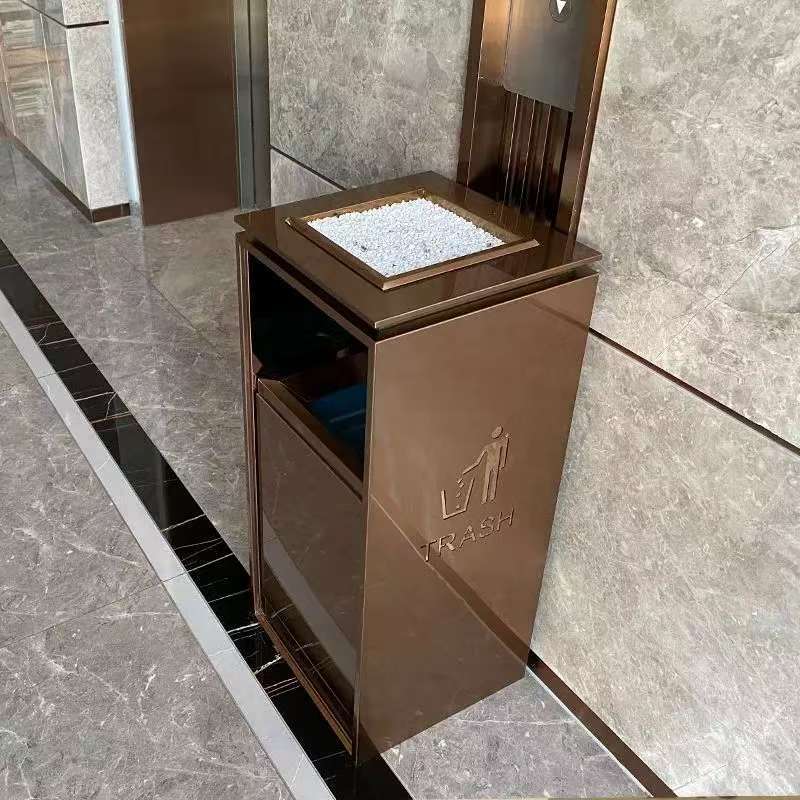
Indoors, the equation changes. A premium lobby waste bin with a wood-grain panel can fit a hospitality interior without subjecting the decorative face to road salt, standing rain, or hard UV. That’s appropriate placement—not fragility disguised as design.
Smoking areas need separation. A stainless steel standing ashtray for lobbies keeps hot cigarette waste away from ordinary liners and helps reduce scorch damage around entrances.
And sensor systems? They have their place. A smart sensor trash can for offices may reduce hand contact in a controlled indoor setting, although batteries, motors, and sensor housings add maintenance points.
I wouldn’t put electronics outdoors simply because “smart” sounds modern. Sometimes a good hood and gravity are better engineering.
Even a compact pedal office trash bin in stainless steel lives or dies by the unglamorous bits: pedal linkage, hinge geometry, liner fit, cleaning access, and spare-part support.
That’s bin reality.
How to Choose Sustainable Public Waste Bins
Start by walking the site.
Seriously. Walk it.
Look for standing water, salt residue, cigarette waste, graffiti, overflowing takeaway packaging, narrow collection routes, uneven paving, and places where users leave household bags. Talk to the cleaning crew. They’ll usually tell you more in ten minutes than a polished product brochure does in twenty pages.
Then write the exposure profile:
Annual temperature range
Rainfall and freeze-thaw conditions
Coastal or de-icing salt exposure
Expected daily waste volume
Collection frequency
Common waste types
Vandalism and graffiti history
Anchoring conditions
Accessibility requirements
Cleaning chemicals and methods
After that, set a minimum service-life target. Ten years can be a reasonable starting point for many fixed commercial outdoor receptacles, but don’t use that figure blindly. A sheltered campus courtyard isn’t a beachfront promenade.
Ask suppliers for the awkward evidence:
Recycled content by total product weight
Post-consumer and pre-consumer percentages
Polymer or stainless-steel grade
UV-weathering results
Impact performance after weathering
Coating thickness and substrate preparation
Corrosion-test method
Replaceable-parts list
Spare-part prices
Warranty exclusions
References from installations at least three years old
End-of-life disassembly instructions
And when a vendor says the product is “100% recyclable,” ask who will actually recycle it.
A mixed assembly of plastic, steel, rubber, concrete, adhesive, and electronic components may be technically separable. That doesn’t mean a local recovery operator will accept it economically.
Technically recyclable. Practically landfilled.
FAQs
Are durable trash bins more sustainable than recycled-material bins?
Durable trash bins are generally more sustainable when their longer service life prevents multiple replacements, reduces manufacturing and freight demand, and allows damaged components to be repaired; however, the strongest environmental result comes from combining verified durability with recycled content, responsible manufacturing, efficient servicing, and a credible end-of-life recovery route.
A recycled body isn’t enough. Compare annualized cost, expected field life, warranty language, spare availability, and exposure-specific testing. If the supplier can’t document those items, the sustainability claim is still mostly sales copy.
What materials are best for eco-friendly trash bins in public spaces?
The best materials for eco-friendly trash bins are corrosion-resistant metals or stabilized recycled polymers selected for the actual site, including 304 stainless steel for general urban use, 316 stainless steel for aggressive coastal exposure, and UV-stabilized HDPE or recycled plastic lumber where moisture resistance and low maintenance are priorities.
But grade names can mislead. Gauge, wall thickness, resin cleanliness, UV additives, weld quality, fasteners, drainage, and anchoring often decide whether a receptacle lasts.
How much recycled content should an outdoor trash bin contain?
An outdoor trash bin should contain the highest independently verified post-consumer recycled percentage that can meet the project’s structural, weathering, fire-safety, appearance, and service-life requirements without causing premature failure; there is no responsible universal percentage because polymers, manufacturing processes, exposure conditions, and performance standards vary between products.
Also check the denominator. “80% recycled plastic” may apply only to one molded component—not 80% of the complete bin by weight.
What makes a public waste bin weather-resistant?
A weather-resistant public waste bin is a receptacle engineered to tolerate rainfall, ultraviolet radiation, temperature changes, wind, de-icing salt, cleaning chemicals, and standing moisture through suitable materials, protected openings, drainage paths, corrosion-resistant hardware, stable anchoring, and finishes that retain adhesion and impact strength throughout the stated service life.
“Suitable for outdoor use” isn’t test data. Ask for the coating system, accelerated-weathering method, corrosion results, and comparable installed sites.
How should buyers compare eco-friendly trash bins?
Buyers should compare eco-friendly trash bins through a weighted scorecard covering verified service life, recycled content, repairability, corrosion and UV performance, collection labor, replacement-part support, warranty terms, freight, installation, and end-of-life recovery rather than selecting the product with the highest recycled percentage or lowest initial purchase price.
My preference is simple: make durability a pass-or-fail gate first. Score recycled content after the product proves it can survive the site.
Buy Fewer Bins—But Better Ones
Here’s the ugly truth: “green” products can still create a lot of waste.
A public receptacle isn’t sustainable because someone mixed recycled flakes into the resin and printed a leaf icon on the datasheet. It earns that description by staying useful—through rain, salt, abuse, rushed collections, spilled coffee, bad cleaning chemicals, and all the other mess the brochure quietly leaves out.
Durability comes first.
Then recycled material strengthens the case.
For your next hotel, office, retail, transit, or municipal project, don’t buy the percentage. Buy the service life. Check the liner, tug the door, inspect the welds, price the lock, question the warranty, and call an older reference site.
The best eco-friendly trash bins for public spaces are the ones you don’t have to buy again in four years.