Share your requirements and target market. We’ll suggest the right configuration, sampling path, and production plan.
During business hours, We can usually provide a preliminary quote within two hours.
: workflow-based setups to improve efficiency and keep corridors tidy
: easier bag changes and maintenance, built for daily facility use
: 1–3 stream options with clear icon/label systems to reduce contamination
: materials, finishes, branding & packaging locked for consistent reorders
Your info is used only for quoting and communication.
Do Hotel Luggage Carts Affect the Check-In Experience?
Most hotels treat the bellman cart like lobby furniture. I think that is lazy buying. A luggage cart is part traffic-control tool, part labor device, part branding object, and part first-impression machine. When it rolls badly, turns wide, bangs walls, or forces re-handling, guests feel the drag before anyone says “welcome.”
Table of Contents
The blunt answer nobody should dodge
Yes, they do.
Not magically, not by themselves, and not enough to rescue a weak front desk, bad staffing model, or broken PMS workflow, but hotel luggage carts absolutely shape the first five to ten minutes of a stay because they affect baggage speed, lobby congestion, staff body language, collision risk, noise, and visual order at the exact moment a guest is deciding whether the property feels composed or underpowered. Why pretend otherwise?
I’ll go further. Most operators understate the effect because they file the bellman cart under “equipment,” when in practice it behaves like an arrival-stage service system. The 2024 North America Hotel Guest Satisfaction Index study covered 39,468 branded hotel guests, and the 2024 third-party hotel management benchmark tied improved staff-service scores to front-desk efficiency and responsiveness. The 2024 ACSI Travel Study also treats “ease of check-in and checkout process” as a measurable lodging attribute, which tells you something important: arrival friction is not vague mood music; it is a scored part of the stay.
What a bellman cart really changes in the first five minutes
It cuts re-handling, or it creates it
Three bags. One trip.
That sounds trivial until you watch a busy arrival bank where one attendant has to split one family’s load into two runs because the deck is unstable, garments have nowhere clean to hang, or the cart tracks badly near elevator thresholds, and suddenly the guest is standing there longer, the front desk gets blamed, and the lobby feels slower than it actually is. Is that a cart problem or a service problem? In real hotels, it is both.
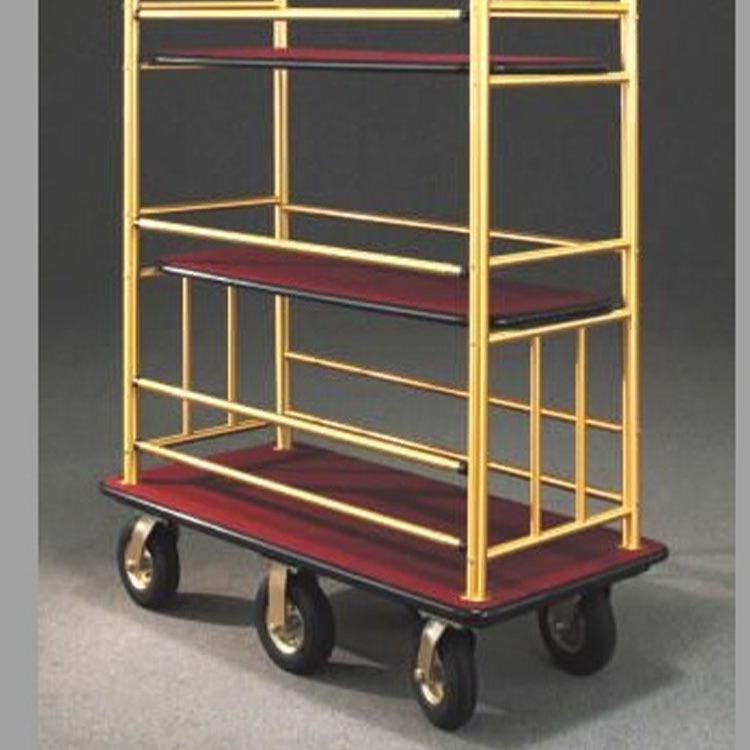
A proper hotel luggage trolley collection should not exist as a decorative cluster of SKUs; it should exist as a workflow ladder. The OEM Birdcage Hotel Luggage Cart with Bumper is positioned around wrap-around bumper protection, non-marking casters, corridor-to-elevator movement, and better item separation, while the Heavy Duty Bellman Luggage Cart with Carpeted Deck is framed around load stability, controlled steering, and reduced re-positioning. That is the right logic, because check-in gets slower when bags have to be corrected mid-route.
It changes what the guest sees
I have seen this before.
A guest does not inspect caster specs, but they do notice whether a cart glides, whether the attendant looks in control, whether garment bags arrive crushed between hard-shell suitcases, and whether the whole sequence feels practiced instead of improvised; that is why a Gold Brass Bellhop Luggage Cart with Hanging Bar is not just a style play, because separating garment bags from heavy luggage reduces staging chaos and keeps the front-of-house presentation cleaner during high-touch arrivals. Doesn’t that sound suspiciously like guest experience?
It reduces the ugly stuff hotels hate paying for
Scuffs cost money.
And not only in maintenance invoices, because every wall strike, door-frame clip, lobby bottleneck, or awkward reset is also a tiny service failure happening in public, which is especially foolish in a period when Reuters reported in April 2024 that hotel workers were pushing to reverse pandemic-era staffing and service cuts, with Unite Here saying those cuts had hurt both workers and guests; Reuters also reported hotel staffing per occupied room was down 13% from 2019. Leaner teams do not need “cheaper carts.” They need cleaner movement.
The data does not isolate luggage carts, but it points hard in one direction
Here is the hard truth I trust more than brochure copy: no major public hospitality study in 2023 or 2024 isolates the bellman cart as a standalone check-in KPI. Fine. Serious operators should still follow the directional evidence.
On September 4, 2024, J.D. Power’s hotel management benchmark said satisfaction with staff service rose year over year, driven by better front-desk efficiency and better responsiveness, based on 4,907 guest responses from stays between May 2023 and May 2024. That matters because baggage flow either protects that front-desk efficiency or contaminates it by adding questions, delays, crowding, and visible stress around the desk. Better arrival equipment supports better arrival behavior.
The 2024 ACSI Travel Study is even more revealing than people think. It explicitly includes “ease of check-in and checkout process” among lodging experience benchmarks, and on the complaints side it shows just how destructive service failures are: leisure lodging guests who complained had an ACSI score of 64 in 2024 versus 77 in 2023, while business guests who complained scored 59 in 2024 versus 78 in 2023. Complaint mechanics differ by property, sure, but arrival friction lives inside that zone. Why invite it?
And I do not buy the old procurement excuse that this is “only a front-office issue.” California’s Title 8, Section 3345 treats hotel housekeeping injury control as an equipment-and-process question, defining control measures as tools, equipment, devices, work practices, and administrative controls; the regulation also explicitly flags loading, unloading, pushing, and pulling carts as part of the risk picture. The 2023 Cal/OSHA fact sheet keeps the same message: pushing, pulling, awkward posture, excessive work rate, and appropriate equipment are linked. Bellman carts are guest-facing, not housekeeping carts, but the body does not care what department bought the wheels.
A 2023 Applied Ergonomics study looked at tasks from 54 hotel assessments in California and found hotel work remained highly demanding and exposed workers to musculoskeletal-disorder risk. So when I hear someone say, “It’s just a luggage trolley,” I hear a buyer telling me they have not done the math on labor strain, presentation, or repeatable service flow.
What good hotel luggage carts actually do on the floor
I buy the route.
Not the catalog glamour shot, not the plated finish by itself, and definitely not the lowest FOB number without context, because the winning spec is the one that survives curb-to-lobby-to-elevator-to-room without forcing resets, wall strikes, or awkward guest-facing pauses.
Cart feature
Operational effect
Guest-visible effect
Where it matters most
Non-marking casters
Cleaner turns, less drag, fewer stops
Quieter arrival, fewer floor marks
Marble lobbies, mixed flooring, elevator thresholds
Wrap-around bumper
Lower contact damage to walls and door frames
Fewer public collisions, cleaner corridors
High-traffic urban hotels, group arrivals
Carpeted deck
Better bag stability, less re-handling
Faster transfers, less bag slippage in view of guests
Convention hotels, family arrivals, long lobby routes
Hanging bar
Separates garments from suitcases
Fewer wrinkled items, tidier visual presentation
Luxury, upper-upscale, wedding and business arrivals
That table is not theory pulled from thin air. It lines up with how the Facility Project Solutions pages position the product family: the Hotel Service Carts hub groups luggage, housekeeping, linen, and room-service movement under one operations umbrella; the luggage pages stress non-marking casters, bumper protection, controlled steering, hanging-bar separation, and corridor/elevator handling; and the OEM / ODM hotel supply program pushes buyers to think in terms of corridor widths, elevator turns, load targets, cleaning routines, and noise expectations rather than one-off visual preference. That is exactly how a serious buyer should spec arrival equipment.
How I would think about internal linking on Facility Project Solutions
Then I would close the loop commercially. The right bottom-of-funnel destination is the OEM / ODM hotel supply program, because that page already frames the buying conversation around fit, flow, handling, QC checkpoints, prototypes, and multi-property rollout consistency. In other words, it speaks the language procurement teams actually use when they are done browsing and ready to spec.
FAQs
Do hotel luggage carts really affect the check-in experience?
Hotel luggage carts affect check-in because they directly shape how quickly, quietly, and visibly baggage moves from curb to lobby to elevator, which changes queue pressure, staff composure, hallway damage risk, and the guest’s first judgment about whether the property is organized or improvising. I would treat the cart as part of arrival operations, not lobby décor.
What features matter most in a bellman cart?
The most important hotel luggage cart features are non-marking casters, controlled steering, a stable deck, bumper protection, and load separation, because those five variables decide whether staff can move bags in one trip, avoid wall strikes, keep garments clean, and maintain a polished arrival scene under pressure. Finish matters, but movement matters first.
Are hotel luggage carts a labor-safety issue too?
Hotel luggage carts are a labor issue as much as a guest-experience issue because every extra push, awkward turn, blind spot, or re-handling step adds physical strain, slows lobby flow, and raises the odds that a rushed employee will clip a wall, fumble a bag, or lose composure in front of the guest. Good arrival equipment protects both the body and the brand.
Should luxury and limited-service hotels use different luggage cart specs?
Luxury and limited-service hotels should not buy the same luggage cart spec because arrival patterns, garment volume, lobby finish sensitivity, staffing levels, and guest expectations differ, meaning the right cart for a 500-room convention hotel is often wasteful, noisy, or visually wrong for a smaller select-service property. I would spec to route density and guest mix, not vanity.
Your next step
Audit the route.
Time one real arrival path from porte-cochère to guestroom door. Count the elevator resets, wall-contact moments, bag re-handles, and seconds spent sorting garments from hard luggage. Then compare that reality against the internal path on Facility Project Solutions: begin with Hotel Service Carts, narrow through the hotel luggage trolley collection, review the cart that fits your traffic pattern, and send the serious brief to the OEM / ODM hotel supply program. I would not buy a bellman cart until that route test is done, because once you see the friction, you cannot unsee it.