Share your requirements and target market. We’ll suggest the right configuration, sampling path, and production plan.
During business hours, We can usually provide a preliminary quote within two hours.
: workflow-based setups to improve efficiency and keep corridors tidy
: easier bag changes and maintenance, built for daily facility use
: 1–3 stream options with clear icon/label systems to reduce contamination
: materials, finishes, branding & packaging locked for consistent reorders
Your info is used only for quoting and communication.
Housekeeping Cart vs Luggage Cart vs Room Service Trolley
Not all hotel carts do the same job. One protects room-turn labor, one protects arrival flow, and one protects in-room dining presentation. Mix them up and you do not save money—you buy slower service, more damage, and more staff frustration.
These are not twins. I keep watching buyers lump a housekeeping cart, a hotel luggage cart, and a room service trolley into one vague “hotel carts” bucket, then wonder why a bellman cart looks elegant but fails on guest-floor replenishment, or why a maid cart for hotels clogs sightlines in the lobby and kills the arrival experience. Why keep paying for confusion?
Table of Contents
One name, three jobs, three failure modes
The labor backdrop makes this comparison a lot less academic than it sounds. In AHLA’s June 10, 2024 survey, 76% of hotels said they were facing staffing shortages, 79% still could not fill open positions, and housekeeping was the top hiring need at 50% of properties; meanwhile, the U.S. Bureau of Labor Statistics counted 836,230 maids and housekeeping cleaners in May 2023, with 397,640 of them working in traveler accommodation at a mean annual wage of $33,870, which tells you exactly where repetitive inefficiency gets expensive fast. Then Reuters reported on September 3, 2024 that 9,376 hotel workers remained on strike in seven cities, demanding higher wages, fair staffing and workloads, and the reversal of COVID-era cuts. When labor is tight, contested, and expensive, the cart is not a side note. It is workflow on wheels.
And the guest side matters just as much. AHLA’s January 26, 2024 state-of-the-industry report put cleanliness and friendly service right at the center of guest expectations, which is why I do not treat these carts as warehouse hardware; two of the three categories are visible to the guest, and all three affect service speed, noise, clutter, and control. Does anyone serious about operations still think these are interchangeable?
What each cart is actually for
Housekeeping cart: the labor multiplier
Start backstage. A housekeeping cart exists to compress motion, reduce reaching, separate fresh and soiled flows, and keep attendants from making stupid extra trips for towels, amenities, liners, paper goods, and chemicals; if it cannot do that, it is not a housekeeping cart, it is corridor furniture with wheels. OSHA is blunt here: housekeepers face strain and sprain risks from pushing and pulling heavy carts, and the agency specifically points to large, low-resistance wheels, maintained carts, and sensible handle height as part of the control logic. That is why a page like custom linen and amenity cart for hotels matters more than glossy finish shots, and why I would also push readers toward the site’s hotel housekeeping cart total cost of ownership piece before they pretend purchase price is the whole story.
My hard truth: this category lives or dies on zoning, wheel behavior, and refill logic. Call it a housekeeping cart, a maid cart for hotels, or a floor-stock cart if you want; the name is secondary, the route is not. If attendants are bending into deep bags, overloading top shelves, or dragging sticky wheels across elevator thresholds, you did not buy a cheaper cart. You bought recurring payroll loss.
Luggage cart: arrival velocity with theater
Front of house now. A hotel luggage cart, or bellman cart, is built for guest baggage, garment separation, stable loading, and a clean visual signal at the exact moment the guest is deciding whether your property feels organized or sloppy; that is a different mission from housekeeping, and I get impatient when buyers act as if a bag platform and a linen workstation are cousins. Facility Project Solutions’ own how to choose heavy-duty luggage carts for resorts article gets this right by sorting fit around operating reality, and the Heavy Duty Bellman Luggage Cart with Carpeted Deck page makes the point even more plainly: carpeted deck, controlled steering, guest-facing presentation, baggage stability. Not chemical caddies. Not refill bins. Not laundry separation.
I will say it more sharply. A luggage cart is part transport tool, part stagecraft. It is there to move cases fast without banging finished walls, dragging bag edges, or making the entrance look like back-of-house spilled into the lobby. Use it as a housekeeping substitute and the property starts broadcasting operational confusion before the guest even reaches the elevator.
Room service trolley: controlled presentation in a narrow route
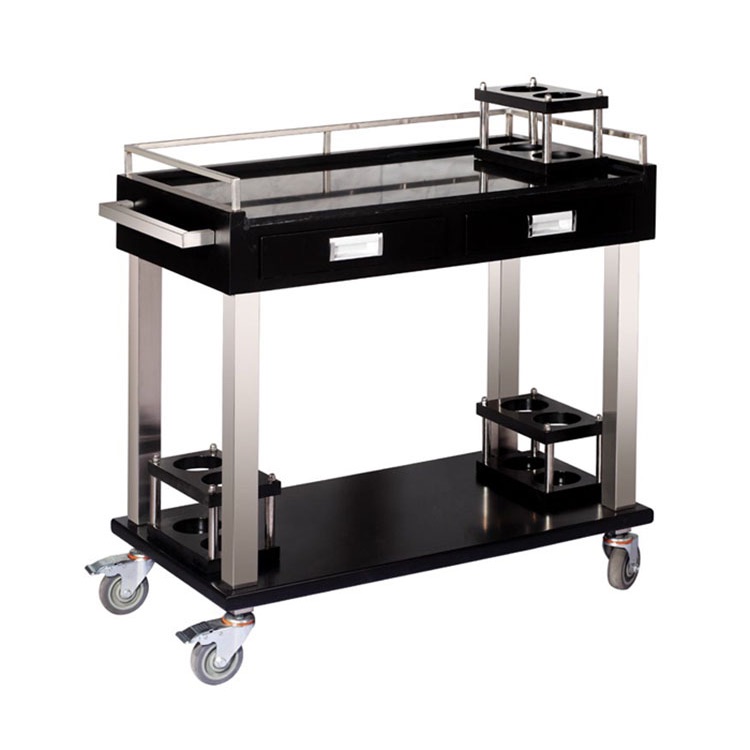
This one is quieter. A room service trolley, or room service cart, is built for plated meals, beverage service, serviceware, pickup runs, and corridor discretion, which means the design priorities shift toward tray organization, spill control, noise discipline, and clean maneuvering at the guestroom threshold rather than raw storage density or bag capacity. On Facility Project Solutions, the room service trolley with stainless shelves page leans into exactly that logic: clear tray zones, non-marking casters, protective bumpers, easy restocking between runs. That makes sense because room service is not about hauling more stuff; it is about delivering the right stuff without visual mess.
And here is the opinion some suppliers dodge: if your hotel does not run a meaningful in-room dining or controlled food-delivery program, a room service trolley can become vanity equipment. Nice to photograph. Weak to justify. I would rather see a property buy one fewer decorative trolley and one better housekeeping cart than pretend an underused guest-facing asset is somehow the smarter spend.
The comparison buyers should do before they ask for price
I would put this table in front of any procurement team before the first quote request, because the design signals across housekeeping, luggage, and room service equipment are telling you what the cart is meant to do and, just as important, what it should never be asked to do.
The useful distinction is simple. Housekeeping carts are labor equipment. Luggage carts are arrival infrastructure. Room service trolleys are presentation tools. Mix those priorities and the failure lands in different budgets—payroll, maintenance, guest satisfaction, or all three at once.
The money argument most buyers still dodge
Cheap carts lie. At the BLS May 2023 traveler-accommodation mean of $16.28 an hour for maids and housekeeping cleaners, just three wasted minutes per shift adds up to roughly $297 per cart per year over 365 operating days before you even touch benefits, overtime, supervision, wall damage, or replacement parts; spread that across 30 carts and you are already near $8,910 in annual drag from what looked like a “good deal” on paper. That is exactly why I like the site’s TCO framing: labor drag, maintenance, facility damage, compliance exposure, replacement cycle. Why are so many buyers still fixated on invoice price and blind to route cost?
My ranking is blunt. If a full-service hotel is under pressure, the housekeeping cart usually deserves the first serious spend because room turns happen all day and inefficiency compounds; the luggage cart comes next if arrival volume is high or the property sells experience hard; the room service trolley earns its keep only when in-room dining is real, repeatable, and operationally defended—not when it is a leftover fantasy from a brochure era.
FAQs
What is the difference between a housekeeping cart and a luggage cart?
A housekeeping cart is a back-of-house mobile workstation for linens, amenities, cleaning tools, and waste separation, while a luggage cart is a front-of-house transport unit built to move guest baggage quickly, safely, and with a polished presentation through lobbies, corridors, and elevators. In practice, the first is judged by labor efficiency and ergonomics, and the second by baggage control and arrival flow.
What is a room service trolley used for in hotels?
A room service trolley is a guest-facing service cart designed to move plated meals, beverages, serviceware, and pickup items between kitchen, elevator, corridor, and guestroom while protecting presentation, reducing spills, and keeping delivery runs organized in tighter, quieter pathways than housekeeping routes. Hotels use it when in-room dining, amenity delivery, or serviceware collection is an actual operating line rather than a rare exception.
Can a hotel use one cart for housekeeping, luggage, and room service?
A single cart should not be used for housekeeping, luggage, and room service because each route demands different load shapes, hygiene rules, visibility standards, wheel behavior, and storage logic; combining them usually creates slower service, poorer ergonomics, more corridor damage, and a worse guest impression. Hotels save more by matching cart type to route than by forcing one design across three unrelated jobs.
Which hotel cart usually has the best ROI?
The hotel cart with the best ROI is usually the one assigned to the route with the highest daily labor volume, which in most full-service and limited-service properties means the housekeeping cart, because room turns repeat every day and small frictions multiply into payroll loss much faster than buyers admit. Luggage carts and room service trolleys can pay off well too, but only when arrival volume or in-room dining volume is high enough to justify route-specific equipment.
Your Next Move
Run a route audit first. Count corridor widths, elevator thresholds, daily room turns, arrival peaks, baggage mix, and whether in-room dining is daily, event-driven, or basically dead; then spec three separate workflows instead of hiding everything inside one mushy “hotel carts” category.
If you want to turn this into a buying brief instead of another vague vendor conversation, send site count, service model, and brand standards to contact the OEM/ODM team. That is the moment to decide whether you need a real housekeeping cart, a real bellman cart, a real room service trolley—or whether you have been trying to make one cart do three jobs badly.