Share your requirements and target market. We’ll suggest the right configuration, sampling path, and production plan.
During business hours, We can usually provide a preliminary quote within two hours.
: workflow-based setups to improve efficiency and keep corridors tidy
: easier bag changes and maintenance, built for daily facility use
: 1–3 stream options with clear icon/label systems to reduce contamination
: materials, finishes, branding & packaging locked for consistent reorders
Your info is used only for quoting and communication.
How to Choose a Slim Housekeeping Cart for Narrow Hotel Corridors
Most hotels buy housekeeping carts for capacity and regret it in the corridor. This guide explains how to choose a slim housekeeping cart that protects clearance, speeds room turns, reduces wall damage, and fits the internal SEO architecture of Facility Project Solutions.
Width lies.
I’ve watched too many hotel buyers obsess over shelf count, color finish, even whether a bag frame looks “premium,” while ignoring the thing that decides whether a cart works on a guest floor at 10:40 a.m.: clearance, turning behavior, parked footprint, and how much chaos the cart creates once a room door swings open. Why do buyers still treat a housekeeping cart like showroom furniture instead of what it is, a labor tool under pressure?
The labor pressure is not theoretical. The June 2024 AHLA staffing survey said 76% of surveyed hotels were dealing with staffing shortages, 79% still could not fill open positions, and housekeeping ranked as the top hiring need for 50% of properties; then Reuters reported on September 2, 2024 that 10,000 hotel workers struck while fighting over pay, workloads, and staffing cuts. In May 2023, the U.S. Bureau of Labor Statistics estimated 397,640 maids and housekeeping cleaners in traveler accommodation, with a mean hourly wage of $16.28. So yes, the wrong hotel housekeeping cart is a staffing problem in disguise.
Table of Contents
The corridor is the real buyer
Corridors decide.
A narrow guest-floor corridor does not care what your procurement spreadsheet says, what your render looked like, or how many towels the vendor promised you could stack on shelf two; it cares about live movement, door arcs, elevator lips, housekeeping bodies, guest luggage, and whether the cart can stop outside Room 1218 without turning the hallway into a choke point. Isn’t that the only test that matters?
The compliance floor is uncomfortably plain. ADA design standards set a minimum clear width of 36 inches (915 mm) for continuous passage, with 32 inches (815 mm) allowed only at a point for a maximum of 24 inches; California’s Title 8, Section 3345 treats pushing and pulling linen carts, supplying rooms, and collecting trash as hotel housekeeping tasks inside a musculoskeletal injury prevention framework. My reading is blunt: if your housekeeping trolley turns every room stop into a twist-pull-bump-repeat routine, you already bought badly.
And there is another layer buyers duck. A 2023 peer-reviewed study hosted by WU Vienna University of Economics and Business found tourism produces more than 35 million tons of solid waste annually and that hotel waste patterns vary enough that targeted operating choices beat one-size-fits-all buying. That matters because the minute your cart mixes clean linen, refill stock, chemicals, and soiled collection badly, you are not saving space; you are exporting disorder into every room turn.
Start with clearance, not capacity
Big carts seduce.
They promise fewer replenishment trips, more linen onboard, more visible “readiness,” and the sort of bloated operational confidence that looks nice in a vendor PDF but turns ugly in a 60-inch corridor once guests, carts, and doors all try to occupy the same slice of air at once. Why are hotels still buying cubic volume when the real problem is lateral interference?
Here is the hard rule I use: define “slim” by working profile, not brochure width. That means cart body, bumpers, bag-holder projection, handle projection, caster track, and the operator’s stance while pulling items from the side. A compact housekeeping cart with disciplined zoning usually beats an oversized maid cart that carries too much but parks badly, turns slowly, and drifts into baseboards every time the attendant corrects trajectory. That is not elegance. It is hidden labor.
What a slim cart must earn
Features matter.
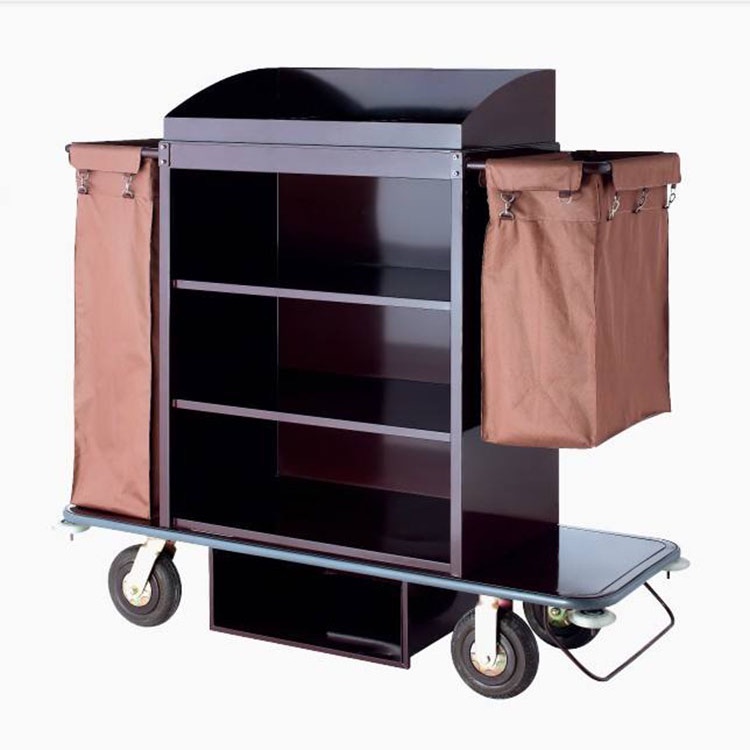
A slim cart wins only when it keeps separation without stealing corridor width, and Facility Project Solutions actually has the right product logic for that if you follow the site in the right order rather than jumping blindly into one SKU. Their housekeeping carts collection gives the broad category view, the Compact Maid Cart with Linen Storage pushes the dedicated-linen-storage argument, the Housekeeping Cart with Lockable Cabinet Doors handles guest-facing concealment and security, and the Hotel Housekeeping Cart with Bag Holder covers hygienic separation of soiled material from clean inventory. That is the internal journey I would want a buyer to take.
I would also keep one adjacent link in play: the Compact Room Service Cart for Corridors. It is not a housekeeping cart page, yes, but it reinforces the corridor-first buying idea with the same language operators care about, tight turns, elevator access, non-marking casters, bumper protection, divided storage, wipe-down speed. And if the reader is a multi-property buyer, the OEM/ODM hotel equipment program is where the conversation should end, because that page speaks the right procurement dialect: corridor widths, elevator turns, load targets, cleaning routines, noise expectations, standardization, and repeatable reorders.
The slim-cart spec matrix buyers should actually use
Specs first.
Not romance, not “hospitality grade” theater, not the weird industry habit of confusing larger with more professional; just the operating variables that keep attendants moving and guest corridors calm. Isn’t that the adult way to buy?
Buying factor
Slim open-shelf cart
Slim cart with bag holder
Slim cart with lockable doors
My take
Corridor behavior
Fast access, but more visual clutter
Better dirty/clean separation with controlled profile
Cleanest guest-facing presentation if width stays disciplined
Narrow corridors usually reward restraint, not maximum carrying volume
Refill speed
Fastest for high-frequency items
Fast when linen and waste split is designed well
Slightly slower access, but cleaner looking in public areas
I prefer open access only when the floor is operationally forgiving
Guest-area appearance
Most exposed
Moderate exposure
Strongest concealment
Guest-facing upscale floors usually justify enclosure
Hygiene workflow
Depends on shelf discipline
Strong, because soiled collection is separated
Strong if shelves are zoned well inside the cabinet
Dirty-clean separation is worth more than raw shelf count
Wall and door protection
Requires good bumpers and caster control
Same
Same
Non-marking casters and bumpers are not optional
Best fit
Back-of-house heavy floors, limited guest visibility
Standard hotel floors with steady room turns
Premium floors, mixed public visibility, amenity security concerns
Most properties need one disciplined slim format, not three bloated compromises
That matrix is not abstract. Facility Project Solutions repeatedly emphasizes non-marking casters, protective bumpers, adjustable shelving, zoned compartments, easy-clean surfaces, dedicated linen storage, bag-holder separation, and corridor/elevator maneuverability across the relevant cart pages; their OEM page also frames design around corridor widths and elevator turns, which is exactly the right operational sequence.
The mistakes I see again and again
Buyers overbuy.
They buy a slim line housekeeping cart that is only slim in the center body, then let the side bag, corner bumpers, and loaded shelf edges bloat the real profile until the thing behaves like a standard cart with a better sales name. Have they actually measured the live footprint with linen onboard?
Mistake two is uglier. Hotels forget that parked depth matters as much as rolling width. A cart can glide fine in motion and still become a nuisance once parked outside a room, because attendants need side access to towels, amenities, spray bottles, gloves, microfiber, and trash collection without stepping into the centerline of corridor traffic. So when I choose the best housekeeping cart for hotels with narrow hallways, I do not ask, “How much can it carry?” I ask, “How little friction does it create while carrying enough?”
A slim housekeeping cart is a hotel housekeeping trolley with a reduced working width and controlled side profile, selected so staff can carry linen, amenities, chemicals, and waste through guest corridors without blocking circulation, clipping walls, or forcing repeated stop-start repositioning at room doors and elevator thresholds. In practice, I judge it by live behavior, not by catalog adjectives. If the cart parks neatly, keeps clean and dirty flows apart, and does not bully the corridor, it is slim enough.
What width should a slim housekeeping cart be for narrow hotel corridors?
The right width for a slim housekeeping cart is the narrowest overall profile that preserves storage separation while respecting corridor clearance, door swing, and parked footprint, because a cart is not evaluated in isolation; it is evaluated with bumpers, bag frames, operator body position, and nearby guest traffic. I would start from corridor reality, not vendor bravado. The legal reference point is ADA clearance, 36 inches continuously and 32 inches at a pinch point, but your cart spec should stay comfortably away from forcing that kind of squeeze.
Is a cart with lockable cabinet doors better than an open maid cart?
A cart with lockable cabinet doors is a more controlled guest-floor format that hides amenities and chemicals from view, reduces visual clutter, and supports a tidier presentation in public-facing corridors, though access can be a little slower than a completely open maid cart during rapid replenishment cycles. I prefer lockable doors on premium floors, mixed-use corridors, and properties where presentation discipline matters. I prefer open access only when the operational gain is real and the corridor can absorb it.
Is an integrated bag holder worth it on a hotel housekeeping cart?
An integrated bag holder is a built-in collection zone that separates soiled linen or waste from clean stock, which matters because hotels lose time and hygiene discipline when attendants improvise dirty-clean separation on the same shelf stack during fast room turns. Yes, usually. On standard hotel floors, I think a well-designed bag-holder cart is one of the smartest compromises available. It gives you flow separation without forcing a huge enclosed cabinet onto a narrow corridor.
Your next move
Choose smaller.
But choose smarter, because “small” by itself solves nothing if the cart still has a sloppy side profile, weak bumpers, poor zoning, or a bag frame that turns every doorway into a contact sport. So what should you do next?