Share your requirements and target market. We’ll suggest the right configuration, sampling path, and production plan.
During business hours, We can usually provide a preliminary quote within two hours.
: workflow-based setups to improve efficiency and keep corridors tidy
: easier bag changes and maintenance, built for daily facility use
: 1–3 stream options with clear icon/label systems to reduce contamination
: materials, finishes, branding & packaging locked for consistent reorders
Your info is used only for quoting and communication.
10 Overlooked Trash Bin Specs in Hotel Brand Standards
Most hotel brand standards obsess over finishes and forget the operational math. This guide breaks down the trash bin specifications that actually affect housekeeping speed, guest perception, safety exposure, and multi-property consistency.
Table of Contents
The Uncomfortable Truth About Hotel Trash Cans
Small bins matter.
I know that sounds like the sort of line procurement people roll their eyes at, but I have seen brand standards spend five pages on lobby scent, robe fold direction, and brass finish temperature while giving hotel trash cans one lazy sentence: “wastebasket to match room design.” What happens after that?
Chaos, usually.
A trash bin is not décor pretending to be operations. It is a guest touchpoint, a housekeeping task, a fire-risk container, a recycling signal, a corridor-clearance decision, and a replacement-part problem hiding under a liner. When hotel brand standards ignore those facts, every property improvises. Then the brand wonders why one hotel has elegant guest room wastebaskets, another has scratched plastic buckets, and a third has lobby bins with crooked decals and visible liner overhang.
The hard truth: most “premium” hotel waste bins fail in boring ways. They show the liner. They wobble. They trap liquid. They make housekeepers bend twice. They use a proprietary inner bucket nobody can reorder. They look good in the mock-up room and become ugly by the second quarter.
That is why serious hotel trash bin specifications need to go beyond color and capacity. Facility Project Solutions frames its own B2B program around OEM/private label hotel carts, commercial trash bins, and recycling systems configured to brand standards, signage rules, and deployment needs, which is exactly the level of thinking hotel groups should demand before a multi-site rollout (OEM/private label hotel trash cans and recycling systems).
Spec 1: Usable Capacity, Not Catalog Capacity
The catalog says 10 liters. Fine. But how much of that volume is actually usable once the liner is folded, the lid mechanism drops into the body, and housekeeping avoids filling the bag to the point where it tears?
That difference matters.
For standard guest rooms, I usually treat capacity as a waste-stream question, not a furniture question. A sleeping-area bin mostly sees dry waste: tissues, receipts, snack wrappers, amenity packaging, and paper cups. A bathroom bin sees wet waste, hygiene waste, cotton pads, floss, small packaging, and sometimes things nobody wants to discuss at breakfast.
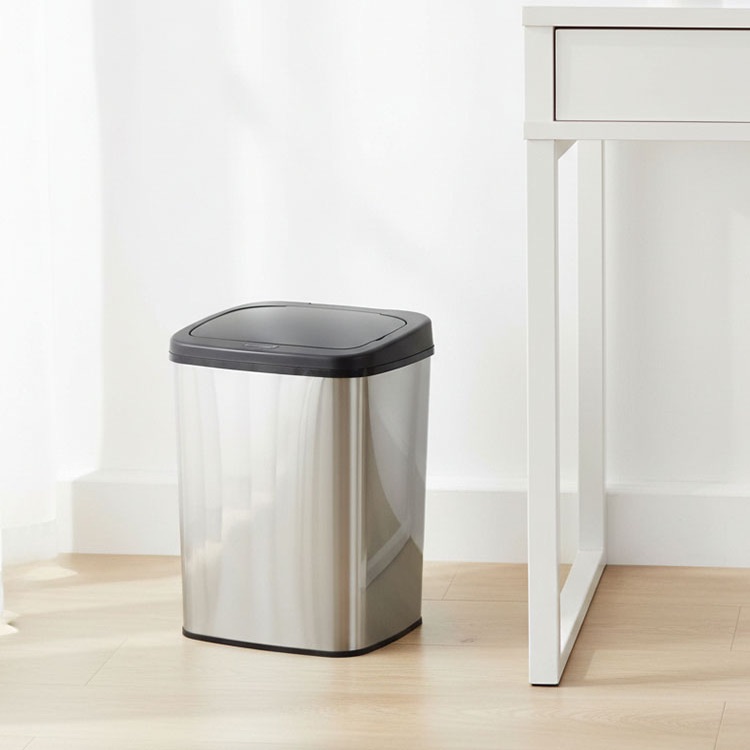
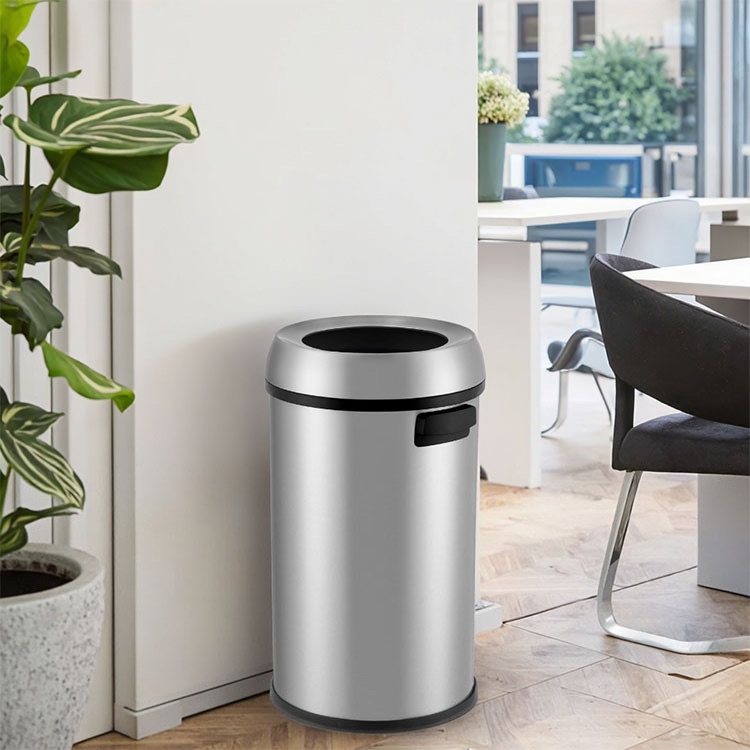
So, yes, the main-room bin and bathroom bin should not be the same default object. A 10–13 L open-top or liner-ring bin can make sense near the desk or coffee station. A 3–6 L covered pedal or sensor bin often makes more sense in bathrooms. In suites, extended-stay rooms, and family-heavy resorts, the math changes fast.
Here is the insider mistake: brands spec “one guest room wastebasket” and let every property decide placement, quantity, and size. That is not standardization. That is outsourcing the decision to whoever got the renovation quote last.
Use the hotel room bins collection as the internal decision path for room-level formats before you start debating finish, logo, or lid style.
Spec 2: Liner Control Is a Brand Detail, Whether Designers Admit It or Not
Visible liner ruins the room.
I am not being precious. A white trash bag folded over a matte black hospitality waste receptacle tells the guest, instantly, that the property bought a pretty shell and forgot the working part. The bin becomes a cheap-looking object because the spec did not require a hidden liner ring, inner bucket lip, bag-retention notch, or removable collar.
And the problem gets worse under time pressure. In a real room turn, housekeeping will not origami-fold liners to protect a design mood board. They will do what works at speed.
Brand standards should state one of three acceptable liner-control methods:
Liner-Control Method
Best Placement
What It Prevents
What Buyers Should Watch
Hidden liner ring
Guest rooms, suites, bathrooms
Visible bag edges
Ring must survive daily removal without cracking
Removable inner bucket
Bathrooms, sensor bins, wet waste zones
Leaks into decorative shell
Bucket must be reorderable by part number
Tapered body with bag tuck
Budget guestrooms, dry waste
Loose liner collapse
Too much taper reduces usable capacity
This is where the best trash bins for hotels separate themselves from showroom trash. If the liner solution depends on staff patience, it is not a solution.
Spec 3: Housekeeping Ergonomics, Because Labor Is the Real Cost Center
Nobody wants to say it during a design presentation, so I will: the purchase price of the bin is often the least interesting number in the room.
The bigger number is labor friction repeated thousands of times.
The U.S. Bureau of Labor Statistics reported that “Hotels (except casino hotels) and motels” had a 2023 total recordable case rate of 4.1 cases per 100 full-time workers, higher than the broader accommodation and food services rate shown in the same table. That does not mean trash cans caused the injuries, obviously, but it does mean hotel operations sit inside a physical-work environment where small equipment choices should not be treated as harmless. See the BLS industry table here: 2023 nonfatal occupational injury and illness rates by industry.
California’s Title 8, Section 3345 is even more direct: its hotel housekeeping musculoskeletal injury prevention standard is intended to control the risk of musculoskeletal injuries and disorders to housekeepers in hotels and lodging establishments (Cal/OSHA §3345).
So when I review hotel trash bin specifications, I want the operational details:
Does the inner bucket have a grip point?
Can staff lift it with one hand?
Does the bathroom bin require bending, twisting, and fighting a tight lid?
Does the liner snag on rough welds?
Can the bin be wiped fast without sharp seams?
In September 2024, Reuters reported that roughly 10,000 U.S. hotel workers went on strike across several cities after contract talks stalled, with workers pressing issues that included pay, staffing, and workloads (Reuters hotel strike report). That is not “labor news” off to the side. It is the operating climate in which your wastebasket spec has to survive.
Spec 4: Fire Behavior, Especially Around Batteries and Smoking Drift
Hotels are now battery buildings.
Guests carry phones, power banks, vape devices, laptops, earbuds, toothbrushes, e-scooter batteries, camera batteries, and sometimes damaged lithium-ion cells they should never have packed. Pretending that every bin is just receiving paper and tissues is a fantasy.
Seattle’s January 30, 2024 Fire Line notice said all batteries, embedded-battery products, and electronics were banned from garbage under a rule that took effect January 1, 2024. The same notice quoted the Seattle Fire Chief saying the department had responded to 79 lithium-ion battery fires in the prior two years, often involving e-scooters, e-bikes, and portable electronics (Seattle Fire Department battery disposal rule).
What does that mean for hotel trash cans?
It means fire-resistant waste bins are not automatically needed everywhere, but they are absolutely worth considering in the right zones: smoking-adjacent entrances, staff break doors, parking levels, elevator lobbies, meeting floors, business centers, and back-of-house areas where batteries, paper, and low supervision intersect.
Not every bin.
That is the point made in Facility Project Solutions’ own article on fire-resistant waste bins for hotels, which argues for risk-based placement rather than blanket overbuying. I agree with that view because “fireproof everywhere” is usually vendor theater; “fire-resistant where ignition pathways exist” is a real procurement strategy.
Spec 5: Material Chemistry and Finish Durability
“Metal” is not a spec.
Neither is “plastic.”
A hotel brand standard should name acceptable material classes and finish expectations. Stainless steel 304 behaves differently from 201. Powder-coated steel behaves differently from brushed stainless. Polypropylene, often marked as PP or resin code #5, handles impact and cleaning differently from thin ABS. HDPE, resin code #2, is common in rugged utility contexts but may look too industrial for front-of-house unless the design is controlled.
Here is my blunt preference: do not spec luxury finishes where abuse is routine, and do not spec cheap plastic where guest perception is part of the value. Lobby bins, elevator bank bins, and public restroom bins should be treated as architectural equipment. Standard guest room wastebaskets should be treated as fast-service equipment with a brand-visible face.
Those are not the same thing.
If a supplier cannot tell you coating thickness, corrosion assumptions, stainless grade, replacement inner-bucket availability, and cleaning compatibility with common agents, they are not selling a brand-standard program. They are selling objects.
Spec 6: ADA Clearance, Reach, and Protrusion
This is where brands quietly get sloppy.
The 2010 ADA Standards apply minimum scoping and technical requirements for accessible and usable public accommodations and commercial facilities (2010 ADA Standards for Accessible Design). The Access Board’s ADA standards also state that objects with leading edges more than 27 inches and not more than 80 inches above the finished floor may protrude only 4 inches maximum into the circulation path. Accessible routes generally require 36 inches minimum clear width, and operable parts must fall within reach ranges and be operable without tight grasping, pinching, or twisting, with 5 pounds maximum activation force (ADA Accessibility Standards).
Now apply that to bins.
A freestanding trash can in an accessible restroom can block turning clearance. A wall-mounted hospitality waste receptacle can become a protruding-object issue. A pedal bin can be awkward for some users. A sensor bin may solve one problem and create another if the opening height, approach space, or lid swing is poorly placed.
The spec should not say “ADA compliant trash can” as if the bin alone earns that label. The room layout, approach clearance, door swing, operating force, height, and protrusion all decide whether the placement works.
That is a hard truth architects know and purchasing teams sometimes learn too late.
Spec 7: Opening Geometry and Guest Behavior
Guests follow shapes better than paragraphs.
A round hole says bottles and cans. A slot says paper. A flap says landfill or mixed waste. A wide open top says “throw anything here and make it someone else’s problem.”
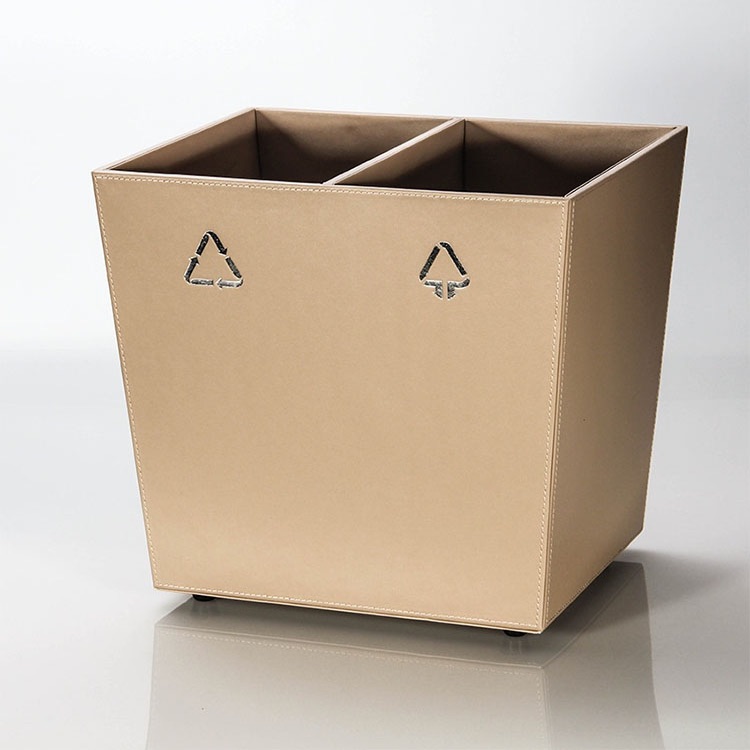
That is why high-performing hotel waste bins do not rely only on labels. They use opening geometry, contrast, icons, and placement to guide behavior before the guest reads anything. Facility Project Solutions’ branded 2/3-stream recycling station uses clear labels and optional restrictive openings, and its 2-stream waste sorting bin for hotel public spaces follows the same logic for lobbies, cafés, and offices.
This is not sustainability theater. It is interface design.
The European Commission, summarizing UNEP’s 2024 Food Waste Index, states that around 1.05 billion tonnes of food waste were generated globally in 2022, with 28% coming from food services and 12% from retail (European Commission food waste summary). For hotels with breakfast rooms, banquets, cafés, club lounges, and event spaces, waste-stream clarity is no longer a nice add-on. It is part of operational control.
And for accommodation specifically, the EU Green Forum notes that the sectoral reference document set a benchmark of less than 0.6 kg of waste per client per night, while acknowledging that many hotels remain far from that target (CIRC-HOTEL circular economy case).
So, no, a recycling station is not just a bin with three stickers.
Spec 8: Noise, Lid Damping, and Guest-Room Acoustics
A loud bin is a bad bin.
In public spaces, a clanging lid is annoying. In guest rooms, it is worse. It can wake a partner at 1:13 a.m., make a bathroom feel cheap, or turn a premium suite into an acoustic joke.
Soft-close mechanisms, silicone bumpers, damped lids, and pedal resistance should be stated in the spec. Not assumed. Not left to the sample.
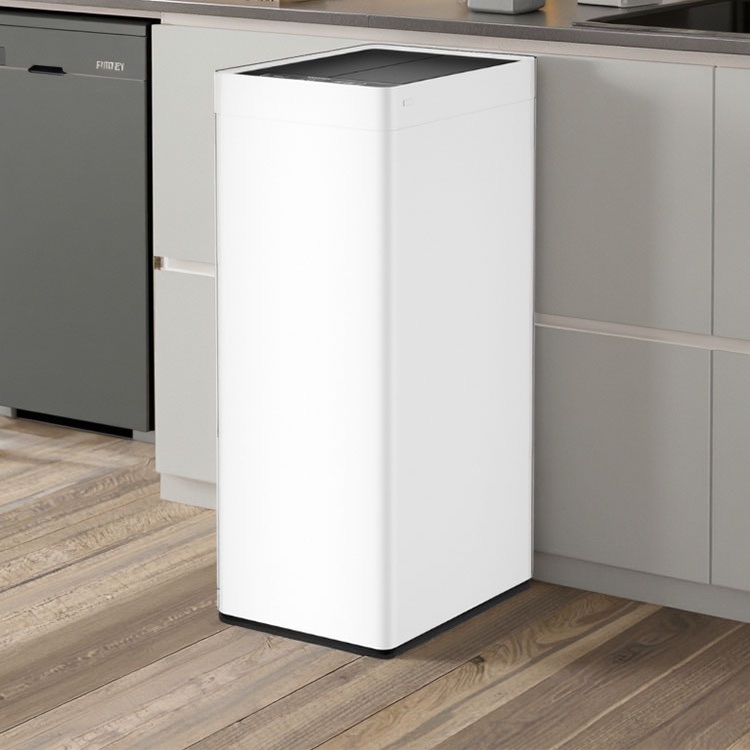
This is where touchless bins become tempting, but I would be careful. Sensor bins make sense in high-touch public zones, premium bathrooms, and hygiene-sensitive spaces. They are not always the right answer for standard guest rooms. Facility Project Solutions’ article on whether sensor trash cans fit hotel rooms takes the same selective view: bathrooms and premium suites can justify them; standard guestrooms often need simpler, faster bins.
The best trash bins for hotels are not always the most technical ones. Sometimes the best bin is quiet, wipeable, replaceable, and boring in the right way.
Spec 9: Brand-Standard Replacement Parts
Here is where procurement gets exposed.
A hotel group orders 1,200 bins. Eighteen months later, 7% of the inner buckets are cracked, 4% of lids are dented, 11 liner rings are missing, and nobody knows whether the supplier still has the same mold. The property team starts buying near-matches. Now the brand standard is dead, but slowly enough that nobody admits it.
Every multi-property hotel trash can program should include a replacement-parts matrix:
Part
Required in Brand Standard?
Why It Matters
Inner bucket
Yes
Prevents whole-bin replacement after leaks or cracks
Liner ring
Yes
Protects brand appearance and relining speed
Lid assembly
Yes, if covered/sensor/pedal
Extends product life beyond first mechanism failure
Feet/glides
Yes
Prevents floor scratches and wobble
Decals/icons
Yes, for sorting bins
Keeps recycling language consistent
Sensor module
Optional by zone
Avoids junking the full bin for one failed part
If you cannot reorder the parts, you are not buying a standard. You are buying a future mismatch.
Spec 10: Rollout Packaging and Property-Level Identification
The last overlooked spec is not on the bin. It is on the box.
Multi-site rollouts fail when cartons arrive without room-type labels, floor-zone mapping, spare-part counts, mock-up approvals, finish batch records, or QR-linked maintenance instructions. Then the receiving team becomes the sorting system.
For brand-wide hotel trash cans, require packaging by placement: “Standard King Guestroom Main Bin,” “Accessible Bathroom Covered Bin,” “Lobby 2-Stream Station,” “Meeting Floor Fire-Resistant Bin,” and so on. Add SKU codes, finish codes, liner-size references, and spare-part IDs.
This sounds boring because it is. It is also how grown-up procurement works.
Facility Project Solutions’ sustainability programs for facility supplies mention consistent standards across properties, durable construction, easy servicing, and repeatable reorders. That is exactly the procurement language hotel groups should pull into bin specifications instead of treating the trash can as an afterthought.
The Spec Table I Would Put Inside a Hotel Brand Standard
Overlooked Spec
Minimum Brand-Standard Requirement
Risk If Ignored
Best Location to Control It
Usable capacity
Define capacity by room type and waste stream
Overflow, bad guest perception, extra service calls
Guest rooms, bathrooms, suites
Liner concealment
Hidden ring, inner bucket lip, or bag-retention system
Fire-resistant bins only where ignition pathways exist
Overspending or under-controlling real risk
Entrances, smoking zones, BOH
Material grade
State stainless grade, PP/ABS/HDPE, coating, corrosion expectations
Finish failure, dents, cleaning damage
Public spaces, bathrooms
ADA placement
Protect 36-inch routes, reach ranges, protrusion limits, operating force
Access barriers, complaints, retrofit cost
Accessible rooms, restrooms, corridors
Opening geometry
Match aperture to stream: slot, round, flap, open top
Recycling contamination, guest confusion
Lobbies, dining, meeting areas
Noise control
Soft-close, bumpers, damped lids, stable feet
Cheap feel, guest annoyance
Rooms, suites, restrooms
Replacement parts
Require part numbers for buckets, rings, lids, feet, decals
Mismatched replacements, full-bin waste
Multi-property programs
Rollout packaging
Label cartons by room type, zone, SKU, finish, and spare part
Installation errors, delayed openings
Renovations, new builds, brand refreshes
The Brand-Standard Language I Would Actually Use
Here is the kind of language I would write into a real hotel brand standard:
“Hotel trash cans shall be specified by placement zone, waste stream, service frequency, accessibility clearance, liner-control method, material grade, finish code, replacement-part availability, and property-level rollout labeling. Guest room wastebaskets shall conceal liners under normal housekeeping installation. Bathroom bins shall use covered, wipeable, removable-bucket designs where wet waste is expected. Public-area recycling stations shall use consistent color, icon, text, and restrictive-opening logic across the property. Fire-resistant bins shall be placed according to documented ignition-risk zones, not as a universal default.”
Plain. Enforceable. Procurement-friendly.
And much better than “wastebasket to match décor.”
FAQs
What trash bin specs are required in hotel brand standards?
Hotel brand standards should require trash bin specifications for usable capacity, placement, liner concealment, material grade, accessibility clearance, opening type, fire-risk suitability, servicing method, replacement parts, signage, and rollout labeling, because these details control guest perception, housekeeping speed, safety exposure, and multi-property consistency.
After that first standard, the brand can add finish codes, logo rules, approved suppliers, sample approval steps, and reorder SKUs. But the operating specs should come first. A beautiful bin that cannot be serviced quickly is still a bad hotel bin.
How do I choose hotel trash cans for guest rooms?
Choose guest room trash cans by separating dry waste from bathroom waste, then match each bin to capacity, liner control, noise level, cleaning method, and housekeeping speed rather than choosing one decorative wastebasket for every placement across the room.
For most standard rooms, I would keep the sleeping-area bin simple: open-top, liner-ring, quiet base, easy wipe-down. For bathrooms, I would consider a compact covered pedal or sensor bin with a removable inner bucket. Suites may justify premium finishes, but the servicing logic still wins.
Are sensor trash cans the best trash bins for hotels?
Sensor trash cans are best for selected hotel placements where hands-free use, odor control, shared traffic, or premium guest perception outweigh the added maintenance, battery, mechanism, and cleaning burden created by motion-activated lids in daily hotel operations.
I like sensor bins in lobby restrooms, premium suite bathrooms, spa areas, and hygiene-sensitive shared zones. I do not like blanket rollouts into every standard guestroom. That is usually a design team trying to look modern while housekeeping inherits the problem.
Do hotel trash cans need to be fireproof?
Hotel trash cans do not need to be fireproof everywhere, but fire-resistant waste bins should be considered in areas where ignition sources, combustible waste, guest behavior, and delayed staff visibility overlap, such as smoking transition points, meeting floors, elevator lobbies, garages, and selected back-of-house zones.
The better question is not “fireproof or not?” It is “where is the ignition pathway?” Cigarettes, lithium-ion batteries, paper loads, oily wipes, and unsupervised disposal change the answer. If none of those risks exist, the upgraded bin may be wasted money.
What size trash can should a hotel room use?
A standard hotel room usually needs separate bin sizes for different waste streams: a larger main-room wastebasket for dry packaging and paper waste, and a smaller covered bathroom bin for wet or hygiene waste, with final capacity adjusted by room type, occupancy pattern, and service frequency.
Do not copy one size across every room category. Extended-stay rooms, family resorts, suites, and properties with in-room dining generate different waste volumes. Capacity should be validated in a mock-up room and, ideally, through a short waste audit before brand-wide ordering.
Your Next Steps
Do this before your next hotel trash can order: walk one actual room, one accessible bathroom, one elevator lobby, one breakfast area, one meeting-floor corridor, and one back-of-house service zone with housekeeping, engineering, design, and procurement in the same hour.
Bring a tape measure.
Then write the bin schedule by placement, not by catalog photo. Lock capacity, liner control, material, ADA clearance, opening geometry, fire-risk logic, replacement parts, and rollout labeling before asking for final pricing. If you are standardizing across multiple properties, request a B2B quote and a spec table through Facility Project Solutions’ hotel trash cans and recycling systems program so the supplier has to answer the operational questions before the purchase order is issued.