Share your requirements and target market. We’ll suggest the right configuration, sampling path, and production plan.
During business hours, We can usually provide a preliminary quote within two hours.
: workflow-based setups to improve efficiency and keep corridors tidy
: easier bag changes and maintenance, built for daily facility use
: 1–3 stream options with clear icon/label systems to reduce contamination
: materials, finishes, branding & packaging locked for consistent reorders
Your info is used only for quoting and communication.
Best Housekeeping Cart Setups for Extended-Stay Hotels
Most hotels buy housekeeping carts like catalog shoppers. That is the mistake. Extended-stay properties need carts built around corridor width, refill cadence, kitchen-trash volume, guest visibility, and staff strain—not vanity features and oversized footprints.
Table of Contents
Most hotels buy the wrong cart
Most buyers guess.
They compare shelves, doors, and bag frames as if those parts live in a vacuum, even though the real job of a housekeeping cart is to reduce wasted motion, protect guest-facing appearance, separate clean from dirty flow, and keep attendants from turning every corridor run into a low-grade endurance event.
Why are we still pretending this is a furniture decision?
I’ll say the quiet part out loud: extended-stay hotels should not copy the cart logic of a transient full-service hotel. The room-turn pattern is different. The mess profile is different. The guest-visibility problem is different. Stayover service is lighter on some days, heavier on others, and kitchenettes create a very specific nuisance mix of food packaging, odor, wet waste, and awkward replenishment requests. If you buy a giant trolley because it “looks commercial,” you usually buy a corridor blocker. If you buy a stripped-down open cart because it looks lean, you usually buy extra trips and sloppy overflow.
That is not theory. On June 10, 2024, the AHLA staffing survey said 76% of surveyed hotels were dealing with staffing shortages, 13% said they were severely understaffed, and housekeeping ranked as the top hiring need for 50% of respondents. When labor is that tight, a bad cart setup is not an inconvenience; it is an operating penalty you pay every shift.
Then Labor Day 2024 made the labor issue impossible to sanitize. Reuters reported that about 10,000 U.S. hotel workers struck across eight cities, with workers and the union pointing to wage pressure, job cuts, and teams being stretched too thin. I do not think enough procurement people connect that story to equipment choice, but they should. If three people are doing the work of four, the cart has to remove friction, not add it.
Extended-stay changes the cart math
Less glamour. More logic.
An extended-stay housekeeping cart should be built for irregular replenishment, longer guest occupancy, and tighter visual discipline, because the cart is not just a linen shuttle anymore; it becomes a mobile control point for towels, paper goods, trash liners, kitchen-cleaning stock, spot-clean tools, and locked chemicals that should never sit exposed outside occupied rooms.
So what actually matters?
First, footprint. I care less about shelf count than turning radius, wheel behavior, and whether the cart can pause outside a room without looking like a barricade. Second, zoning. Fresh linen, guest amenities, soiled-linen collection, trash, and chemistry need their own logic. Third, visibility. Extended-stay guests notice carts more because they see them more often. Fourth, restocking cadence. I would rather run a disciplined compact cart with one smart midday refill than let attendants wrestle a bloated rig that clips door frames and burns shoulders.
The injury angle is not optional, either. A 2024 PubMed systematic review found that low back pain was the most common musculoskeletal problem among hotel housekeepers and cleaners, affecting up to one of two people, with the low back, shoulders, and wrists/hands taking the biggest hit. California’s still-active Title 8, Section 3345 goes further and explicitly requires employers to evaluate tasks such as loading, unloading, pushing, and pulling linen carts, along with force, work rate, and recovery. That is the law catching up with what operators already knew and too often ignored.
My blunt view? Buyers love capacity because capacity photographs well. Operators should love control because control is what survives the fifth floor, the service elevator lip, the 4:30 p.m. linen shortfall, and the guest who opens the door while your attendant is parked outside with NaOCl bathroom chemistry, terry stock, and trash all fighting for the same cubic feet.
The four housekeeping cart setups I’d actually deploy
Setup 1: The compact extended-stay workhorse
This is the smartest default for most extended-stay assets under roughly 120 rooms, especially where corridors are narrow, elevators are shallow, and the property runs on disciplined refill cycles instead of brute-force onboard inventory.
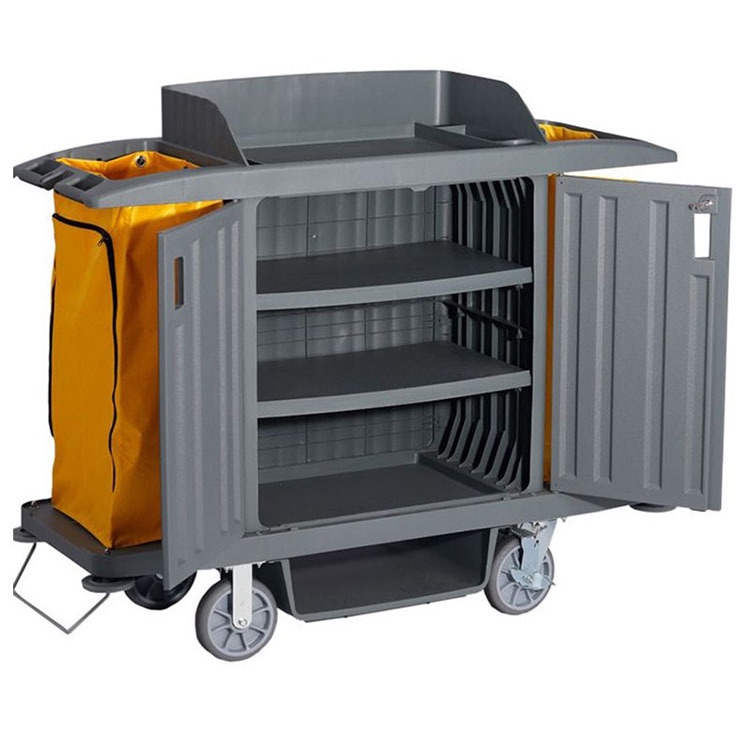
I would build this setup around one active-par linen zone, one amenity zone, one small trash/soiled-linen collection point, a top tray for high-frequency items, and lockable or at least concealed chemical storage. That is why a natural internal step from this article is a compact maid cart with linen storage, because the page is built around the exact features that matter here: dedicated linen storage, zoned compartments, an adjustable shelf, non-marking casters, and protective bumpers.
I have seen small hotels overbuy capacity for years. They buy the bigger silhouette, then spend the next year teaching staff how to apologize to walls, door frames, and guests.
Setup 2: The bag-holder split-flow setup
This is the setup I trust when the property has enough volume to justify better onboard separation, but not so much route length that you need a full high-capacity trolley. In plain English: the mid-band extended-stay property that still wants calm corridors.
The integrated-bag-holder concept solves one ugly truth many teams ignore: once clean and dirty streams start mixing on the cart, the setup is already broken. A hotel housekeeping cart with an integrated bag holder makes more sense than improvised side sacks, overloaded rear hooks, or linen stacked too close to waste. The point is not elegance. The point is containment.
And yes, I prefer this setup for extended-stay hotels with frequent trash pulls from kitchenette rooms. Food waste changes the workflow. Anyone who has actually walked those floors knows it.
Setup 3: The lockable guest-facing setup
Looks matter. Security too.
If the cart sits near suites, premium floors, mixed-use corridors, or properties where guests see attendants repeatedly throughout longer stays, I would spend the extra money on concealment and access control every single time.
That makes a housekeeping cart with lockable cabinet doors more than a nice upgrade. It is a presentation and risk-control choice. Facility Project Solutions is right to emphasize adjustable shelving, zoned storage, non-marking casters, protective bumpers, and lockable doors on that page, because exposed amenities and loose chemicals make even competent operations look second-rate.
Here is the hard truth. Guests do not distinguish between a bad system and a tired employee surviving a bad system. They just see disorder.
Setup 4: The custom linen-and-amenity cart for hybrid properties
Some extended-stay hotels are not really simple extended-stay hotels. They sit in that awkward middle where longer-stay guests, occasional deep cleans, corporate relocations, and higher amenity expectations all collide. For those properties, I like a configurable cart more than an off-the-shelf compromise.
A custom linen and amenity cart for hotels is the better internal link when the reader is moving from “Which size?” to “Which compartment logic actually matches my rooms?” Adjustable shelving, compartmentalized storage, and a practical top deck are not decorative. They are what keep towels, boxed amenities, pillows, paper goods, and cleaning stock from turning into a heap.
Oversized footprint kills corridor flow in the wrong building
Rarely the right first answer for extended-stay
What the best housekeeping cart setup actually looks like
Not complicated. Just disciplined.
I would stock an extended-stay hotel housekeeping cart in five zones: top deck for fast-touch consumables, upper shelf for fresh terry and linen, middle shelf for guest amenities and paper goods, isolated dirty-flow collection for soiled linen or trash, and enclosed lower storage for chemicals, PPE, and backup stock. Kitchenette properties need more liners, more degreasing supplies, and better odor control than standard transient hotels. Properties with weekly or limited stayover service need less vanity linen bulk and better replenishment logic.
The best housekeeping cart setup for hotels is usually the one that respects refills. That sounds boring. It is also true. I have watched teams try to solve weak floor replenishment discipline by stuffing more product onto the cart. It never ends well. The cart gets heavier. The route gets uglier. And the staff absorb the inefficiency in their backs and wrists.
FAQs
What is the best housekeeping cart setup for an extended-stay hotel?
The best housekeeping cart setup for an extended-stay hotel is a compact or mid-width, zone-based cart that separates fresh linen, guest amenities, kitchenette-waste supplies, and locked chemicals while staying easy to steer, easy to park, and easy to restock during irregular service cycles. After that, I would size the cart to corridor reality, not to procurement ego. If the building cannot absorb a large footprint, the cart is too big.
How should you stock a hotel housekeeping cart for longer-stay guests?
A properly stocked hotel housekeeping cart for longer-stay guests should carry only the active working set for one floor run, with clear zones for terry, paper goods, boxed amenities, trash liners, spot-clean tools, and enclosed chemical storage so attendants can replenish fast without mixing clean and dirty flow. In practice, that means fewer vanity extras and better replenishment discipline. Longer stays create odd requests, not infinite cart space.
Are lockable housekeeping carts worth it in extended-stay hotels?
A lockable housekeeping cart is worth it in extended-stay hotels when attendants work in guest-facing corridors, premium floors, or mixed-use environments where exposed chemicals, loose amenities, and visible clutter create both presentation risk and access-control problems during repeated daily contact with long-stay guests. I would not call it mandatory everywhere. But I would call it smart anywhere optics and control matter.
What size housekeeping cart works best in narrow hotel corridors?
The best housekeeping cart size for narrow hotel corridors is the smallest footprint that can still carry one attendant’s live linen, amenity, and waste load for a normal floor run without forcing chaotic mid-run improvisation, wall strikes, or constant returns to the service closet. Small does not mean underbuilt. It means correctly built. There is a difference.
Your next step
Do this השבוע? No. Do it now.
Walk one live floor. Measure corridor width, elevator clearance, and the real parked footprint outside an occupied room. Time one attendant through a full run. Count how often they restock. Watch where clean and dirty flow start to collide. Then choose the cart setup that fixes that failure first.
If you are writing, buying, or standardizing around this category, use the internal path that already makes sense: start with the hotel housekeeping cart buying guide by property size, move readers to the right-fit product page, and only then push them toward the OEM/ODM services path when they have mapped real operational constraints. That sequence is not just better SEO. It is better judgment.