Share your requirements and target market. We’ll suggest the right configuration, sampling path, and production plan.
During business hours, We can usually provide a preliminary quote within two hours.
: workflow-based setups to improve efficiency and keep corridors tidy
: easier bag changes and maintenance, built for daily facility use
: 1–3 stream options with clear icon/label systems to reduce contamination
: materials, finishes, branding & packaging locked for consistent reorders
Your info is used only for quoting and communication.
How Ergonomic Housekeeping Carts Reduce Staff Fatigue
Most hotels do not have a motivation problem in housekeeping. They have an equipment problem. This article explains how ergonomic housekeeping carts reduce staff fatigue, which design features matter, and how to connect readers naturally to the strongest related pages across Facility Project Solutions.
Hotels keep misdiagnosing the problem
Fatigue compounds fast.
Most hotels still talk about housekeeping exhaustion as if it were a soft HR issue, when in practice it is often a mechanical one, because every overloaded shelf, sticky caster, blind hallway turn, and badly placed bag frame adds force, repetition, and wasted steps to a shift that is already brutal. Why are we still pretending the cart is neutral?
I have watched buyers obsess over finish color and almost ignore push effort. That is backwards. According to the June 2024 AHLA staffing survey, 76% of surveyed hotels reported staffing shortages, 79% said they still could not fill open positions, and housekeeping was the top hiring need for 50% of properties. Then Labor Day 2024 hit, and Reuters reported that more than 10,000 hotel workers struck across 25 hotels in nine U.S. cities while pressing for fair workloads and restored staffing. In plain English: hotels are asking thinner teams to do harder work, faster.
That matters because a housekeeping cart is not storage on wheels. It is the shift’s moving workstation, supply room, linen node, waste-transfer point, and sometimes the reason an attendant’s shoulders are cooked by 2:30 p.m. Hard truth: when the route is bad and the cart is worse, fatigue stops being a staffing issue and becomes a design failure.
Table of Contents
The biomechanics are not subtle
Bad carts hurt.
A 2024 PubMed-indexed systematic review found high musculoskeletal disorder prevalence among hotel housekeepers and cleaners, with low back symptoms at 53.9%, shoulders at 41.4%, and wrists or hands at 40.1%. That is not random soreness; that is a pattern. And the Canadian Centre for Occupational Health and Safety’s 2024 guidance makes the basic point many operators still dodge: hand carts save workers a lot of effort and can decrease overexertion injury risk, but pushing and maneuvering them still creates hazards when design or loading is poor. So yes, carts reduce carrying strain. But bad carts simply relocate the strain into push force, turning force, and awkward posture.
What regulation already tells us
Codes remember.
California’s Title 8, Section 3345 exists specifically to control the risk of musculoskeletal injuries and disorders to hotel housekeepers, and its definition of “control measures” explicitly includes tools, equipment, devices, work practices, and administrative controls. That is a legal way of saying equipment choices are not decorative. They are part of hazard control. And in NIOSH’s March 2023 hotel worker safety tip sheet, workers are told to ask for help when passing through narrow spaces like elevators, to bend their knees when lifting or unloading, and to use long-handled tools. Why would that guidance exist if the physical load were trivial?
My view is blunt. If a hotel buys carts that are hard to steer, hard to see around, and hard to load logically, it is manufacturing fatigue one corridor at a time.
What ergonomic housekeeping carts actually change
They cut wasted force before they cut wasted time
Push less. Turn cleaner.
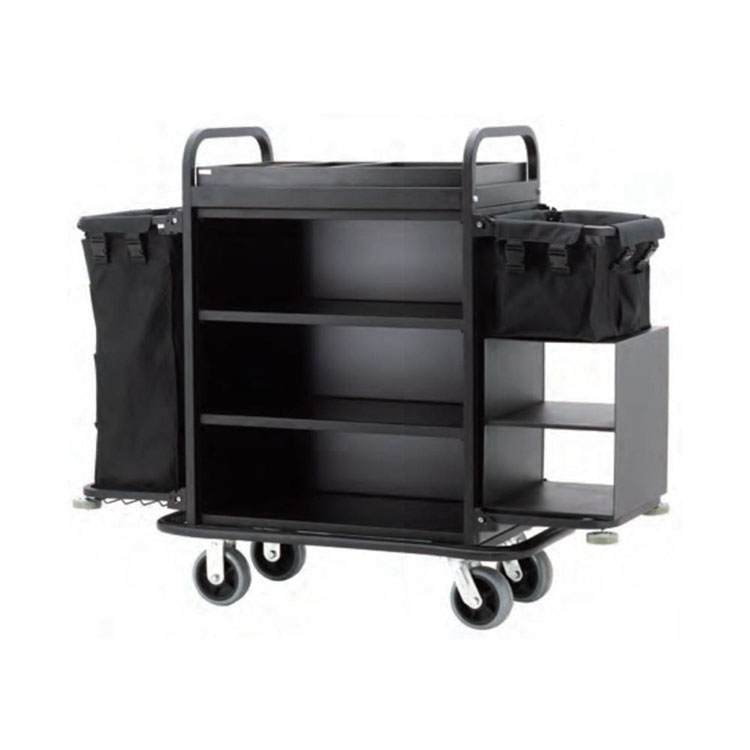
This is the part the brochures usually soften. Housekeeping cart ergonomics starts with force management: smoother rolling, cleaner tracking, better stability at thresholds, and less side-body compensation when the cart enters elevators or tight guest-floor turns. Facility Project Solutions already frames its housekeeping carts collection around corridor-friendly use, and the individual pages for the Compact Maid Cart with Linen Storage, Heavy-Duty Cleaning Cart for Hotel Floors, Hotel Housekeeping Cart with Bag Holder, and Housekeeping Cart with Lockable Cabinet Doors repeatedly emphasize non-marking casters, protective bumpers, zoned storage, adjustable shelving, easy-clean surfaces, and maneuverability through corridors and elevators. That is the right frame because those features attack friction at the exact points where attendants lose energy.
They reduce rehandling, which is where fatigue hides
Rehandling drains people.
I think the industry underrates how much fatigue comes from stupid little repeats: moving clean stock to access soiled stock, digging for amenities below waist height, re-sorting linen later because the cart forced mixed collection now, or walking back to the closet because the shelf plan was dumb from the start. That is why I like the adjacent path from hotel service carts into laundry & linen carts, especially the Double-Bag Laundry Cart for Hotel Housekeeping Teams, which the site positions around faster separation, fewer re-sorts, controlled steering, and easier change-outs between rooms, floors, or shifts. Why make attendants sort the same problem twice?
They protect pace without wrecking presentation
Guest floors are political.
A cart that rolls quietly, parks neatly, and does not scar door frames is not just saving surfaces. It is saving interruptions, apologies, and the micro-stress that comes from fighting equipment in public view. That matters more in hotels than in back-of-house janitorial settings, which is why hotel housekeeping carts should not be treated as generic janitorial cleaning carts with a hospitality label slapped on later.
The feature test I would use before buying anything
I would not buy on looks. I would buy on labor math.
The pages across Facility Project Solutions point toward a practical decision model: start with movement, then visibility and organization, then containment, then standardization across properties. The site’s OEM/ODM services page also makes clear that its commercial argument is repeatable specification and rollout consistency across properties, not random one-off cart shopping. That is smart, because fatigue reduction falls apart when every property uses a different cart logic.
Feature
What it does to fatigue
Operational payoff
My take
Non-marking smooth casters
Lowers push and turning effort on guest floors
Less drag, fewer stop-start corrections, less floor scuffing
Mandatory
Zoned shelving
Cuts repeated bending, searching, and reshuffling
Faster room turns, cleaner SOP execution
Mandatory
Integrated bag holder
Separates soiled flow from clean stock
Better hygiene and fewer awkward transfers
Usually worth it
Adjustable shelves
Fits different room mixes and shift loads
Fewer return trips to closets
Worth it in mixed properties
Protective bumpers
Reduces wall and door-frame contact stress
Fewer collisions, smoother corridor movement
Cheap insurance
Lockable cabinet doors
Keeps supplies secure and visually controlled
Better guest-facing presentation, better product control
Useful in public or mixed-use floors
Double-bag linen separation
Removes a later sorting step
Less rehandling in laundry flow
High value for larger operations
Here is the hard commercial point. The best ergonomic housekeeping carts do not save labor by magic. They save labor by deleting friction: fewer blind turns, fewer reaches, fewer collisions, fewer re-sorts, fewer wasted closet runs. That is how ergonomic carts reduce staff fatigue in the real world, not in the catalog fantasy.
That is not just cleaner SEO. It is cleaner buyer psychology. Give the reader a category, then a route-specific product, then an operational adjacent page, then a sourcing endpoint. Anything else is just internal linking theater.
FAQs
What is an ergonomic housekeeping cart?
An ergonomic housekeeping cart is a hotel service cart designed to reduce physical strain by lowering push force, limiting awkward reaches, organizing supplies at usable heights, and separating clean and dirty materials so attendants can complete room turns with fewer repeated motions and less cumulative stress. In practice, that means smoother casters, smarter shelf zoning, cleaner sightlines, and less rehandling during the shift.
How do ergonomic carts reduce staff fatigue?
Ergonomic carts reduce staff fatigue by removing unnecessary force, repetition, and poor posture from the work itself, which means attendants spend less energy wrestling the cart, less time hunting for supplies, and less time re-sorting linen or waste later in the shift. That is why features such as zoned shelving, bag separation, corridor-friendly steering, and stable movement matter more than cosmetic finish.
What features matter most in hotel housekeeping carts?
The most important features in hotel housekeeping carts are smooth-rolling casters, logical shelf zoning, clean-versus-soiled separation, adjustable storage, controlled steering, and surface protection, because those are the design points that directly affect push effort, turning effort, rehandling, wall impact, and the pace of room servicing across long shifts. I would rank movement first, organization second, and visual polish a distant third.
Are ergonomic housekeeping carts worth the higher upfront cost?
Ergonomic housekeeping carts are worth a higher upfront cost when they remove repeated strain, reduce corridor damage, cut back on rehandling, and standardize workflow across floors or properties, because the real return shows up in labor stability, cleaner room turns, lower friction for supervisors, and fewer equipment complaints from staff. I think hotels get cheap in the wrong places; saving on cart design often means paying later in fatigue, maintenance, and turnover pressure.