Share your requirements and target market. We’ll suggest the right configuration, sampling path, and production plan.
During business hours, We can usually provide a preliminary quote within two hours.
: workflow-based setups to improve efficiency and keep corridors tidy
: easier bag changes and maintenance, built for daily facility use
: 1–3 stream options with clear icon/label systems to reduce contamination
: materials, finishes, branding & packaging locked for consistent reorders
Your info is used only for quoting and communication.
How Room Service Trolleys Reduce Corridor Noise and Damage
Most hotels do not have a corridor noise problem. They have a trolley specification problem. Here is how the right room service cart lowers rattling, protects finishes, and saves operators from repair work that should never have existed.
Table of Contents
The corridor problem hotels keep underestimating
Most hotels miss this.
They will spend serious money on carpet, wall vinyl, guestroom acoustics, and decorative lighting, then send a badly configured room service trolley down the hallway with loose trays, hard contact points, and poor turning control, as if the corridor somehow does not count as part of the guest experience. Why are we still pretending that the hallway is operational dead space?
I have seen this logic before. Operators treat corridor noise like an occasional nuisance and wall scuffs like housekeeping’s problem, when in fact both are usually procurement errors that were baked into the trolley spec months earlier. That is the hard truth: a cheap cart can make an expensive hotel feel second-rate in about six seconds.
Noise is not abstract. The World Health Organization says bedrooms should stay below 30 dB(A) at night for good sleep quality, and it recommends less than 40 dB(A) annual average night noise outside bedrooms; the U.S. EPA has also identified 45 dB indoors as a level that prevents activity interference and annoyance. In other words, a hallway clatter is not “just operations.” It is a sleep problem the moment it leaks through the door. According to the WHO noise guidance and the EPA’s noise levels guidance, the tolerance window is tighter than many hotel teams act like it is.
And guests are less forgiving now. The 2024 North America Hotel Guest Satisfaction Index by J.D. Power surveyed 39,468 branded-hotel guests, found average stays rose from 3.36 days in 2023 to 3.43 days in 2024, and said operators should focus on guest rooms, property and facilities maintenance, and renovation quality as room rates remain elevated; J.D. Power also noted U.S. ADR hit $158.45 in May 2024. Longer stays plus higher rates equals a harsher microscope on every avoidable disturbance.
Where the noise really comes from
Noise travels sideways.
A hotel service trolley becomes loud for predictable reasons: wheels transmit vibration, trays chatter because the load is poorly zoned, cabinet doors or swing panels add extra impact points, and oversized frames force staff to correct the cart mid-turn, which is when corners kiss walls and elevator jambs. Is that a staffing issue, or is that a geometry issue?
I’ll say it plainly. “Silent wheels for hotel trolleys” is sloppy buyer language, because the wheel is only one part of the acoustic result. A quieter room service cart is usually the outcome of non-marking casters, better load separation, fewer loose items, tighter turning behavior, and fewer secondary impacts from doors, shelves, or frame corners. That is why a narrow compact room service cart for corridors behaves differently from a broad, badly balanced cart even before anyone mentions staff training.
And guests notice more than many brands admit. In Hilton’s 2024 Trends Report on sleep and travel, nearly 10% of global travelers said they travel with a white-noise machine, and 20% said they choose or request a room away from the elevator or on a high floor to limit outside noise. Read that again. Guests are actively routing themselves around hotel-generated sound.
Why sliding doors beat swing doors in tight corridors
Small detail. Big difference.
A covered room service cart with swing doors can create its own mess in a narrow hallway because the operator needs clearance to open the panel, reposition their body, and close it again, all while balancing trays and stopping drift. A covered room service cart with sliding doors removes that extra swing arc, which means less awkward shuffling at the guestroom threshold and fewer accidental taps on walls, door frames, and elevator surfaces.
Damage control is a design choice, not a paint-budget problem
Scuffs tell stories.
If I walk a hotel corridor and see repeated marks at a consistent height, I do not blame bad luck. I blame repeated cart contact, usually from overwide platforms, weak bumper coverage, poor caster response, or operators compensating for unstable loads with last-second steering inputs. Why would you budget for touch-up labor forever instead of fixing the collision pattern at the source?
The financial backdrop makes this worse, not better. The HVS U.S. Hotel Development Cost Survey 2024 says median hotel development costs rose 3% since the last survey, with full-service hotels at a median cost of over $400,000 per room and luxury hotels at over $1,000,000 per room. When build and finish costs stay high, preventable corridor damage stops being cosmetic trivia and starts looking like pure operational waste.
And reputation multiplies the bill. In the AHLA 2024 State of the Industry Report, a cited Dimensional Research survey found 95% of users were likely to share bad experiences and 35% said they used online review sites to spread them. Hotels love to separate “maintenance” from “marketing,” but the guest never does. They just experience the property as one thing.
The trolley features that actually reduce corridor noise and damage
Below is the comparison that buyers should be having with suppliers, engineers, and brand standards teams.
Design choice
How it reduces corridor noise
How it prevents damage
What I’d ask the supplier
Non-marking swivel casters
Reduces rolling harshness and keeps movement more controlled on mixed flooring
Cuts floor scuffs and reduces abrupt side impacts
What wheel type, load range, and maintenance interval are specified?
Protective bumpers
Lowers secondary rattles from hard contact
Protects walls, door frames, elevator jambs, and furniture
Are the bumpers replaceable, full-perimeter, and mounted at real impact points?
Compact corridor-friendly footprint
Minimizes oversteer and sharp corrective movements
Reduces clipped corners and repeated wall strikes
What is the loaded width and turning behavior in elevators and narrow hallways?
Sliding-door cabinet access
Avoids extra movement and panel slap at room thresholds
Lowers door-edge contact with walls and frames
Are the tracks smooth, quiet, and easy to clean?
Zoned shelving or tray-rack storage
Keeps trays, china, and amenities from shifting and rattling
Prevents sudden operator corrections caused by unstable loads
How is serviceware separated during breakfast, late-night, and mixed-delivery runs?
Stainless wipe-down shelves
Keeps the load area predictable and easier to reset between runs
Lowers messy handling and rushed restocking errors
How quickly can the shelves be cleaned and reloaded between trips?
The buying mistake I would stop making immediately
Spec sheets lie.
Well, not exactly lie, but they hide the problem in polite language: “smooth mobility,” “easy handling,” “durable construction.” I do not buy any of that unless the supplier can explain corridor width assumptions, elevator entry behavior, load zoning, bumper coverage, and the cart’s behavior when partially loaded rather than perfectly staged in a photo. Why keep buying catalog adjectives?
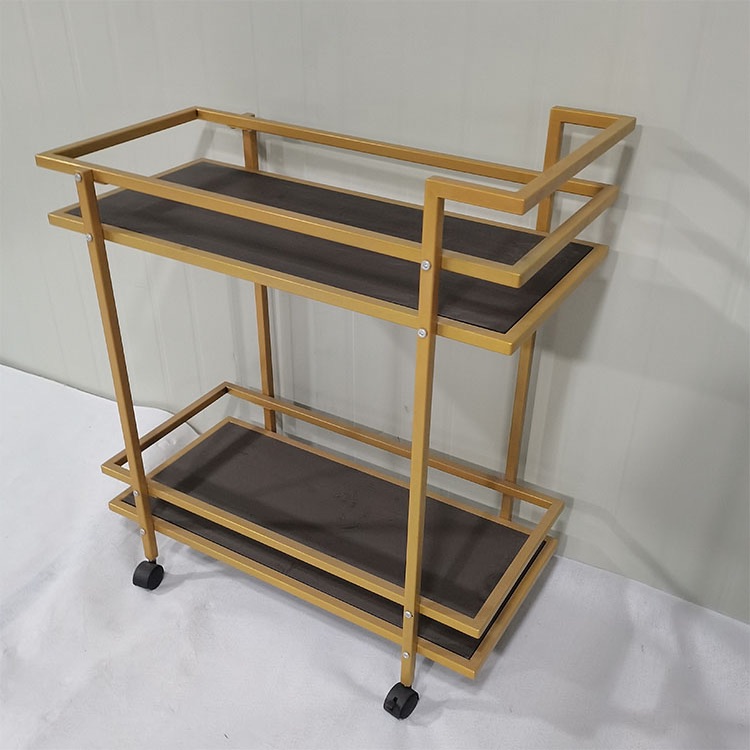
A room service trolley is a mobile hotel service cart built to transport plated meals, beverages, serviceware, and guest amenities from kitchen or pantry to guestroom while keeping loads organized, movement controlled, and corridor disruption as low as possible during daily hospitality operations.
That definition matters because buyers often confuse a room service trolley with a generic utility cart. The difference is not cosmetic. A true room service cart has to perform in guest-facing corridors, elevators, and room thresholds without adding noise, drift, clutter, or visible damage.
How do silent wheels for hotel trolleys reduce corridor noise?
Silent wheels for hotel trolleys are not magic parts; they are wheel-and-cart systems designed to limit vibration transfer, control rolling harshness on mixed surfaces, and keep the trolley tracking smoothly so trays, frames, and accessories do not create extra noise during corridor movement.
In practice, quieter rolling comes from the whole setup: caster quality, stable loading, compact footprint, bumper protection, and fewer loose contact points. That is why “just change the wheels” is usually an incomplete answer.
What causes hotel corridor wall damage from room service carts?
Hotel corridor wall damage from room service carts is usually repeated low-speed contact caused by oversized cart width, weak bumper placement, unstable loads, poor turning response, or awkward door-clearance maneuvers that force staff to overcorrect at corners, elevator entries, and guestroom thresholds.
I would add one more cause: bad workflow. When operators have to stack mixed items without defined zones, they rush, the load shifts, and the cart stops behaving predictably. The wall ends up paying for a storage mistake.
What should buyers ask before ordering a hotel service trolley?
Buyers should ask for a hotel service trolley’s loaded width, turning behavior in corridors and elevators, caster and bumper configuration, storage zoning, cleanability, spare-part availability, and whether the supplier can adapt the trolley to the property’s actual service routes instead of selling a one-size-fits-all frame.
If a supplier cannot answer those questions in plain language, I would not trust the promise of “smooth and quiet.” Good trolley procurement starts with route realities, not brochure photography.
Your Next Steps
Do this first.
Walk one guest corridor during active service, listen for tray rattle, watch how the cart enters an elevator, and note the height of every wall mark you can find; then compare those observations against the current room service trolley collection and the supplier’s OEM/ODM engineering options. If the hardware does not match the route, the problem is already identified.