Share your requirements and target market. We’ll suggest the right configuration, sampling path, and production plan.
During business hours, We can usually provide a preliminary quote within two hours.
: workflow-based setups to improve efficiency and keep corridors tidy
: easier bag changes and maintenance, built for daily facility use
: 1–3 stream options with clear icon/label systems to reduce contamination
: materials, finishes, branding & packaging locked for consistent reorders
Your info is used only for quoting and communication.
How to Align Replenishment Workflows with Housekeeping Cart Design
A housekeeping cart is not storage on wheels. It is a moving replenishment system. When the cart layout ignores refill cadence, dirty-vs-clean separation, corridor width, and stocking discipline, labor costs rise fast. Here is how to fix it.
Table of Contents
Most hotels are solving the wrong problem
This is backwards.
I keep seeing hotel teams buy a housekeeping cart the way they buy lobby décor: they compare finish, silhouette, and photo appeal, then act surprised when room attendants start hanging overflow bags off the side, mixing clean amenities with soiled linen, or making extra closet runs by 10:45 a.m., which is when the pretty cart stops being pretty and starts becoming expensive. Who is that helping?
The labor pressure is not subtle. According to the June 2024 AHLA staffing survey, 76% of surveyed hotels said they were facing staffing shortages, 13% said those shortages were severe, and housekeeping ranked as the top hiring need for 50% of properties; then Reuters reported in September 2024 that more than 10,000 U.S. hotel workers went on strike across multiple cities, with hotel operators facing demands around pay, staffing, and workload, and with housekeeping disruptions already visible on the ground.
Here is the hard truth.
If your replenishment workflow is unstable, your housekeeping cart design will expose it in public. Not in a spreadsheet. In the hallway.
And the worker economics matter more than many operators admit. The U.S. Bureau of Labor Statistics estimated 836,230 maids and housekeeping cleaners nationwide in May 2023, with a mean hourly wage of $16.66, while the traveler accommodation sector alone employed 397,640 of them at a mean hourly wage of $16.28; meanwhile, OSHA’s 2023 Work-Related Injury and Illness Summary listed maids and housekeeping cleaners among the top 25 occupation groups reporting injury and illness cases, at 10,239 cases in employer-submitted data. Low-margin labor plus repeatable physical strain is not a design footnote. It is the whole brief.
The ergonomic and compliance angle buyers keep dodging
Some people hate this point.
I do not, because California already wrote the memo for the rest of the market: Title 8, Section 3345 says the rule exists to control musculoskeletal injury risk for hotel housekeepers, and the defined housekeeping tasks explicitly include pushing and pulling linen carts, removing and supplying linen and other room supplies, and collecting and disposing of trash, which means cart design, replenishment design, and injury prevention are already braided together in the law. Why are buyers still pretending these are separate meetings?
The research is even more annoying, because it ruins a lazy story. In a January 2023 paper in Applied Ergonomics based on 54 hotel assessments in California, researchers found housekeepers still faced high musculoskeletal risk after the standard took effect, with high RULA scores for scrubbing, vacuuming, and trash-collecting tasks; at the same time, 98% of measured cart pushing forces were within acceptable ranges, which tells me the issue is not merely “buy a cart that rolls.” It is how the cart is loaded, turned, parked, reached into, and used across the shift. That is a much less comfortable conversation for procurement.
And the supply logic matters too.
The CDC’s 2024 guidance on cleaning supplies and equipment shows cleaning cart setup with color-coded buckets for different solutions and notes that products and cloths may be carried on the cart or in a caddie kit, which is a quiet way of saying that zoning, separation, and portability are design requirements, not housekeeping superstition.
So my position is simple: if your housekeeping cart organization does not reduce reaching, rehandling, contamination risk, and closet returns, then it is decorative equipment masquerading as an operating tool.
Build the cart backward from the replenishment trigger
Start there.
Not with shelves. Not with colors. Not with whatever a factory catalog calls “premium.”
I build room attendant cart setup backward from five ugly questions: what gets replenished most often, what must stay segregated, what gets touched at every room, what creates the heaviest or messiest return flow, and where the attendant loses time when the cart is parked outside a room. That sequence exposes the real cart brief faster than any showroom demo.
Here is the model I would use.
Replenishment condition
Cart design response
Why it works
What goes wrong if ignored
High-frequency amenity restock
Top-tray fast-pick zone for soaps, coffee, tissue, bottles
Cuts repeated bending and shelf digging
Attendants overstock side shelves and waste motion
Clean/dirty separation needed
Dedicated bag holder or isolated return zone
Protects linen and amenity hygiene flow
Dirty linen and waste start sharing space with refill stock
Cart becomes a corridor obstacle and brand irritant
High-value amenities or chemicals
Lockable cabinet doors
Controls access and visual clutter
Open shelves expose product, invite tampering, and look messy
Long routes between closet and room blocks
Larger multi-shelf hotel housekeeping trolley
Reduces refill trips when the route really supports it
Small carts create endless backtracking
That table is the part many teams skip.
They ask, “How do we stock a housekeeping cart?” when the real question is, “Which items deserve prime real estate because they burn the most labor when misplaced?” Different question. Much better answer.
A real housekeeping cart checklist should therefore track par levels by route, not by fantasy. On a 120-room urban property, I would separate fast picks from reserve picks, keep one shift’s working quantity at hand height, push bulky backup stock lower only if the attendant will not access it every room, and never let the dirty return stream hijack the clean stock zone. That is how housekeeping supply replenishment stops feeling random and starts acting like a system.
What the Facility Project Solutions site gets right, and how I would use its internal link structure
The architecture makes sense.
After reviewing the site, I would not bury this topic inside generic service-cart copy. I would start readers with the broad housekeeping cart collection, because that page already clusters the right decision variables: compact, bag-holder, lockable, heavy-duty, and larger multi-shelf options, which mirrors how operators actually narrow the spec once workflow—not aesthetics—takes over.
For small properties or tight elevator and corridor conditions, the right internal bridge is the compact maid cart with linen storage, because the page emphasizes dedicated linen storage, zoned compartments, an adjustable shelf, non-marking casters, and protective bumpers, which is exactly the language of compact replenishment discipline rather than brute-force carrying capacity. That is where I would send a boutique-hotel reader first.
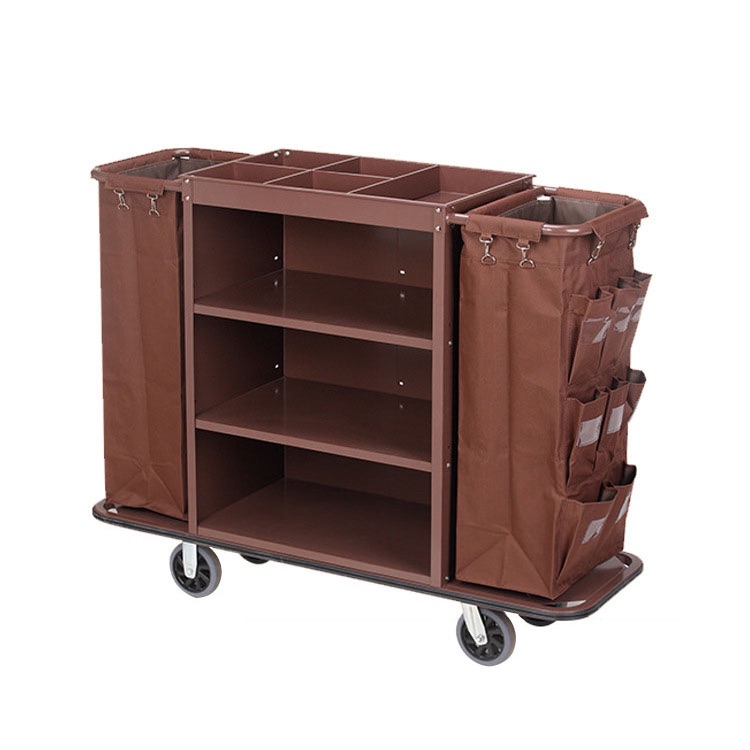
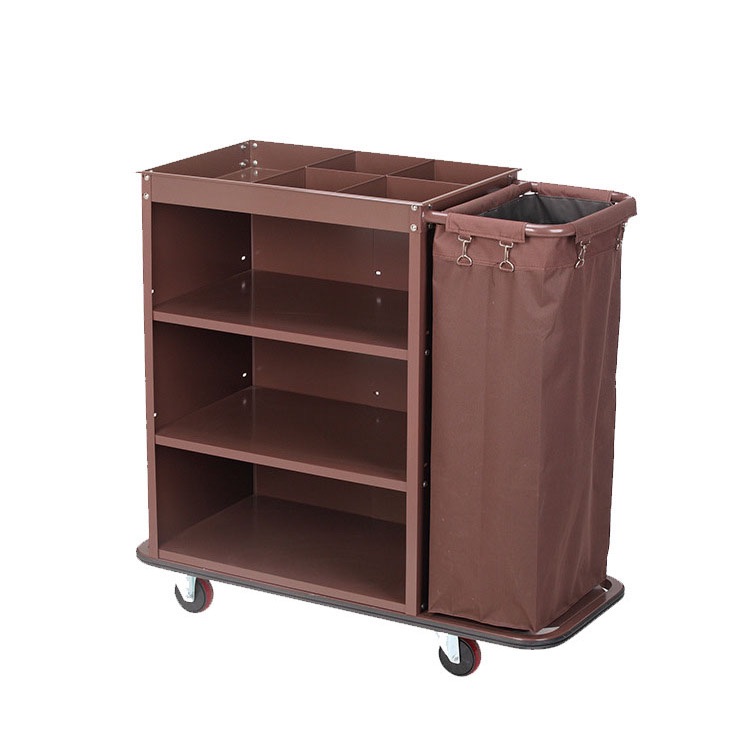
For mid-size properties, I would lean into the hotel housekeeping cart with bag holder, and I would do it aggressively, because the integrated bag holder solves the dirty-flow problem buyers love to wave away until linen, trash, and chemicals start sharing the same visual field; the product copy also stresses zoned shelving, easy-clean surfaces, non-marking casters, and corridor/elevator control, which is the right operational frame for room-turn efficiency.
For guest-facing floors, premium towers, or properties carrying high-value amenities, the better fit is the housekeeping cart with lockable cabinet doors, because lockable access, adjustable shelving, and a cleaner public-area profile matter once the cart is no longer just a back-of-house object but part of the visible service experience. I think more hotels need this option than they admit.
For large resorts and long walking routes, I would link to the large housekeeping trolley with multiple shelves, but with a warning label in the copy: bigger only wins when the building can absorb it. The page rightly stresses multi-shelf zoning, adjustable shelf positions, and route efficiency, yet oversized trolleys still become premium bottlenecks in properties with bad elevator geometry or narrow staging points. Large is not smart by default.
And when the buyer is managing multiple sites, the natural endpoint is the OEM/ODM hotel cart standardization program, because that page frames the conversation the right way: durable, compliance-ready manufacturing, design around corridor width and elevator turns, and a spec library that can repeat across a portfolio without turning replenishment into a property-by-property improvisation contest. That is not sexy copy. It is useful copy.
My blunt framework for matching workflow to cart type
Keep it boring.
Boring systems make money.
If I were writing the spec from scratch tomorrow morning, I would use three decision bands. A compact cart works when replenishment is frequent, floor closets are close, and corridor tolerance is low. A medium cart with an integrated bag holder works when room turns are dense and dirty-vs-clean separation is your daily headache. A large hotel housekeeping trolley works when closet distance is long enough that extra onboard par stock actually removes trips instead of creating drag.
I would also standardize slot logic. Top zone for fast picks. Mid zone for linens and folded textiles. Isolated return zone for soiled materials. Locked or shielded zone for chemicals or premium amenities. Lower zone for backup stock that is touched less often. Simple? Yes. Too simple? No.
And I would audit one ugly metric that almost nobody tracks.
How many times does a room attendant touch the same SKU before it reaches the guestroom?
If the answer is four or five touches—stockroom shelf, restock bin, cart reserve shelf, top tray, room placement—you do not have a supply issue. You have a motion tax.
FAQs
What is housekeeping cart design?
Housekeeping cart design is the planned arrangement of shelves, trays, bag holders, handles, wheels, bumpers, and security zones so a room attendant can carry the right par stock, separate clean and dirty flows, move safely through corridors, and complete replenishment with fewer wasted steps and fewer awkward reaches.
That definition matters because too many teams reduce housekeeping cart design to dimensions and finish. The real job is workflow control.
How should you stock a housekeeping cart?
Stocking a housekeeping cart means loading the cart by frequency of use, contamination risk, and route length, with fast-pick items placed at hand height, reserve items lower or farther back, and dirty-return capacity isolated from clean linen, guest amenities, and chemicals so the cart supports the room-turn sequence instead of disrupting it.
I would never stock by “whatever fits.” That is how carts become rolling junk drawers.
What is the difference between a hotel housekeeping trolley and a maid cart?
A hotel housekeeping trolley is a broader term for wheeled service equipment used to move linen, amenities, waste, and tools across guest floors, while a maid cart usually refers to the room-attendant version built around guestroom turnover, replenishment zoning, compact maneuvering, and clean-versus-dirty separation during daily housekeeping.
In practice, buyers often use the terms interchangeably. Operationally, the difference is route design and task mix.
How often should housekeeping supply replenishment happen?
Housekeeping supply replenishment should happen at the cadence that minimizes closet returns without overloading the cart, which usually means pre-shift cart staging, a defined mid-shift top-up for high-velocity SKUs, and a post-shift reset based on actual par depletion by room type, occupancy pattern, and route length.
The worst habit is blind full reloads. They create weight, clutter, and stale stock.
Your Next Step
Do this tomorrow.
Take one existing cart, follow one attendant for one floor, and count five things: extra closet trips, blocked-reach moments, dirty/clean crossover points, time spent searching for SKUs, and the number of times the cart has to be repositioned because its footprint is fighting the corridor. Then rewrite the cart spec around those five observations.
That is the move.
Not another meeting about finishes. Not another generic housekeeping cart checklist downloaded from somewhere that has never seen your elevator core. Audit the route, rebuild the zones, and then choose the cart that matches the replenishment workflow you actually run.