Share your requirements and target market. We’ll suggest the right configuration, sampling path, and production plan.
During business hours, We can usually provide a preliminary quote within two hours.
: workflow-based setups to improve efficiency and keep corridors tidy
: easier bag changes and maintenance, built for daily facility use
: 1–3 stream options with clear icon/label systems to reduce contamination
: materials, finishes, branding & packaging locked for consistent reorders
Your info is used only for quoting and communication.
Room Service Trolley Buying Guide: Open, Enclosed, or Double-Door?
Most hotels do not buy the wrong room service trolley because they lack options. They buy the wrong one because they confuse appearance with route performance. This guide breaks down when open shelves win, when enclosed carts earn their keep, and why double-door models are often oversold.
Three choices.
I think most hotel buyers still get this wrong because they shop by silhouette—open looks fast, enclosed looks premium, double-door looks “executive”—when the real variables are labor pressure, corridor clearance, food-safety discipline, door motion, reload speed, and how much visual disorder your property can tolerate before a guest reads it as sloppy operations. Want the hard truth?
Most hotels do not need the fanciest room service trolley. They need the one that creates the least friction between kitchen pass, elevator threshold, guest corridor, and room door.
And friction is getting expensive. Bloomberg reported in June 2024 that more than 75% of US hotels were dealing with staffing shortages, while the underlying AHLA survey said 76% were short-staffed, 13% were severely understaffed, and housekeeping was the top hiring need for 50% of properties. In that climate, a bad cart is not a small nuisance. It is payroll drag with wheels.
Table of Contents
Stop buying the silhouette
Width lies.
I have watched too many procurement teams obsess over finish color, cabinet shape, and whether the trolley looks “luxury,” while ignoring the things staff actually fight with: reach depth, caster behavior, bumper profile, parked footprint, and whether the door system slows the handoff at 7:10 a.m. breakfast rush. Why do buyers still treat a hotel room service trolley like lobby décor instead of a route tool under pressure?
Food safety makes the decision less cosmetic than buyers want to admit. In its April 2024 summary on safe food preparation, the CDC said time pressure and poor staffing make it harder for workers to keep heated food hot, cooled food cold, and prevent contamination. So no, enclosure is not just about looks, and open access is not just about speed. It is a handling-control decision.
Open room service trolleys are fast, visible, and unforgiving
Speed matters.
An open room service trolley is the simplest answer when your service pattern is high-frequency, your menu mix is straightforward, and your staff needs instant access to trays, beverage setups, lids, condiments, and clearance items without losing seconds to panels or locks. That is exactly why the site’s stainless-shelf room service trolley and tray-rack food delivery trolley make sense for operators who value staged visibility, wipe-down surfaces, and quick grab points.
But open carts punish weak discipline. The minute your team overloads the top deck, mixes hot entrées beside room-drop collateral, or lets the corridor see half-cleared china and stray amenity stock, the cart stops looking efficient and starts looking tired. I am blunt about this: open trolleys are the best performers in strong systems and the fastest way to expose weak ones.
Reuters put a number on why that matters. In April 2024, Reuters reported that roughly 40,000 hotel workers were entering contract talks, citing a market where staffing per occupied room was down 13% from 2019 according to union figures, while CoStar data in that same report showed US RevPAR hit a record $97.97 in 2023. Revenue expectations stayed high. Staffing density did not. That is why I like open carts only where workflow discipline is already real.
When I would choose open
I would pick an open room service cart when breakfast volume is heavy, route times are short, corridor visibility is low to moderate, and the team clears and resets fast enough that the trolley never looks like a rolling bus tub.
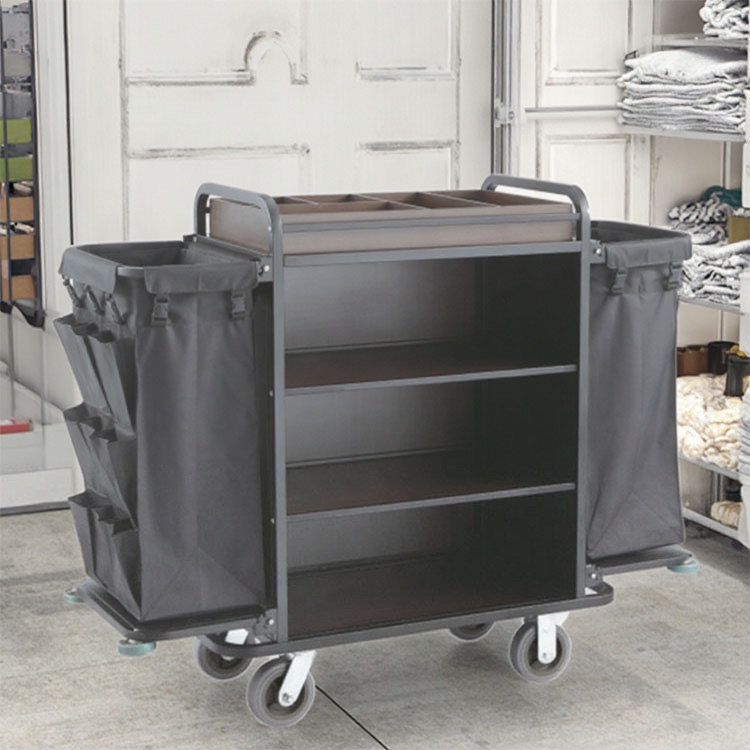
I would also choose open when the property needs a lighter, cleaner, corridor-aware form factor. The compact room service cart for corridors leans into exactly that logic with divided storage, adjustable shelving, non-marking casters, and bumper protection. Those details sound boring. They are not. Those are the details staff feel every shift.
Enclosed room service trolleys sell control, and often earn it
Optics matter.
An enclosed room service trolley is usually the smarter buy for upscale floors, longer delivery paths, mixed public visibility, and properties where guest-facing presentation matters almost as much as service speed. This is where I stop being romantic about open shelving. Guests do not care that your runner saved six seconds if the corridor view screams clutter.
The strongest version of this on the site is not a generic cabinet box. It is the covered room service cart with sliding doors. And that detail matters because sliding doors do not demand the same swing clearance at tight thresholds or elevator entries that hinged doors do. In other words, enclosed does not have to mean bulky.
I like enclosed carts when you need concealment, cleaner visual lines, and better protection for service items during longer runs. I do not like them when buyers use enclosure to hide bad staging. That move is common. It is lazy. And eventually the laziness shows up as slower reloads, crowded shelves, and runners opening the cabinet three times to find one spoon packet.
There is also a compliance mood shift in the industry that buyers ignore at their own risk. In November 2024, New York City signed the Safe Hotels Act, which added licensing, staffing, training, safety, and daily room-cleaning obligations unless a guest declines service. The law is not a trolley law. I know that. But it is a signal that hotel operations are being judged more closely on safety, cleanliness, and consistency. That makes “guest-facing concealment” a management issue, not just a design preference.
When enclosed wins
I would choose an enclosed room service trolley when the route is long, the floor is premium, the property runs more elaborate tray setups, or the operator needs a tidier corridor image during peak service windows.
I would also choose enclosed when cleaning discipline is strong enough to maintain the cabinet interior, tracks, and handles. Because here is the catch nobody likes to say out loud: a dirty enclosed trolley looks worse than an open one. The dirt is just concentrated.
Double-door room service trolleys are often oversold
Doors change everything.
My unpopular view is simple: most hotels buy a double-door room service trolley for status, not necessity, and then spend the next two years working around door swing, parked depth, hinge maintenance, and awkward threshold choreography. Why buy more door than your corridor can tolerate?
A true double-door room service trolley can make sense. Large-suite service. VIP dining. Heavier china programs. Wider tray footprints. Bigger amenity presentation. Fine. But it only earns its keep when the building gives it room and the SOP gives it purpose.
The corridor piece is where buyers get careless. The US Access Board’s ADA guidance says accessible routes generally require 36 inches of continuous clear width, with brief reductions to 32 inches at points such as doorways. That is why I care about the live footprint, not the brochure width. Cart body width is only part of the truth; handles, bumpers, open door leaves, and the operator’s stance finish the story.
So when would I actually approve double-door? Only when the property has generous service geometry, the service style truly benefits from wide cabinet access, and the buyer has measured the route with the doors open, not just closed. If that is your use case, I would not settle for a generic catalog compromise. I would push the reader toward request pricing or a custom OEM/ODM proposal so the spec locks in shelf pitch, door behavior, wheel package, and bumper profile before anyone places a bulk order.
The comparison table I would actually trust
Pretty photos mislead.
What follows is the matrix I would use before approving a room service cart order for a serious hotel operator.
Trolley type
Best fit
Service speed
Guest-facing optics
Corridor tolerance
Hidden weakness
My verdict
Open room service trolley
High-volume breakfast, short routes, strong staff discipline
And if the reader is cost-sensitive, I would absolutely cross-link the logic into how to calculate housekeeping cart total cost of ownership. Different cart family, same procurement truth: the invoice is not the whole story. Labor drag, damage, and route mismatch eat the margin later.
FAQs
What is an open room service trolley?
An open room service trolley is a hotel room service cart with exposed shelves, racks, or decks that gives staff immediate access to plated meals, beverages, and serviceware, making it best for fast delivery cycles where speed matters more than concealment, thermal buffering, or a cabinet-style look.
I like open trolleys when the team is fast, disciplined, and serving high-frequency orders. I dislike them when operators expect the cart to hide clutter it was never built to hide.
What is an enclosed room service trolley?
An enclosed room service trolley is a service cart with cabinet panels or sliding doors that shields trays and service items from corridor sightlines, incidental contact, and some dust exposure, making it better for guest-facing floors that care about presentation, item security, and a tidier visual impression.
For most full-service hotels, this is the safer default. But only if the cabinet interior is well-zoned and the team will actually keep it clean.
What is a double-door room service trolley?
A double-door room service trolley is an enclosed cabinet-style cart with two hinged access panels, typically chosen when operators want wide internal access, larger tray capacity, or a more formal service presentation, but it demands more clearance and better corridor discipline than many buyers admit.
I approve double-door only when the building is generous and the service ritual really needs it. Otherwise, buyers are paying for door swing they do not need.
How do I choose between open, enclosed, and double-door room service trolleys?
Choosing between open, enclosed, and double-door room service trolleys means matching the cart to service speed, corridor width, guest visibility, sanitation discipline, and staff workload, because the right model is not the prettiest one; it is the one that creates the least friction on your actual route.
My rule is blunt: buy for the route, not the rendering. If the corridor is tight and the service mix is ordinary, overbuilt cabinetry usually backfires.
How much corridor space does a room service trolley really need?
Corridor fit for a room service trolley means the loaded cart, not just its brochure width, can move, park, and be accessed without blocking guest traffic, door swing, or accessible clearances, which is why buyers must measure handles, bumpers, door motion, and operator stance rather than body width alone.
I never trust quoted width by itself. I want the live footprint with trays loaded and a staff member actually working the cart.
Your next move
Do this next.
Walk one live route with a tape measure. Record corridor width, elevator interior size, threshold behavior, average tray count, and whether service is mostly breakfast rush, all-day dining, or premium in-room presentation. Then choose the cart format backward from that reality.