Share your requirements and target market. We’ll suggest the right configuration, sampling path, and production plan.
During business hours, We can usually provide a preliminary quote within two hours.
: workflow-based setups to improve efficiency and keep corridors tidy
: easier bag changes and maintenance, built for daily facility use
: 1–3 stream options with clear icon/label systems to reduce contamination
: materials, finishes, branding & packaging locked for consistent reorders
Your info is used only for quoting and communication.
How to Organize a Housekeeping Cart for Faster Room Turns
Most hotels do not have a “slow housekeeper” problem. They have a cart logic problem. Here is how I would organize a housekeeping cart so room attendants move faster, stay cleaner, and stop burning minutes on avoidable motion.
Table of Contents
Slow room turns usually start with a bad cart, not a bad attendant
Three wasted minutes.
I have seen too many operators blame room attendants for slow room turns when the real failure is sitting in the corridor: a housekeeping cart overloaded with backup stock, trash liners buried under linen, chemicals riding beside guest amenities, and no fixed logic for where anything belongs once the rush starts.
Who pays for that?
According to the May 2024 AHLA staffing survey, 76% of hotels said they were dealing with staffing shortages, and 50% said housekeeping was their top hiring need; meanwhile, the U.S. Bureau of Labor Statistics accommodation profile counted 422,760 maids and housekeeping cleaners in 2024, with a median hourly wage of $16.40 inside the accommodation sector. When labor is tight and every floor is short-handed, cart organization stops being a tidy-side-task and becomes operations design.
My view is blunt. Hotels love to talk about standards. But a sloppy housekeeping trolley setup destroys standards before the first bathroom is touched.
Build the housekeeping cart around sequence, not inventory
One route matters.
A room attendant does not clean a room randomly, and the cart should not be stocked randomly either; the fastest hotel room turnover process usually follows a repeatable order of movement, from doorway entry to bathroom reset, bed reset, surface clean, trash and linen pull, final amenities, and exit status update, so the cart has to mirror that sequence instead of acting like a mobile storeroom.
Why keep stocking it like a closet on wheels?
The mistake I see most is overstocking. Managers think more inventory means fewer closet trips, but overloading raises push force, slows turning, wrecks parking at the door, and turns every reach into extra strain. A 2024 PubMed-indexed systematic review found very high musculoskeletal-disorder prevalence among hotel housekeepers and cleaners, including low-back symptoms at 53.9%, shoulders at 41.4%, and wrists or hands at 40.1%; OSHA’s ergonomics guidance makes the broader point that fitting the job to the worker reduces muscle fatigue and improves productivity. That is not soft theory. That is floor math.
The four-zone system I would enforce on every guest floor
Keep it simple.
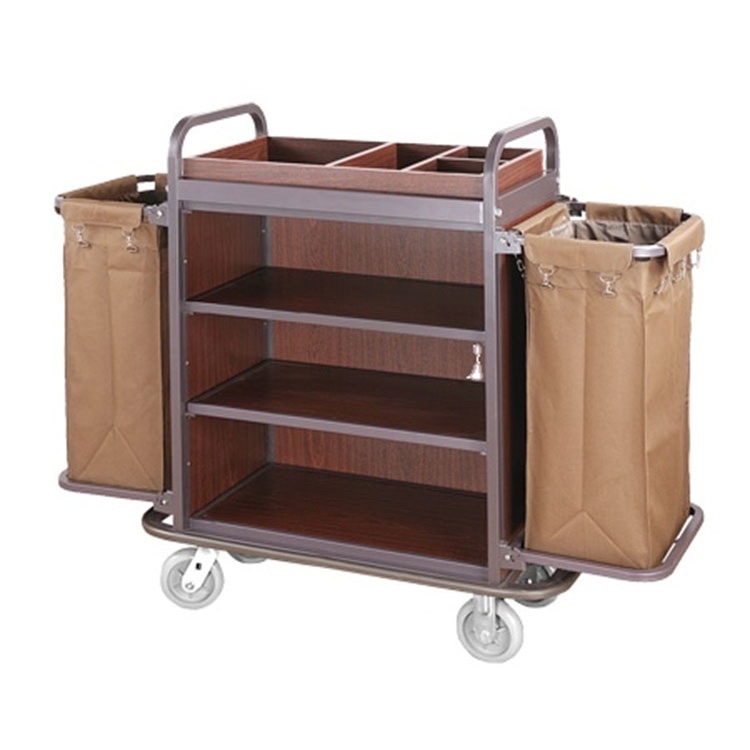
If I were running a floor today, I would organize the housekeeping cart into four zones: a top-tray grab zone, an eye-level active-stock zone, a lower bulk zone, and a rear dirty-flow zone. Clean stock should move forward. Dirty material should move back. The moment those flows mix, speed falls and errors climb.
Towels, sheets, pillowcases, amenities for the active floor mix
One-shift par only
Reduces bending and overloading
Lower shelves / cabinet
Backup linen, sealed chemicals, liners, PPE
Heavy or less-frequent stock only
Improves balance and keeps the center of gravity lower
Rear bag-holder zone
Soiled linen, trash, used rags
Never mix with clean stock
Prevents rehandling and contamination confusion
That table is not fancy. It works.
What belongs on top, what stays hidden, and what should never touch guest amenities
Top tray discipline wins.
The top shelf of a housekeeping cart is prime real estate, which means it should hold only the items a room attendant touches again and again during the first 30 to 90 seconds inside the room. I would keep it brutally limited: gloves, cloths, toilet paper, amenity top-offs, and the device or checklist used to close the room. Everything else is clutter wearing a uniform.
And chemicals? Hide them.
OSHA’s cleaning-industry guidance and its Hazard Communication Standard explainer are very clear about employer duties around chemical hazards, labeling, and worker awareness. So I do not want sodium hypochlorite solution, hydrogen peroxide disinfectant, or any quat-based spray riding loose next to wrapped cups, coffee kits, or guest toiletries. That is lazy cart organization, and lazy cart organization becomes safety risk faster than people admit.
The stocking rule most hotels get wrong
Carry less stock.
I know that sounds backward, but I would rather run a cart with a disciplined one-shift par than a bloated “just in case” load that turns every corner into a wrestling match. A faster room turn comes from shorter reach distance, cleaner sightlines, easier parking, and less re-sorting later. Not from hauling half the storeroom down the corridor.
A practical housekeeping cart checklist should answer seven questions in under 20 seconds: Is the top tray clean? Is active linen at eye level? Are chemicals labeled and separated? Is the bag holder empty enough to start strong? Are spare liners accessible? Are casters rolling cleanly? Is there any duplicate stock that does not belong on this run? That is the audit I trust.
The site architecture already tells you the right internal-link story
Because the site is consistently built around the variables that actually affect faster room turns: zoned storage, adjustable shelving, non-marking casters, protective bumpers, corridor and elevator maneuverability, and standardization across properties. I would not bury those pages. I would use them to move the reader from category intent to workflow fit to procurement intent, because that is how a real buyer thinks on a Tuesday afternoon when rooms are waiting and the floor is understaffed.
And yes, I would say this out loud: most internal linking on B2B hotel supply sites is theater. This one does not have to be.
Organizing for speed also means organizing for injury prevention
Bad carts hurt.
California’s current Title 8 §3345 hotel-housekeeping rule says the section exists to control the risk of musculoskeletal injuries and disorders to housekeepers, and it defines “control measures” to include tools, equipment, devices, work practices, and administrative controls. That matters because it means cart design and housekeeping cart setup are not decorative decisions. They sit inside risk control.
The injury picture is not trivial, either. The BLS reports that the accommodation industry posted a 2024 injury-and-illness rate of 2.3 cases per 100 full-time workers, with 1.2 cases involving days away from work. So when I argue that a cleaner cart layout protects speed and bodies at the same time, I am not making a motivational speech. I am making a cost argument.
The room attendant cart organization standard I would write into SOP
No improvising allowed.
I would write one photo-standard for every cart type, one par-level sheet by room mix, one restock sequence by floor, and one end-of-shift reset rule. If attendants personalize the cart too much, your room-turn times become noisy, your training gets weaker, and your inspections start measuring style instead of process.
So here is my hard rule: the best housekeeping cart setup is the one that looks almost boring because every attendant can read it in two seconds.
FAQs
How do you organize a housekeeping cart for faster room turns?
A housekeeping cart should be organized by task sequence, frequency of use, and contamination risk, with the top tray reserved for high-touch consumables, eye-level shelves for linen and amenities, closed or separated sections for chemicals, and the rear bag zone dedicated to waste or soiled textiles. I would build the cart to match the room-cleaning route, not the stockroom shelf.
What should be included on a housekeeping cart checklist?
A housekeeping cart checklist is a floor-level control document that confirms par stock, clean-versus-soiled separation, chemical labels, PPE availability, wheel condition, bumper condition, device readiness, and end-of-shift reset status so attendants begin each run with the same setup instead of personal guesswork. The checklist should be short enough to verify in under 20 seconds.
What is the best hotel housekeeping cart setup?
The best hotel housekeeping cart setup is a zoned, corridor-friendly layout that keeps high-frequency items on top, active linen at eye level, bulk stock lower, chemicals secured, and soiled material isolated, while preserving smooth steering, clean sightlines, and a narrow working profile for elevators and guest-floor traffic. I would choose the cart format based on route conditions, not catalog ego.
How much stock should a room attendant cart carry?
A room attendant cart should carry only the active par needed for the immediate floor run or shift segment, because overstocking increases push force, slows parking and turning, hides critical items, and adds repeated strain to the low back, shoulders, and hands during the workday. In my experience, “just in case” inventory is where speed goes to die.
Your next step
Run one audit.
Take one live cart, on one live floor, during one live shift. Time the elevator entry. Time the first 60 seconds of the room. Count how many reaches happen before the bathroom is reset. Then strip the cart back to a one-shift par, rebuild it by zone, and compare the result against the housekeeping cart collection and the OEM/ODM hotel equipment program if you need a standardized setup across sites.
I would not wait for the next staffing crunch. It is already here.