Share your requirements and target market. We’ll suggest the right configuration, sampling path, and production plan.
During business hours, We can usually provide a preliminary quote within two hours.
: workflow-based setups to improve efficiency and keep corridors tidy
: easier bag changes and maintenance, built for daily facility use
: 1–3 stream options with clear icon/label systems to reduce contamination
: materials, finishes, branding & packaging locked for consistent reorders
Your info is used only for quoting and communication.
How to Plan Multi-Cart Upgrades During Hotel Renovations
Most hotel renovation teams obsess over finishes and under-budget the rolling equipment that staff touch all day. I do the opposite. Here is how I would phase multi-cart upgrades, write specs, control risk, and keep corridors, elevators, and guest floors running while the project is still noisy.
Table of Contents
Renovation budgets usually fail in the hallway
Carts get ignored.
That is the expensive mistake, because a renovation is not judged only by stone, lighting, millwork, or the Instagrammable lobby shot; it is judged by whether housekeeping can turn rooms faster, whether bell staff can move luggage without banging door frames, whether room service can pass through elevators cleanly, and whether the guest sees organized movement instead of operational drift. Who gets blamed when the corridor looks “new” but service still feels old?
The hard math is ugly. In June 2024, AHLA’s staffing survey said 76% of surveyed hotels were dealing with staffing shortages, and housekeeping was the top hiring need for 50% of respondents. By December 2024, CoStar’s hotel labor analysis said it cost about $9 more to staff a hotel room than in 2023, while rooms labor still made up the biggest share of staffing expense. And Reuters reported in June 2024 that U.S. business travel had returned at higher booking levels and prices. My read is blunt: thinner labor, pricier service, higher guest expectations. That is exactly why multi-cart upgrades belong in the renovation core scope, not in the leftovers pile.
The four-cart stack I would approve before I sign off on finishes
Housekeeping carts decide whether the renovation feels efficient
I have watched operators spend serious money on guestroom finishes and then let attendants wrestle with carts that still drag, wobble, overhang elevator thresholds, or force staff to dig for linen at knee height. That is amateur budgeting. The better move is to write the housekeeping-cart scope around zoned shelving, non-marking casters, bumper protection, easy-clean surfaces, and clean/soiled separation first, then let the finish team complain later. Facility Project Solutions leans hard into that logic on its product pages, and frankly, it should.
Linen carts are not backup equipment
A linen cart is not just a metal frame with fabric hanging off it; it is a pacing tool for room turns, especially when you are renovating live floors and storage rooms are temporarily compressed, blocked, or relocated. A fold-flat linen collection cart makes more sense during phased renovation because it reduces dead bulk in service closets, keeps elevator transfers cleaner, and gives you a controllable dirty-linen route instead of a hallway eyesore.
Luggage carts carry your first impression
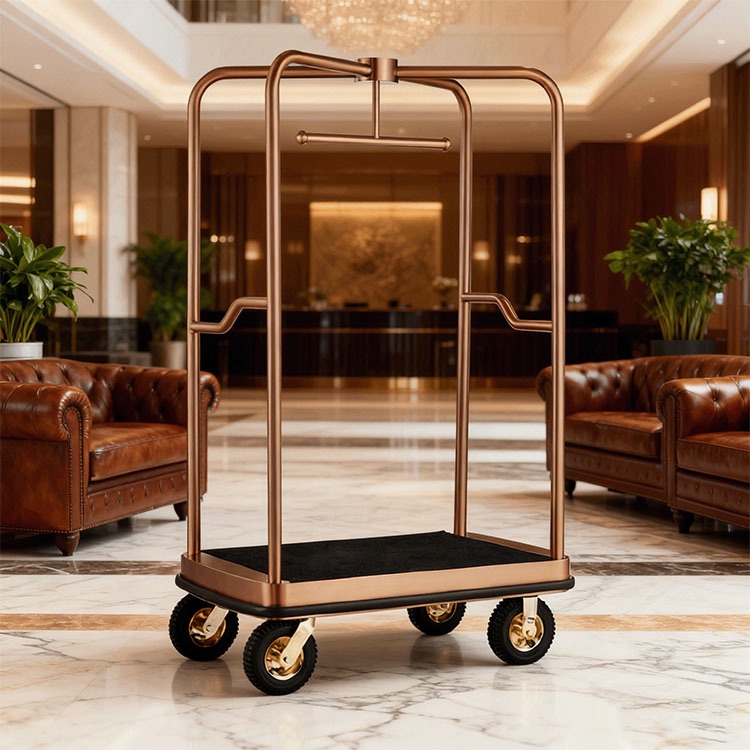
Bell staff do not get the luxury of “back of house.” Their equipment is the show. If the property is renovating porte-cochère access, guest elevators, or lobby flow, your hotel luggage cart program needs to be reviewed at the same time, not six months later. A cart with stable steering, protective bumpers, and a garment bar is doing more than moving bags; it is reducing stalled check-ins, garment creasing, and that cheap-looking lobby congestion owners always pretend not to notice.
Most teams miss this one. When guest floors are narrowed by swing zones, staging materials, temporary protections, or elevator contention, a full-size trolley becomes a traffic problem. A compact room-service cart for corridors makes sense when you need divided storage, tighter turning, and non-marking mobility without sacrificing presentation. If your renovation phasing memo does not mention in-room dining routes, you are not planning operations; you are decorating.
The upgrade matrix I would use on a real project
Cart Family
Replace Now If…
Non-Negotiable Specs
Best Installation Phase
What It Fixes Fast
Housekeeping carts
Staff are rehandling stock, bumping walls, or blocking corridors
Zoned shelves, bag holder, bumper system, 125–150 mm non-marking casters, wipe-clean panels
During mock room approval or first live-floor phase
Faster turns, less wall damage, cleaner guest-floor presentation
Linen/laundry carts
Dirty-linen flow is visible, closets are cramped, or elevators jam at peak shift change
Fold-flat frame, quiet casters, easy-clean bag system, stable steering
Before first guest-floor shutdown
Cleaner dirty-flow routing, less storage pressure
Luggage carts
Lobby flow is being redesigned, finishes are upgraded, or check-in congestion is recurring
Protective bumpers, garment bar, smooth steering, durable deck surface
Before lobby reopening
Better arrival impression, fewer transfer delays
Room-service carts
Corridor widths tighten during renovation or in-room dining remains active
Here is my rule: spec the force, not the brochure. I want wheel compound, caster diameter, axle/bearing quality, bumper depth, handle height, shelf adjustability, bag-frame geometry, and door-swing clearance defined before finish color. I also want material logic to match route logic: 304 stainless where wet-service exposure is real, powder-coated steel where impact durability matters, polypropylene or engineered resin where wipe-down speed and weight control matter, and thermoplastic rubber non-marking casters where guest-floor finish protection matters. That is how you stop paying labor twice: once in payroll, again in wasted motion.
And no, I would not let procurement bury this under “miscellaneous OS&E.” Facility Project Solutions is explicit that buyers standardize mobility, service access, durability, signage, and security across rollouts, and that factory QA should include spec lock, sample approval, in-process checks, final inspection, and packing verification. That is the language of renovation control, not catalog browsing. Use it.
Phase the rollout like construction, not like late-stage shopping
Deadlines distort judgment.
When the job gets tight, people start saying things like “we can always buy the carts later,” which sounds reasonable until the renovated floors reopen and nobody has tested elevator fit, storage footprint, replenishment sequence, or how clean and soiled flows now cross because back-of-house paths moved during demolition. Why keep pretending carts are separate from circulation design?
I would phase a multi-cart replacement plan in five moves. First, measure every live route: corridor width, turn radius, elevator door opening, service closet depth, and swing clearances with protective panels in place. Second, build a cart matrix by floor type, not by department ego; suites, standard keys, club floors, spa levels, and banquet zones rarely need the same cart logic. Third, run one pilot floor before bulk approval. Fourth, lock packing lists and receiving labels by zone, not by carton count. Fifth, train the shift supervisors, not just the attendants, because supervisors are the ones who either protect the new system or quietly kill it in week two.
Cost pressure is not getting softer. HVS’s 2024 U.S. Hotel Development Cost Survey, which includes redevelopment projects, said median hotel development costs rose 3% from the last survey; it also showed select-service around $250,000 per room, full-service above $400,000 per room, and luxury above $1 million per room. I am not saying a housekeeping cart equals a guestroom renovation. I am saying that in a capex environment like that, anything ignored becomes rushed, and rushed operating equipment creates recurring expense long after the ribbon cutting.
So I would end the internal journey where buyers actually make decisions: at a rollout conversation, not a generic contact form buried in the footer. If you are staging this article on the Facility Project Solutions site, the right final anchor is a B2B rollout quote request, because renovation buyers need configuration, sampling, and deployment support, not vague inspiration.
FAQs
What is a multi-cart upgrade plan during hotel renovations?
A multi-cart upgrade plan during hotel renovations is a property-wide operating schedule that defines which housekeeping, linen, luggage, and room-service carts will be replaced, what specs each cart must meet, when each cart type will be deployed, and how storage, training, elevators, and spare units will be managed during construction. In plain English, it is the missing bridge between the renovation schedule and daily service reality. Without it, you reopen polished spaces with broken movement patterns.
When should hotels replace housekeeping and luggage carts during a renovation?
Hotels should replace housekeeping and luggage carts when renovation work changes corridor widths, elevator use, guest expectations, storage layouts, or service pacing, because those changes alter how equipment moves, where it is staged, and whether it still protects finishes, labor time, and front-of-house presentation after the project is complete. My bias is early, not late. Pilot the new carts before the first major reopening phase so you can catch fit and workflow failures while the contractor is still mobilized.
What specs matter most for hotel housekeeping cart upgrades?
The most important specs for hotel housekeeping cart upgrades are controlled steering, non-marking casters, zoned storage, clean-and-soiled separation, bumper protection, easy-clean materials, and shelf adjustability, because those features reduce push force, cut wasted motion, protect renovated finishes, and make the cart usable across different room mixes and shift loads. I would add one hard truth: pretty carts that fight the route are bad carts. Buy for motion, not for showroom photography.
How do you avoid downtime when rolling out multiple new carts?
You avoid downtime during a multi-cart rollout by measuring routes first, piloting one floor or zone, approving samples before bulk order, labeling deliveries by deployment zone, training supervisors on the new standard, and keeping a temporary crossover fleet so service does not collapse if one phase opens before the next shipment is fully installed. That is boring project control. It also works.
Your Next Step
Start small. Start now.
Walk one guest floor, one service elevator, one laundry transfer path, and one lobby arrival route this week, then write down every point where current carts slow staff, scar finishes, block traffic, or force rehandling. After that, group the problem by cart family, not by vendor catalog, and turn it into a real renovation scope.