Share your requirements and target market. We’ll suggest the right configuration, sampling path, and production plan.
During business hours, We can usually provide a preliminary quote within two hours.
: workflow-based setups to improve efficiency and keep corridors tidy
: easier bag changes and maintenance, built for daily facility use
: 1–3 stream options with clear icon/label systems to reduce contamination
: materials, finishes, branding & packaging locked for consistent reorders
Your info is used only for quoting and communication.
When to Choose a Lockable Housekeeping Cart for Hotels
Most hotels buy the wrong cart for the wrong reason. I’ve seen operators pay for lockable doors when a slimmer frame would have saved more labor, and I’ve seen luxury properties cheap out on open carts that broadcast chemicals, amenities, and disorder right into guest sightlines. Here’s when a lockable housekeeping cart actually earns its keep.
Most hotels guess.
I’ve watched operators spend five figures standardizing the wrong hotel housekeeping cart across multiple sites, then wonder why attendants hate the cart, guests notice the clutter, walls get clipped, elevators jam, and replenishment still feels chaotic because the team bought a shape, not a workflow. Why are we still pretending a cart is just a cart?
Here’s my blunt view: a lockable housekeeping cart is not the “premium” option by default. It is the right option only when access control, guest visibility, and supply security are bigger operational problems than the extra seconds, weight, and friction that doors inevitably add. And yes, doors add friction. They always do.
Table of Contents
The hard truth: locks solve one class of problem, not all of them
A 2024 PubMed meta-analysis on hotel housekeepers and cleaners found musculoskeletal disorder prevalence at 53.9% for low back pain, 41.4% for shoulders, and 40.1% for wrists and hands. And California Title 8, Section 3345 is explicit: housekeeping tasks include loading, unloading, pushing, and pulling linen carts, because those motions are part of the injury problem, not some side note procurement can ignore. I care about caster resistance, handle height, door swing, and shelf reach more than I care about sleek brochure photos, because the body always invoices you later.
Chemicals complicate everything.
The CDC’s April 2024 cleaning and disinfection guidance says cleaning solutions should be clearly labeled and stored out of reach of children and animals, and warns against mixing chemicals. That matters when your cart carries sodium hypochlorite (NaOCl), hydrogen peroxide (H2O2), or quaternary ammonium disinfectants in open view on a family-heavy guest floor, near conference traffic, or outside a room where a curious child can touch what your team left exposed for “just a minute.” And yes, “just a minute” is how half the bad stories start.
When I would absolutely choose a lockable housekeeping cart
Guest-facing luxury floors where optics matter as much as speed
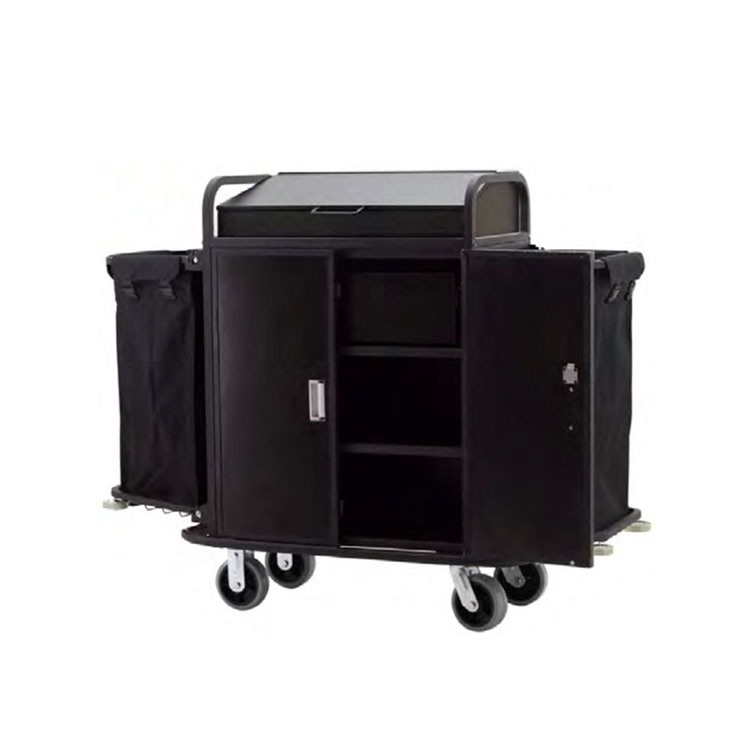
A lockable housekeeping cart is the right call when attendants work outside suites, executive floors, mixed-use corridors, meeting-room zones, or any polished guest path where open shelving makes the operation look messy, noisy, or careless. Facility Project Solutions positions its Housekeeping Cart with Lockable Cabinet Doors around lockable storage, adjustable shelving, non-marking casters, protective bumpers, and easy-clean surfaces, which is exactly the spec mix I want when the cart has to perform and still look controlled in public view.
Hotels carrying higher-value amenity packs, minibar resets, or turn-down kits
A secure housekeeping cart for hotels earns its keep when attendants carry boxed amenities, branded retail items, premium slippers, robe sets, minibar stock, or VIP welcome materials that disappear one piece at a time, not by the case. I’m not saying every property has a theft epidemic. I am saying open carts make casual loss easier, harder to trace, and more embarrassing to explain.
Family-heavy resorts and mixed-traffic corridors with chemical exposure risk
A housekeeping cart with lock makes more sense in resorts, extended-stay properties, and mixed-use hotels where children, pets, and guest traffic overlap with active cleaning routes, because the issue stops being “presentation” and becomes controlled access to labeled chemicals and tools. CDC guidance is not written for your lobby aesthetics, but it lands there anyway: store chemicals safely, label them clearly, and don’t treat active solutions like décor.
Hotels where carts sit parked for long intervals outside rooms
Some operations have attendants actively moving every five minutes. Others stage carts outside a room cluster, then work inside for 15, 20, even 30 minutes at a time. That difference matters. A parked open cart is an invitation: loose amenities, visible bottles, exposed cloth stacks, random tools, maybe a lost-and-found bag on the wrong shelf. That is not disciplined housekeeping. That is unsecured inventory wearing wheels.
Multi-property brands that need one visual standard
This one gets missed.
If you manage ten, twenty, or fifty properties, the cart is no longer just equipment; it is part of brand control, replenishment logic, replacement planning, packaging, and visual consistency. Facility Project Solutions makes that point clearly in its OEM/ODM services for multi-property rollouts, emphasizing corridor widths, elevator turns, load targets, branding systems, and repeatable production standards. I like that because random cart buying creates random service behavior, and random service behavior is what brand teams politely call “property-level variation.”
When I would not pay for lockable doors
Here is the part vendors often mumble through: a lockable housekeeping cart for hotels is a bad buy when the cart lives almost entirely back-of-house, the property has tight service corridors, attendants need fast open access, and the real problem is not security but bulk, route length, or dirty-flow separation.
If your hotel is a compact select-service property with narrow turns and shallow elevators, I would usually rather see a compact maid cart with linen storage than a heavier enclosed unit, because the slim silhouette, dedicated linen zone, adjustable shelf, and corridor-friendly maneuverability solve the actual problem: space. Doors do not fix bad geometry.
If your team struggles to separate clean inventory from soiled linen or waste, I would look first at a hotel housekeeping cart with bag holder, because integrated bag handling and zoned shelving often solve more daily chaos than adding a lock ever will. Hard truth: many operators buy security hardware when what they really need is cleaner workflow.
And if you run a large resort where the issue is carrying capacity and fewer refill trips, then a large housekeeping trolley with multiple shelves may beat a lockable model simply because volume, zoning, and stable steering reduce wasted motion better than enclosed doors can. Bigger properties usually lose money through labor drag first, not amenity shrink first.
My operator’s table: when the lock is worth the hassle
Hotel condition
Open cart
Bag-holder cart
Lockable housekeeping cart
My call
60-room boutique, tight corridors, shallow elevator
Family resort carrying active chemicals on public floors
Risky
Better separation, still exposed
Best for controlled access
Choose lockable
350-room resort with long routes and heavy par stock
Too little capacity
Sometimes balanced
Only if visibility risk is high
Prioritize capacity first
Multi-property brand rollout
Inconsistent
Better operationally
Best when paired with spec discipline
Standardize intentionally
This is not a universal law. It is the buying framework I trust when I care more about labor math, guest optics, and controlled access than about brochure language.
What features separate a smart lockable cart from a dumb one
Door design that does not punish attendants
A lockable housekeeping cart for hotels should secure supplies without forcing attendants into awkward reaches, repeated bending, or annoying extra motions every few minutes. If the door swing is clumsy, the latch feels cheap, or the shelf depth turns every towel grab into a shoulder strain, the cart is lying about being “efficient.” And workers’ bodies are not forgiving, as the 2024 PubMed data makes painfully clear.
Non-marking casters and bumpers are not cosmetic
Facility Project Solutions repeats this point across its compact maid cart with linen storage, hotel housekeeping cart with bag holder, and lockable cabinet-door model: non-marking casters, smooth steering, and protective bumpers matter in corridors and elevators. I agree. Not because it sounds nice, but because scuffed walls, clipped door frames, and carts that fight the operator are signs of spec failure, not staff failure.
Zoned storage beats brute capacity
A commercial housekeeping cart should separate fresh linens, amenities, chemicals, tools, and dirty-flow items in a way that matches the sequence of room servicing. The site’s product family keeps coming back to zoned compartments, bag holders, adjustable shelves, and easy-clean surfaces, and that pattern is correct. A chaotic cart wastes time twice: once when stocking, once again in the room.
Standardization matters more than buyers admit
I’ve seen hotel groups obsess over unit price and then bleed money on mismatched reorders, inconsistent finishes, and replacement headaches. The OEM/ODM service model is useful because it frames carts around repeatability, branding, quality control, labeling, and rollout logic, not just one isolated purchase order. Procurement teams love pretending every purchase is one-and-done. It never is.
FAQs
What is a lockable housekeeping cart for hotels?
A lockable housekeeping cart is a hotel housekeeping cart with enclosed storage and secured cabinet doors that limits casual access to chemicals, amenities, linens, tools, and replenishment stock while the cart moves through guest-facing corridors, elevators, mixed-use floors, or other areas where open shelving creates safety, loss-prevention, or presentation problems.
In plain English, it is not just a cart with a lock. It is a control device. I use it when I need better access control, a cleaner visual profile, and less exposed inventory in public view.
When should a hotel use a housekeeping cart with lock?
A hotel should use a housekeeping cart with lock when attendants work on guest-visible floors, carry higher-value amenities or active cleaning chemicals, park carts outside rooms for extended periods, or operate in mixed-traffic environments where exposed inventory, supplies, or tools create avoidable safety, security, or brand-image problems.
That includes upscale properties, family resorts, mixed-use hotels, executive floors, and brands that care about corridor presentation. It does not automatically include every small hotel with a hallway and a mop.
Is a lockable housekeeping cart worth it for a small hotel?
A lockable housekeeping cart is worth it for a small hotel only when the property has frequent guest exposure, visible corridor staging, premium amenity stock, or active chemical handling in public-facing areas; otherwise, a slimmer or better-zoned cart usually saves more labor than enclosed doors ever will.
I would not buy one just to feel “more professional.” That is procurement vanity. In a small property, tight turning radius and faster access often beat enclosed storage.
How do I choose a housekeeping cart for hotels?
Choosing a housekeeping cart for hotels means matching the cart to corridor width, elevator depth, par-stock volume, room mix, guest visibility, chemical load, and dirty-flow separation, instead of buying by appearance, shelf count, or generic size labels that ignore how attendants actually move and work.
My rule is simple: audit the route first, then the stock, then the risk. If visibility and access control dominate, go lockable. If geometry dominates, go compact. If separation dominates, go bag-holder. If route length dominates, go higher-capacity.
What features matter most in the best lockable housekeeping cart for hotels?
The best lockable housekeeping cart for hotels combines secure cabinet doors, zoned internal storage, smooth non-marking casters, impact-protective bumpers, accessible shelf geometry, durable easy-clean surfaces, and a frame size that fits real corridor and elevator conditions without forcing attendants into awkward reaches or slower room-turn routines.
I would add one more feature vendors underplay: disciplined door behavior. If the latch, hinge, or opening angle slows the attendant every room, the lock becomes a labor tax, not a control measure.
Your next move
Do the floor walk.
Before you approve any hotel maid cart, walk one live route with housekeeping, carry the actual stock, note every elevator threshold, every corridor pinch point, every guest-visible parking spot, and every chemical that should not be sitting open on a cart beside a family room door. Then compare that reality against the housekeeping cart catalog, the lockable cabinet-door model, the bag-holder option, and the OEM/ODM rollout path if you manage multiple properties. The right cart is not the fanciest one. It is the one that fits your building, protects your staff, and stops making ordinary work harder than it already is.