Share your requirements and target market. We’ll suggest the right configuration, sampling path, and production plan.
During business hours, We can usually provide a preliminary quote within two hours.
: workflow-based setups to improve efficiency and keep corridors tidy
: easier bag changes and maintenance, built for daily facility use
: 1–3 stream options with clear icon/label systems to reduce contamination
: materials, finishes, branding & packaging locked for consistent reorders
Your info is used only for quoting and communication.
Why Non-Marking Wheels Matter on Hotel Housekeeping Carts
Most hotels buy housekeeping carts like they are buying storage. I think that is the first mistake. The real decision starts at floor level, because wheels decide whether a cart glides, drifts, scuffs, blocks traffic, or quietly does its job without leaving the building looking tired.
Table of Contents
The wheel is the first thing that fails
Tiny detail. Big consequence.
I think most hotel buyers still overfocus on shelf count, bag volume, and silhouette, while ignoring the one component that decides how a housekeeping cart behaves in corridors, elevators, and guest-facing areas: the wheel. Facility Project Solutions itself keeps repeating the same operational pattern across its product and OEM pages, emphasizing non-marking casters, bumper protection, corridor fit, elevator turns, and guest-area finishes. That is not decorative copy. That is the real buying logic. Why would you treat wheels like an accessory when they are the only part touching the building all day?
A 2024 systematic review on PubMed found that hotel housekeepers and cleaners showed a 53.9% prevalence of low-back symptoms, 41.4% for shoulders, and 40.1% for wrists and hands. Meanwhile, the BLS 2023–2024 injury report showed 721,720 private-industry DART cases tied to falls, slips, and trips, plus 479,480 cases involving days away from work, with a median 13 lost days for those cases. And the Canadian Centre for Occupational Health and Safety makes the point many hotel operators still dodge: hand carts reduce carrying strain, but pushing, pulling, and maneuvering them still create overexertion hazards when design is poor. So no, a hotel housekeeping cart is not just a storage platform with wheels slapped on. It is part of the strain equation. Isn’t that the uncomfortable part buyers would rather not price in?
I’ll put it more bluntly. When a cart rolls badly, staff compensate with force, corrections, stops, micro-turns, and awkward parking outside the room door; that means more shoulder loading, more wrist work, more hallway friction, and a higher chance that the cart starts clipping walls, baseboards, or elevator frames. I have watched operators blame staffing, pace, and training when the equipment itself was fighting every meter of the route. That is procurement failure dressed up as labor management.
Floors remember everything
Scuffs stay visible.
OSHA’s housekeeping slips/trips/falls guidance points straight at the basics: keep floors clean and dry, and keep aisles and passageways clear under 29 CFR 1910.22. The U.S. Access Board’s ADA guidance adds another hard number buyers should not ignore: accessible routes require 36 inches of continuous clear width, with 32 inches allowed only at short pinch points up to 24 inches. Put those two ideas together and the message is obvious: a drifting cart, a badly parked cart, or a cart that needs constant correction is not a style issue. It is an operations issue with a compliance edge.
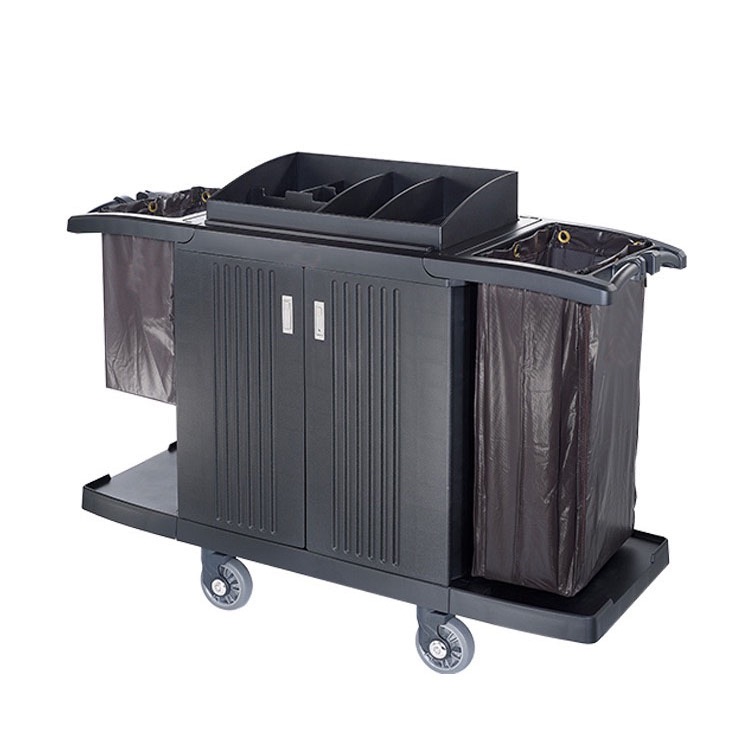
That is why I keep coming back to non-marking wheels and non-marring bumpers. On the Compact Maid Cart with Linen Storage, the site stresses dedicated linen storage, adjustable shelving, non-marking casters, and protective bumpers for corridors and elevators. On the Hotel Housekeeping Cart with Bag Holder, the bag holder separates soiled material from clean inventory while the wheels and bumpers reduce contact marks. On the Housekeeping Cart with Lockable Cabinet Doors, the pitch is even sharper: conceal chemicals and amenities, keep the cart presentation-ready, and move through public areas without leaving scuffs behind. That is the right frame. Hotels are public theaters with maintenance budgets.
The buying matrix I would actually use
If the route is tight, visible, and repeated hundreds of times a week, this is the comparison that matters more than brochure glamour.
Operating reality
Generic hard caster mentality
Non-marking wheel mentality
My take
Narrow guest corridors
“It rolls, so it’s fine”
Lower visible floor marking and cleaner steering corrections
Hotels usually underbuy wheel quality here
Elevator thresholds and turns
More jolts, more drift, more frame contact
Smoother entry and less ugly wall-touch behavior
This is where cheap wheels expose themselves
Premium or guest-facing floors
Cart looks functional but rough
Cart looks controlled and less intrusive
Presentation matters because guests are watching
High-volume room turns
Staff compensate with force when loaded
Better route control under load
Labor strain rarely shows up on the quote, but it shows up later
Multi-property standardization
Every site improvises
One spec, repeatable performance
Standardized wheels beat standardized excuses
The best housekeeping cart is route-specific, not catalog-pretty
Looks fool buyers.
Facility Project Solutions already has the right sub-clusters for this article topic, and I would use them aggressively inside the copy because they match real intent rather than generic SEO theater. A reader interested in corridor-friendly housekeeping cart wheels should move from the category page into the compact maid cart with linen storage when the issue is footprint control, into the hotel housekeeping cart with integrated bag holder when the issue is dirty-versus-clean separation, into the housekeeping cart with lockable cabinet doors when guest visibility and concealment matter, and into the heavy-duty cleaning cart for hotel floors when the route is heavier and the onboard load is less forgiving. That is how a professional buyer thinks. Why send them somewhere vaguer?
I also like one adjacent support link here: the compact room service cart for corridors. Yes, it is not a housekeeping cart page. But it reinforces the same operational language that matters for a hotel cleaning cart or housekeeping cart: tight turns, elevator access, divided storage, bumper protection, and non-marking wheels. That kind of internal link is not random; it widens topical authority around corridor mobility without drifting off into nonsense.
And for multi-site groups, the last stop should be the OEM/ODM services page, because that page finally speaks the procurement language most manufacturers avoid: corridor widths, elevator turns, load targets, cleaning routines, noise expectations, validation samples, and repeatable specs. I trust that more than fluffy “hospitality grade” claims every day of the week.
What non-marking wheels actually buy you
Not glamour. Control.
They buy cleaner floors, fewer visible streaks, less contact drama at corners, more predictable turning, less staff compensation force, and a calmer guest-floor presentation. They also make the housekeeping cart look like part of a system instead of a tired warehouse tool that wandered into a four-star corridor. I know that sounds severe. But hotels live and die on whether routine service looks routine or sloppy.
My opinion is simple: most hotels should stop asking, “How much can this cart hold?” and start asking, “How little damage, drag, and visible disorder does this cart create while holding enough?” That one question will save more money than another debate about shelf count ever will. And yes, the best housekeeping cart with non-marking wheels often wins precisely because it is less dramatic. In operations, boring is expensive to build and cheap to run.
FAQs
What are non-marking wheels on a housekeeping cart?
Non-marking wheels are housekeeping cart wheels designed to move across guest-area floors without leaving visible transfer marks, while keeping the hotel housekeeping cart stable, steerable, and quiet enough for corridors, elevators, and room-door parking during daily room-turn operations for staff use. They matter most on routes where finished surfaces, guest visibility, and repeated turning all collide.
Do non-marking wheels really reduce floor damage?
Yes, when paired with proper load balance and bumper protection, non-marking wheels reduce visible streaking and contact-related surface abuse that cheap hard casters can create, especially on finished guest-floor routes, elevator thresholds, and narrow corridor turns where attendants keep correcting the cart’s line under load. They do not erase every maintenance problem, but they remove one of the dumbest and most preventable ones.
Are non-marking wheels better than generic hard casters for hotels?
Usually, yes: non-marking wheels are the better hotel choice because hospitality equipment lives in public sightlines, mixed route constraints, and tight turning zones, so the cart has to protect finishes, preserve maneuverability, and avoid looking like a maintenance problem every time it leaves the service room. If the property cares about presentation, corridor control, and reduced touch-up cleaning, this should not even be a close argument.
How do I choose the best housekeeping cart with non-marking wheels?
To choose the best housekeeping cart with non-marking wheels, start with the route rather than the brochure: measure corridor working width, doorway pinch points, elevator entry behavior, parking depth outside guestrooms, and how the cart separates clean linen, amenities, chemicals, and soiled material under a real shift load. Then match the format to the actual pain point: compact for footprint control, bag-holder for separation, lockable for guest-facing floors, heavy-duty for higher loads, and OEM/ODM if you need the same spec repeated across sites.
Your Next Move
Run one honest audit.
Take your current housekeeping cart to a live guest floor. Measure the corridor. Watch the turn into the elevator. Park outside a room and see how much working width disappears. Then inspect the floor finish after a full shift and ask one blunt question: are your housekeeping cart wheels helping the building, or quietly billing the building?