Share your requirements and target market. We’ll suggest the right configuration, sampling path, and production plan.
During business hours, We can usually provide a preliminary quote within two hours.
: workflow-based setups to improve efficiency and keep corridors tidy
: easier bag changes and maintenance, built for daily facility use
: 1–3 stream options with clear icon/label systems to reduce contamination
: materials, finishes, branding & packaging locked for consistent reorders
Your info is used only for quoting and communication.
How Housekeeping Cart Appearance Affects Guest Perception
I do not buy the old industry lie that a housekeeping cart is “back-of-house” equipment. In real hotels, it is a moving piece of evidence, and guests read it fast.
Guests notice fast.
I have watched travelers step around a swollen housekeeping cart with one torn liner, two exposed spray bottles, and a gray rag hanging like a surrender flag, then look at the carpet, the baseboard, and the guestroom door as if the floor itself had just confessed its standards in public. Why would they separate the cart from the hotel?
That is the whole point. A housekeeping cart is not neutral. A hotel housekeeping cart is a moving signal about order, hygiene, labor pressure, and whether management is actually in control or just performing control when the lobby cameras are nearby.
Table of Contents
Guests read the hallway before they trust the room
This is not subtle.
According to the 2024 North America Hotel Guest Satisfaction Index, J.D. Power gathered responses from 39,468 branded hotel guests for stays between May 2023 and May 2024, at a moment when U.S. ADR hit $158.45 in May 2024, and the company explicitly tied guest satisfaction gains to room conditions, maintenance, and cleanliness-related performance. Pair that with Ecolab’s September 2024 Hotel Cleanliness Consumer Survey, where 53% of hotel guests said they prefer hotels using disinfectant cleaners that kill bacteria and viruses, versus 14% preferring plant-derived products even when they do not disinfect, and you get the real story: guests arrive already primed to inspect visual proof of hygiene.
So yes, the cart matters.
Not because guests know the spec sheet, but because they know what disorder looks like. Exposed trash. Visible chemicals. Shelves stuffed beyond reason. Squeaking wheels at 7:05 a.m. Scuffed panels that look like nobody wiped them down after the breakfast rush. That is professional housekeeping cart appearance in reverse.
The hallway test is brutal
Pretty does not win.
A cart can look expensive in a product photo and still look cheap in a corridor once bag edges show, amenity packs slump forward, wet cloths sit beside clean linen, and attendants need both hands just to stop the thing drifting into a wall. Isn’t that the dirty secret?
Here is how guests usually read a housekeeping trolley, whether management likes it or not:
Cart signal in the corridor
What the guest assumes
What the hotel problem probably is
Better move
Exposed trash bag or soiled linen
“Clean and dirty are mixing.”
No separation logic
Integrated bag holder or closed return zone
Open chemical bottles and loose gloves
“This floor is being improvised.”
Weak zoning and no concealment
Closed cabinet doors for chemicals and tools
Rattling, hard wheels
“Service is disruptive.”
Cheap caster package or bad load balance
Soft non-marking casters and tighter shelf control
Overstuffed shelves
“Housekeeping is behind.”
Replenishment cadence is broken
Smaller fast-pick zones and better par discipline
Dirty, scuffed exterior panels
“Nobody resets the equipment.”
No wipe-down standard
Easy-clean surfaces and end-of-shift inspection
I would go further. The best housekeeping cart for hotels is usually not the biggest unit, not the glossiest laminate, and not the one with the most shelves. It is the one that still looks disciplined at 11:20 a.m., when half the floor is turning, one attendant is already behind, and the guest in 1128 opens the door early.
Hard truth: cart appearance is labor made visible
Labor shows.
The June 2024 AHLA staffing survey found that 76% of surveyed hotels reported staffing shortages, 79% said they still could not fill open roles, and housekeeping ranked as the top hiring need for 50% of properties. Then Reuters reported that more than 10,000 U.S. hotel workers went on strike over Labor Day 2024, with workload and staffing cuts sitting at the center of the fight. When labor is stretched that hard, cart appearance stops being a styling issue and becomes a symptom.
And there is a legal edge here that too many buyers still ignore.
California Title 8, Section 3345 was written to control musculoskeletal injury risk for hotel housekeepers, and it explicitly ties housekeeping tasks to pushing and pulling carts, handling linen, supplying rooms, and collecting trash. Add the BLS May 2023 wage data for maids and housekeeping cleaners, which put national employment at 836,230 with a mean hourly wage of $16.66, and the fiction that cart design is a decorative afterthought gets hard to defend. We are talking about a huge labor system working under tight margins, visible strain, and public scrutiny.
My opinion? Hotels that still buy carts as if they were hallway furniture deserve the guest complaints they get.
The internal-link route I’d actually build on this site
An informational reader wants “how housekeeping cart appearance affects guest perception.” A commercial reader wants to know which cart type fixes which visible problem. A portfolio buyer wants standardization, noise control, corridor fit, and reorder consistency. Same topic. Different depth. Better funnel.
What I would spec if guest perception actually mattered
Start smaller.
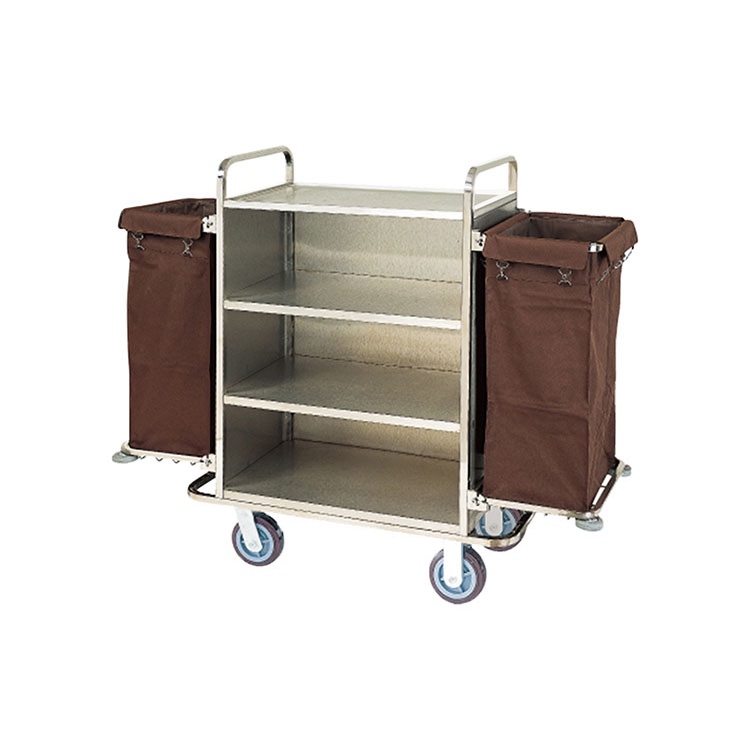
I would rather spec a 38- to 42-inch corridor footprint, soft non-marking 125 mm casters, full-wrap bumpers, one genuinely useful fast-pick zone, and a concealed dirty-return area than chase oversized carts that look “fully equipped” in a catalog and look ridiculous once parked outside a king room. Why block the hallway just to prove you bought capacity?
Order beats ornament
A cart looks professional when the logic is visible even if the supplies are not. Guests should read separation, not volume. That means:
clean linen never slumping next to soiled return bags
chemicals hidden or secured, especially quats or H2O2-based cleaners
no loose plastic liners flapping outside the frame
no squeal, chatter, or metal-on-metal rattle
no stained exterior panels by mid-shift
And yes, I care about noise as part of appearance. Most hoteliers treat sound as a different problem. I think that is lazy. A cart that wakes the corridor already looks unmanaged.
Concealment is not vanity
This is where many operators get cheap.
If a property sells itself on calm, privacy, or premium service, open carts loaded with spray bottles, amenity refills, gloves, and exposed waste are brand sabotage. That is exactly why a lockable or partially concealed configuration often earns its keep on guest-facing floors, while smaller select-service properties may do better with a tighter, lighter, open-access setup that still preserves separation and wipe-clean order.
Housekeeping cart organization is the real aesthetic
I have seen ugly carts perform beautifully and premium carts fall apart by Tuesday.
The difference is housekeeping cart organization. Fast-pick items at hand height. Backup stock lower. Dirty flow isolated. Bag changes easy. Shelves zoned by task, not by whatever item happened to fit. If you are asking how to organize a housekeeping cart, start with the item attendants touch every room, not the item procurement likes seeing in a sample photo.
FAQs
What is housekeeping cart appearance in a hotel?
Housekeeping cart appearance is the visible combination of order, cleanliness, concealment, noise control, and corridor fit that guests interpret as a proxy for the hotel’s operating discipline, hygiene standards, and respect for shared space before they ever inspect the room itself.
That is why a cart can quietly help or hurt guest perception of cleanliness before the room inspection even starts.
Why does a messy housekeeping trolley hurt guest trust?
A messy housekeeping trolley signals contamination risk, weak supervision, and rushed labor because exposed trash, visible chemicals, loose linens, and scuffed panels tell guests that the hotel is struggling to separate clean from dirty work in the very place where service should look most controlled.
In plain English, the cart becomes evidence. Guests may not know the workflow, but they know when it looks sloppy.
When should a hotel use a lockable housekeeping cart?
A lockable housekeeping cart is the right choice when guest-facing corridors, higher-value amenities, chemical concealment, or longer parked intervals make visual control and access security more important than the few extra seconds attendants spend opening doors during each room turn.
I would use one on luxury floors, mixed-traffic corridors, and properties where the cart is visible long enough to become part of the guest experience.
How should a hotel organize a housekeeping cart for better guest perception?
A housekeeping cart should be organized with fast-pick amenities at hand height, soiled linen or waste separated in its own bay, chemicals hidden or secured, shelves zoned by task, and exterior surfaces kept quiet, clean, and uncluttered so the cart reads as controlled rather than improvised.
The goal is not “more storage.” The goal is fewer visual mistakes.
What is the best housekeeping cart for hotels?
The best housekeeping cart for hotels is the model that matches corridor width, room-turn density, replenishment cadence, guest visibility, and supply-security needs while still looking calm, clean, and easy to steer under real shift pressure rather than in a staged product photo.
That answer annoys buyers who want one universal winner. Too bad. There isn’t one.
Your Next Move
Run the hallway audit.
Walk one guest floor at 8:30 a.m., again at 11:00 a.m., and once more at 2:00 p.m. Photograph every cart in service. Count how many show exposed waste, visible chemicals, overfilled shelves, wall-scuff marks, or noise issues. Then compare that reality against your standards, not your purchase order.
If the carts look chaotic by mid-shift, do not rewrite the SOP first. Fix the equipment logic first. Tighten the footprint. Improve the bag-holder setup. Hide chemicals. Clean the exterior. Rebuild shelf zoning. And if you are standardizing across multiple sites, stop buying one-off units and start from a spec-driven program that can repeat without drift.