Share your requirements and target market. We’ll suggest the right configuration, sampling path, and production plan.
During business hours, We can usually provide a preliminary quote within two hours.
: workflow-based setups to improve efficiency and keep corridors tidy
: easier bag changes and maintenance, built for daily facility use
: 1–3 stream options with clear icon/label systems to reduce contamination
: materials, finishes, branding & packaging locked for consistent reorders
Your info is used only for quoting and communication.
Common Housekeeping Cart Problems and Maintenance Checklist
Most hotels do not have a cart shortage. They have a cart-discipline shortage. Here’s the housekeeping cart maintenance checklist I’d use to catch caster drag, bag-holder contamination, shelf failure, door misalignment, and corridor-fit mistakes before they hit labor, guest perception, and replacement budgets.
Most teams miss it.
A housekeeping cart is not a metal box with wheels; in a labor market where the June 2024 AHLA staffing survey found 76% of surveyed hotels dealing with staffing shortages and 50% naming housekeeping as their top hiring need, every cart is a moving workstation, and when that workstation drags, rattles, leaks, or blocks the corridor, the whole floor slows down in ways managers feel in payroll long before they admit it in procurement. Why are so many operators still buying these things like hallway furniture?
And the pressure is not abstract.
On September 2, 2024, Reuters reported that about 10,000 U.S. hotel workers struck across eight cities and 24 hotels over pay, workloads, and staffing cuts, which is the bluntest possible reminder that “do more with less” stops sounding strategic when the tools are bad. I do not buy the soft version of this story. A bad cart is a workload decision.
Table of Contents
The cart fails before the room does
Bad carts drift.
What I like about Facility Project Solutions is that the site already has a usable housekeeping cluster: the broad housekeeping carts collection, an ergonomic housekeeping cart fatigue guide, and a slim housekeeping cart corridor guide all point in the same direction, which is where this article should live instead of being buried under unrelated trash-bin pages or generic “products” fluff. Why sabotage topical authority with messy internal linking?
The site’s product mix also tells you exactly which failure points matter in real use.
The common housekeeping cart problems that actually cost you money
Casters drag, wobble, and flat-spot
Wheels go first.
The CCOHS handcart guidance updated in September 2024 is plain about it: carts reduce carrying effort, but pushing, pulling, and maneuvering them still create overexertion risks, including lower-back, shoulder, and arm strain, along with bump and slip hazards, so once a caster starts binding or wobbling, the cart stops saving labor and starts taxing bodies. Why wait for a complaint when the wheel is already telling you the story?
Bag holders become contamination points
Dirty flow matters.
California’s Title 8, Section 3345 explicitly treats loading, unloading, pushing, and pulling linen carts, supplying rooms, and collecting trash as hotel housekeeping tasks inside a musculoskeletal-injury prevention framework, and the bag-holder model on Facility Project Solutions is built around keeping soiled linen or waste away from clean inventory. When the bag ring loosens, the fabric tears, or the mount starts sagging, you do not have a cosmetic defect; you have process breakdown. Are we really calling that “minor wear”?
Shelves sag and doors fall out of alignment
Structure lies.
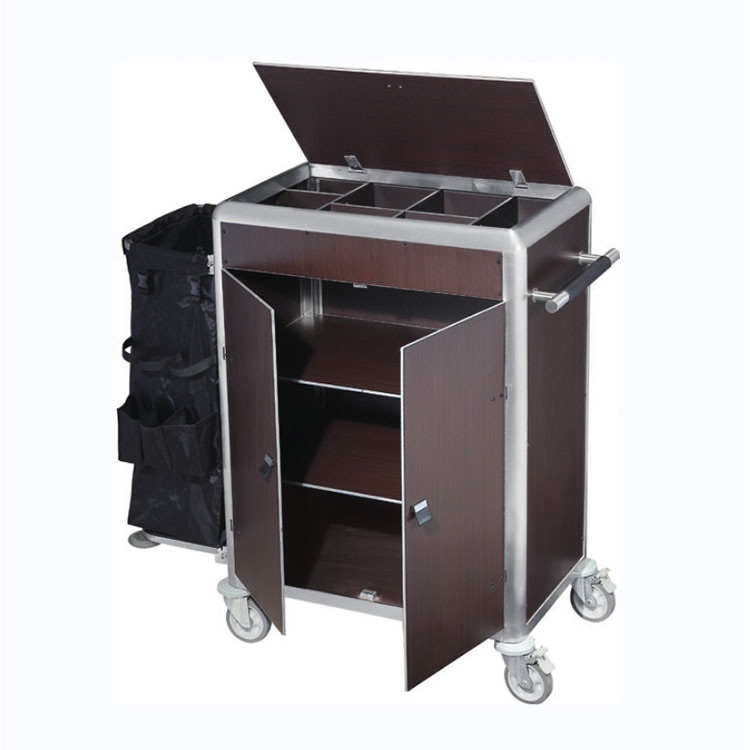
A shelf can look fine in the storeroom and still fail under live load, especially when attendants start stacking bulk towels, chemical bottles, refill stock, and amenity trays in whatever configuration the shift demands, which is why I care less about catalog photos and more about whether shelf pins, hinge points, and latch lines still hold under repetition. The cart with lockable cabinet doors and the compact maid cart both lean hard on adjustable shelving for a reason. Misalignment is not random. It usually means the cart has been overloaded, rammed, or ignored.
Bumpers disappear, and then the walls pay
Small part. Big bill.
Facility Project Solutions keeps repeating “protective bumpers” and “non-marking casters” across its housekeeping cart pages because corridor contact is not an edge case; it is daily traffic reality in elevators, corners, and room thresholds, and once a bumper cracks or drops off, the cost jumps from a cheap replacement part to chipped paint, dented frames, and guest-visible abuse. Why are hotels so willing to save $20 and spend four figures later?
The cart gets wider in use than it looked on paper
Specs cheat.
The ADA passage-width standard sets 36 inches (915 mm) for continuous passage and allows 32 inches (815 mm) only at a point for a maximum of 24 inches, while the March 2023 NIOSH hotel worker safety sheet tells workers to ask for help when passing through narrow spaces such as elevators. So yes, a housekeeping trolley can be “slim” on the spec sheet and still be chaos once door swing, body position, bag bulge, and parked footprint are added. Isn’t live clearance the only width that matters?
The maintenance checklist I’d actually hand to a supervisor
Cheap routines win.
I do not believe in heroic quarterly inspections followed by months of neglect, because cart failures show up as noise, drag, looseness, smell, and crooked movement long before they become purchase orders, which means the best housekeeping cart maintenance checklist is boring, fast, and non-negotiable. Why make this complicated?
Cart pulls left/right, chatters, or needs extra force
Pull from service and inspect caster swivel, axle, and debris
Start of every shift
Bag holder ring, fabric bag, clean/dirty separation
Torn seam, sagging bag, contact with clean linen
Replace bag or ring immediately; do not “use it for one more day”
End of every shift
Top tray, handles, shelves, doors, high-touch wipe-down
Sticky residue, chemical splash, visible grime
Clean with property-approved products; log repeat residue zones
Weekly
Fasteners, shelf pins, hinge screws, latch alignment
Shelf tilt, rattling door, loose frame hardware
Tighten, realign, or replace hardware before reload
Weekly
Bumpers and non-marking caster condition
Missing bumper, cracked rubber, floor scuffing
Replace bumper/caster before next guest-floor run
Monthly
Load discipline and parked footprint in corridors/elevators
Overhang, bag bulge, blocked clearance, awkward turns
Reset par levels and loading zones; retrain by floor type
Monthly
Frame, welds, shelves, cabinet integrity
Bent uprights, cracked welds, doors that will not stay shut
Retire or rebuild; stop treating structural damage as normal wear
Quarterly
Model fit by property type
Staff overloading compact carts or hiding chemicals in open carts
Re-spec the cart model instead of blaming the team
That table is not theory.
The reason I would check wheel drag daily, clean-versus-soiled separation daily, and corridor fit monthly is that official guidance already points to the physical stress points: CCOHS flags overexertion and contact injuries in handcart use, NIOSH tells hotel workers to get help in tight spaces like elevators, and California’s Title 8 §3345 puts cart pushing, room supply, and trash collection squarely inside housekeeping injury prevention. That is your checklist logic.
The hard truth procurement keeps dodging
Labor is expensive.
In May 2023, the BLS occupation profile for maids and housekeeping cleaners counted 397,640 workers in traveler accommodation with a mean hourly wage of $16.28 and a mean annual wage of $33,870, while the BLS accommodation industry page showed 2024 rates of 2.3 cases involving days away from work, job restriction, or transfer per 100 full-time workers, with 1.2 involving days away from work and 1.0 involving transfer or restriction. That is why I laugh when buyers brag about shaving a few dollars off a cart spec. The labor around the cart is always more expensive than the cart.
And regulators are not ignoring ergonomics.
Different sector, same signal: in December 2024, OSHA’s settlement with Amazon locked in corporate-wide ergonomic measures, biannual review of MSD injury trends, site controls like ergonomic mats and redesigned workstations, and a $145,000 penalty payment, which tells me the old industry habit of treating ergonomics as optional décor is getting weaker, not stronger. Why would hotels assume they are somehow exempt from that direction of travel?
So here is the internal-link path I would actually use on Facility Project Solutions.
What is a housekeeping cart maintenance checklist?
A housekeeping cart maintenance checklist is a scheduled inspection routine that confirms wheel performance, frame stability, shelf strength, door or latch function, bag-holder cleanliness, and clean-versus-soiled separation before minor defects turn into slower room turns, guest-visible clutter, staff strain, or avoidable replacement costs. I would keep it short, timed, and tied to shift handoff rather than bury it in a binder nobody opens.
What are the most common housekeeping cart problems?
The most common housekeeping cart problems are caster drag, wobble or flat-spotting, loose fasteners, bent or sagging shelves, torn bag holders, failed door latches, missing bumpers, and residue buildup that turns a mobile workstation into a contamination point and a corridor obstruction. On this site, those problem areas map directly to the features repeated across the category and product pages.
How often should a hotel housekeeping cart be inspected?
A hotel housekeeping cart should be visually checked at the start of every shift, cleaned and rechecked at day’s end, mechanically reviewed every week, and given a deeper monthly inspection, because wheels, hinges, bag frames, and shelves fail gradually long before the cart looks obviously broken. If your team only inspects when something snaps, your system is already late.
Is a lockable cart better than an open maid cart?
A lockable housekeeping cart is better than an open maid cart when guest-facing corridors, chemical concealment, amenity security, or brand presentation matter more than split-second grab access, but it only earns the price premium if the doors stay aligned, the latches hold, and the cart still moves cleanly through elevators. I prefer lockable models on public floors and open or semi-open layouts where speed beats concealment.
How do you maintain a housekeeping trolley for narrow corridors?
Maintaining a housekeeping trolley for narrow corridors means controlling total parked footprint, keeping bumpers intact, replacing sticky casters early, and loading the cart so attendants are not forced into twist-pull-bump movements that choke circulation or clip walls, doors, and elevator jambs. I would test it in a live corridor, not in a warehouse aisle, because the ADA passage-width rule and NIOSH’s elevator-space advice both point to the same reality: tight spaces expose bad cart design fast.
Your Next Step
Do the audit.
Pick 10 carts this week, tag them green, yellow, or red, and stop pretending that a cart which squeals, pulls, leaks, scuffs walls, or mixes soiled material with clean stock is “still usable,” because in a short-staffed operation that is not thrift, that is operational self-harm. If you want this article to convert as well as rank, keep the reader inside the housekeeping cluster, then hand off to the OEM/ODM sourcing page only after the operational case is made. That sequence matches how buyers think, how supervisors complain, and how budgets finally get approved.