Share your requirements and target market. We’ll suggest the right configuration, sampling path, and production plan.
During business hours, We can usually provide a preliminary quote within two hours.
: workflow-based setups to improve efficiency and keep corridors tidy
: easier bag changes and maintenance, built for daily facility use
: 1–3 stream options with clear icon/label systems to reduce contamination
: materials, finishes, branding & packaging locked for consistent reorders
Your info is used only for quoting and communication.
How Standardized Housekeeping Carts Improve Multi-Site Hotel Operations
I’ll say it plainly: most hotel groups do not have a housekeeping problem. They have a cart-standard problem hiding inside labor, procurement, and floor-level chaos. This piece breaks down why standardized housekeeping carts matter, what the 2024 data says, and how hotel operators should standardize specs across multiple properties without buying oversized mistakes.
Boring. Very boring. And that is exactly why standardized housekeeping carts matter so much, because the less glamorous the purchase looks in a board deck, the easier it is for hotel groups to miss the daily labor drag, the training waste, the corridor damage, the refill chaos, and the guest-facing disorder that stack up across 12, 40, or 180 properties. Why do operators still treat carts like minor accessories?
I’ll say the hard part first. In multi-site hotel operations, cart standardization is not a facilities detail. It is an operating system.
The evidence is not subtle. In AHLA’s May 2024 survey of 456 hoteliers, 76% said they were facing staffing shortages, 79% still could not fill open positions, and 50% said housekeeping was their top hiring need; at the same time, BLS data pegged maids and housekeeping cleaners at $36,180 annual mean wage in May 2024, while leisure-and-hospitality employer compensation averaged $19.90 per hour in December 2024. Put differently: every wasted minute on the cart now sits on top of expensive, scarce labor. According to AHLA’s May 2024 staffing survey, BLS May 2024 wage data, and BLS compensation data for December 2024, the payroll excuse is gone.
Table of Contents
The cart is not the cart
It is workflow. A standardized cart determines where fresh terry sits, where guest amenities live, where PPE goes, where soiled linen is isolated, how the attendant enters an elevator, how often the cart clips a baseboard, and whether a new hire from Property A can work Property B on Monday without relearning the whole floor. Isn’t that what operations people say they want from standardization everywhere else?
What I see, over and over, is this: operators obsess over PMS integration, labor scheduling, and SOP binders, then tolerate five different housekeeping cart footprints, three bag layouts, mismatched caster behavior, random shelf logic, and zero common replenishment logic. That is not decentralization. That is drift.
Facility Project Solutions, to its credit, has built its site around the procurement logic most hotel groups actually need: OEM/private-label control, repeatable specs, corridor-friendly mobility, and multi-site rollout consistency. The homepage is explicit that the business is set up for “brand standards” and “deployment needs so multi-site rollouts stay consistent from procurement to daily operations,” which is precisely the frame a serious buyer should use.
Why multi-site hotel operations bleed minutes
Small losses compound. When attendants lose even 60 to 90 seconds per room because the cart is too wide for a 1.8-meter corridor, the linen section is overloaded, or the dirty bag hangs in the wrong place, the loss does not stay small; it multiplies across 70 rooms, across three shifts, across 24 properties, across 365 days. How many owners have ever modeled that honestly?
That is why I’d send a reader from strategy into a housekeeping cart total cost of ownership guide before I sent them to a quote form, because the hidden bill is labor drag, wall hits, caster failure, refill trips, and inconsistent staff behavior, not just unit price. Facility Project Solutions makes that point directly in its TCO content, arguing that “labor drag is the main event,” and I think that view is correct.
And the labor issue is no longer theoretical. Reuters reported on September 2, 2024 that more than 10,000 hotel workers struck at 25 hotels in nine U.S. cities, with demands centered on higher pay, fair workloads, and reversal of COVID-era service and staffing cuts; housekeeping disruption was explicitly reported at affected properties. When a labor market is already tight, why would any operator accept avoidable physical friction from bad maid carts or ad hoc janitorial carts for hotels? Reuters’ September 2024 strike report should have scared more COOs than it did.
What the injury data says, and what many buyers still ignore
Bodies remember. Procurement decks do not. And once a hotel group starts pretending that a cart’s width, push resistance, shelving logic, and dirty-clean separation are “soft” issues, it has already shifted cost from capex into workers’ backs, wrists, and shoulders. Do we really need to keep relearning that lesson?
A 2024 systematic review and meta-analysis indexed in PubMed found that among hotel housekeepers and cleaners, the three most affected body areas were the low back at 53.9%, shoulders at 41.4%, and wrists/hands at 40.1%. That is not background noise. That is a sector signal. Read the 2024 systematic review and then tell me cart ergonomics is secondary.
California has already written the warning into law. Under Title 8, Section 3345, the state’s hotel housekeeping musculoskeletal injury-prevention standard specifically covers “loading, unloading, pushing, and pulling linen carts” inside housekeeping tasks, and it requires employers to implement a written musculoskeletal injury prevention program tied to housekeeping hazards. I’m not saying every state will copy California tomorrow. I am saying the compliance direction is obvious.
Here is the blunt version: if your cart standard makes attendants push overloaded hotel housekeeping carts through carpeted corridors, peer around overstacked shelves, or blend dirty and clean streams because the bag logic is sloppy, the cart is not helping operations. It is degrading them.
The standard that actually works across properties
One format never fits every building. One standard can.
That distinction matters, because good standardization does not mean forcing a 140-room urban select-service hotel and a 420-key resort tower into the same chassis. It means standardizing the rules: maximum live footprint, shelf zoning, dirty-stream isolation, caster spec, bumper spec, handle height range, locked chemical storage, and refill logic. Why do so many buying teams confuse a shared framework with a single SKU?
My preferred operating spec for standardized housekeeping carts
I would standardize five things first, and I would argue about finishes later.
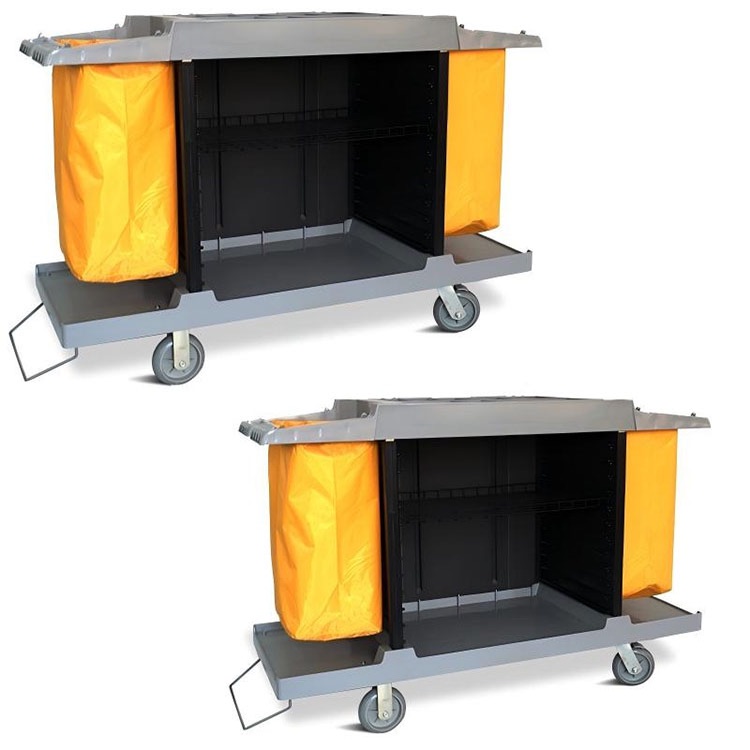
A cart family for multi-site hotel operations should keep the same zone logic across properties: top deck for high-frequency consumables; upper shelf for folded linen and terry; middle shelf for amenities and paper stock; isolated bag-holder or enclosed dirty stream for waste/soiled linen; and enclosed lower or locked section for chemicals and PPE. Facility Project Solutions repeatedly emphasizes zoned compartments, adjustable shelving, non-marking casters, bumpers, elevator maneuverability, and spec control across its cart pages, which is exactly the right hierarchy.
The configuration matrix most buyers should use
Signal
Public data point
What it means for housekeeping carts
Labor scarcity
76% of surveyed hotels reported staffing shortages in May 2024
Cart friction is now labor-cost friction, not a minor inconvenience
Housekeeping hiring pressure
50% of surveyed hotels said housekeeping was their top staffing need
Standardized training and faster cross-property transfer matter more
Wage floor reality
Maids and housekeeping cleaners averaged $36,180 annually in May 2024
“Cheap” carts can become expensive through minutes lost per shift
Total labor cost
Leisure and hospitality compensation averaged $19.90/hour in Dec. 2024
TCO models must include loaded labor, not just purchase price
Worker strain
Low back 53.9%, shoulders 41.4%, wrists/hands 40.1% in a 2024 review
Push force, handle height, and shelf reach are operating variables
Compliance direction
California Title 8 §3345 explicitly includes pushing and pulling linen carts
Cart standardization now touches risk control, not only efficiency
The mistake hotel groups make when they “standardize”
They standardize too late. By the time someone decides to harmonize carts, the portfolio already has legacy maid carts from three vendors, one resort has custom add-ons zip-tied to the frame, downtown properties have oversized carts that cannot park cleanly in service vestibules, and everyone pretends the inconsistency is normal. Why is dysfunction always tolerated once it becomes familiar?
I prefer a three-tier rule set.
The compact standard handles narrow corridors and lower par levels; the mid-volume standard handles typical transient hotels with dirty-stream separation via integrated bag holder; and the guest-facing secure standard adds cabinet doors for visible corridors, premium floors, or higher amenity control. On properties with messy room mixes or extended-stay logic, a configurable custom linen and amenity cart for hotels makes more sense than forcing a rigid template that staff will work around anyway. That product page gets one point exactly right: attendants move faster when supplies are staged by zone instead of by pile.
And yes, I would standardize sustainability alongside service. Facility Project Solutions’ sustainability page treats carts, bins, and sorting systems as one repeatable operating kit for multi-property rollouts, which is smarter than the common hotel habit of treating sustainability as guest signage in the lobby and nothing else in the back of house. Sustainability that ignores housekeeping flow is marketing. Not operations.
FAQs
What is a standardized housekeeping cart?
A standardized housekeeping cart is a hotel service cart built around a fixed operating blueprint—same footprint rules, same shelf zoning, same bag placement, same caster and bumper spec, and same refill logic—so attendants can move between properties without relearning equipment behavior or storage layout. Standardization matters because it cuts training noise, reduces stocking errors, and makes hotel housekeeping efficiency more repeatable across multi-site hotel operations.
How do standardized housekeeping carts improve multi-site hotel operations?
Standardized housekeeping carts improve multi-site hotel operations by reducing variation in room-turn workflow, refill timing, dirty-vs-clean separation, corridor maneuvering, and training demands, which lets operators control labor use, guest-floor presentation, and replacement planning across a portfolio rather than property by property. I would add one ugly truth: consistency is faster than heroics. When attendants stop improvising around random carts, supervisors stop managing exceptions all day.
What is the best housekeeping cart for hotels with different building types?
The best housekeeping cart for hotels with different building types is not one universal unit but a controlled cart family that keeps the same storage logic, wheel behavior, and safety features while adjusting width, cabinet style, and bag configuration to corridor size, guest visibility, and room-mix demands. That is why I favor a compact standard, a mid-volume bag-holder standard, and a lockable guest-facing standard. Same operating language. Different footprints.
How do you standardize housekeeping carts without over-customizing them?
To standardize housekeeping carts without over-customizing them, define the non-negotiables first—live width, zone map, wheel type, bumpers, bag separation, lock needs, and refill logic—then allow limited building-specific variation only where corridor geometry, elevator clearance, or amenity profile genuinely demands it. In other words: standardize the rulebook, not every cosmetic detail. Over-customization usually means somebody skipped workflow mapping and replaced it with preference.