Share your requirements and target market. We’ll suggest the right configuration, sampling path, and production plan.
During business hours, We can usually provide a preliminary quote within two hours.
: workflow-based setups to improve efficiency and keep corridors tidy
: easier bag changes and maintenance, built for daily facility use
: 1–3 stream options with clear icon/label systems to reduce contamination
: materials, finishes, branding & packaging locked for consistent reorders
Your info is used only for quoting and communication.
How Laundry Sorting Carts Reduce Double Handling in Hotels
Hotels do not lose labor only in the laundry room. They lose it on the guest floor, when mixed linen streams force attendants to touch the same load twice. This article explains why laundry sorting carts, hotel laundry carts, and multi-compartment linen systems fix that waste.
Labor gets wasted.
I have watched too many hotel teams create their own bottleneck, not because the staff were slow or the laundry room was understaffed, but because mixed linen collection forced one unnecessary second touch, then a third decision, then a fourth little correction nobody budgets for, and all of it piled up across 120 rooms, 300 rooms, 500 rooms. Why do so many operators still act like the laundry room is where sorting begins?
Here is my hard truth: most hotels do not have a “laundry problem” first. They have a motion problem. Dirty sheets, towels, bath mats, pool textiles, and leak-prone items get thrown into one generic flow, then somebody in the back has to stop, bend, sort, lift, re-bag, and apologize to the next stage of the process. That is double handling. And in a labor market this tight, it is lazy design.
Table of Contents
The second touch is where margins leak
The staffing backdrop is ugly enough without self-inflicted waste. According to AHLA’s June 2024 staffing survey, 76% of surveyed hotels said they were facing staffing shortages, 79% said they still could not fill open roles, and 50% ranked housekeeping as their top hiring need. Then came the operational testimony: in Reuters’ September 2024 reporting on hotel labor strikes, union workers described properties expecting three employees to do the job of four. That is exactly why I get impatient when I see a hotel still mixing all dirty linen into one bag and pretending the labor bill is the real problem.
The injury picture is not abstract either. The U.S. Bureau of Labor Statistics 2023 injury table shows traveler accommodation at 3.9 total recordable cases per 100 full-time workers, while hotels, except casino hotels, and motels came in at 4.1, far above the 2.4 private-industry average. I do not think that number exists in a vacuum. Push-pull work, repeated lifts, hallway turns, elevator thresholds, and re-sorting all leave fingerprints.
And the workforce carrying this load is hardly tiny. The BLS occupational wage data for maids and housekeeping cleaners lists 836,230 workers nationally, with 397,640 employed in traveler accommodation; the mean hourly wage was $16.66 nationally and $16.28 in traveler accommodation. That is a huge labor base doing physically repetitive work for modest pay, which means wasteful handling is not just inefficient. It is disrespectful.
What double handling actually looks like on a hotel floor
Double handling sounds technical.
It is not. It is the everyday habit of picking up linen in one mixed condition, transporting it in a generic bag, unloading it onto a back-of-house surface, then touching it again to separate what should have been separated when the first attendant laid hands on it. Why touch the same towel twice if the first touch could have decided its route?
Mixed bags create fake productivity
A room attendant finishes Room 1218 and throws everything into one bag. Another attendant pushes that cart to the service elevator. A laundry worker opens the bag, finds soaked towels against dry sheets, identifies stray trash, pulls out stained items for a different formula, and re-groups the rest into wash categories. On a spreadsheet, that still looks like “linen collection.” On the floor, it is rework masquerading as throughput.
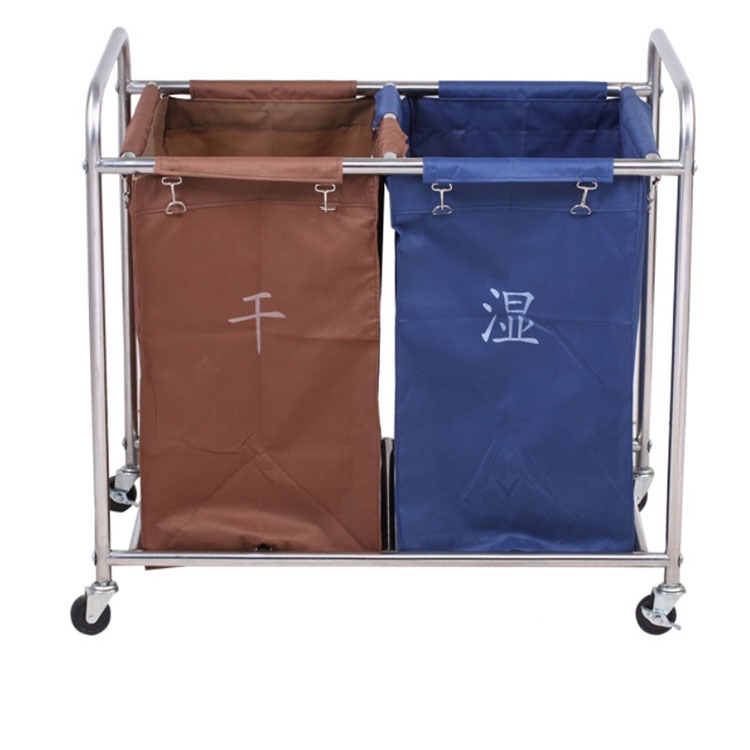
The fix is boring, which is exactly why it works: laundry sorting carts, linen sorting carts, or multi-compartment laundry carts move the sorting decision to the first touch point. Towels go left. Sheets go right. Wet items go into leak-resistant containment. Damaged or specialty items get flagged immediately. The labor disappears not because the cart is magical, but because the second sort never happens.
Hygiene rules already point in this direction
Hospitality is not healthcare, but the process logic travels well. The CDC’s January 2024 laundry guidance says contaminated laundry should be handled with minimum agitation, wet loads need leak-resistant containment, and clean linen can be placed in a properly cleaned cart that is then covered. The OSHA housekeeping ergonomics guidance separately flags pushing and pulling heavy carts full of dirty or clean items as a musculoskeletal risk. Put those two ideas together and the operational lesson is obvious: separated streams, less shaking, fewer extra lifts, cleaner routing.
And when operators say workload pressure is just a management talking point, I point them to law. Seattle’s 2024 Hotel Employee Protections notice gives hourly hotel employees in covered properties the right to clean no more than 4,500 square feet of guest rooms in an 8-hour day and, under certain circumstances, to receive 3x pay for work above that threshold. Cities do not write rules like that because motion waste is imaginary.
How laundry sorting carts remove the extra touch
This is the part buyers miss.
They compare cart capacity, frame material, or bag count, then skip the one question that matters most: does this cart eliminate an entire handling step in my real route, with my real corridor width, elevator depth, staffing ratio, and linen mix? If the answer is no, the cart is just furniture with wheels.
The workflow change, side by side
Workflow stage
Mixed-bag laundry cart
Laundry sorting cart
Operational result
Room pickup
All linen enters one bag
Linen is separated at source
No back-of-house re-sort for standard streams
Wet item control
Wet towels or spill-prone items contaminate the load
Wet items are isolated in their own compartment or leak-resistant bag
Less leakage, less clean-up, better hygiene control
Corridor transport
Cart weight shifts unpredictably as one bag fills
Load balance is easier to manage across compartments
Better steering, fewer awkward turns
Laundry-room arrival
Staff dump, open, sort, and re-bag
Staff route bags directly to next stage
One handling cycle disappears
Exception management
Stained or damaged items are found late
Exception items are flagged early
Faster decisions, fewer wash-mix mistakes
Clean linen redistribution
Dirty/clean logic can blur in ad hoc workflows
Segregation rules are easier to maintain
Better hotel linen handling efficiency
I would argue this is the whole case in one table. Not glamorous. Not trendy. Just fewer touches, fewer decisions, fewer recoveries.
The site structure already tells you which pages should support this H1
What buyers still get wrong about commercial laundry carts
Big is not smart.
I keep seeing buyers choose the biggest basket they can find, then act surprised when the cart becomes a wall in the corridor, a wrestling match at the elevator lip, and a fatigue machine by the end of shift. Should a hotel buy volume first if the route cannot handle the geometry?
The best laundry sorting carts for hotels are rarely the ones with the biggest single bag. They are the ones that match the property’s real split logic. If your operation only needs towels versus sheets, a dual-bag design may be enough. If you are dealing with spa linen, pool towel recovery, or wet-load separation, you probably need more than two streams or at least a strict color-coded bag protocol. If the cart cannot support fast bag change-outs, wipe-clean surfaces, predictable steering, and stable loading through guest corridors, it is not solving double handling. It is relocating it.
And here is another hard truth I have learned: procurement teams love unit price because unit price is easy to defend in a meeting. But the floor does not care about unit price. The floor cares about how many stops the cart causes, how many wall hits it takes, how many minutes attendants spend re-centering a bad load, and whether the laundry room receives a sorted stream or a problem pile. That is why an article about housekeeping cart total cost of ownership belongs inside this funnel. A cheaper cart that preserves double handling is not cheap.
The spec I would approve, and the one I would reject
I would approve hotel laundry carts that are built around route sequence: first touch separation, stable rolling under partial load, removable and replaceable bags, surfaces that can be disinfected between shifts, and dimensions chosen from corridor and elevator measurements rather than catalog bravado. I would also insist on visible bag logic, because unlabeled compartments are how “multi-compartment” designs quietly collapse back into mixed loads.
I would reject any commercial laundry cart that treats all dirty linen as one stream by default, especially in properties already struggling with staffing, injuries, or inconsistent room-turn timing. By the time the mixed bag reaches the laundry dock, the damage is done. The extra labor is already baked in.
FAQs
What is a laundry sorting cart?
A laundry sorting cart is a mobile linen collection unit with two or more separated compartments, removable bags, and corridor-safe wheels, designed to let hotel staff divide sheets, towels, wet items, and contaminated textiles at the room or floor level before they reach the laundry room. In practice, it replaces one large mixed bag with a controlled first-touch workflow.
How do laundry sorting carts reduce double handling in hotels?
Laundry sorting carts reduce double handling by moving the sorting decision to the first touch point, so attendants separate linen streams during pickup rather than dumping one mixed load onto a back-of-house table for a second round of lifting, shaking, reaching, and resorting. That aligns with the CDC’s preference for minimum agitation and controlled containment during textile handling.
Are double-bag laundry carts enough for hotel operations?
A double-bag laundry cart is enough for many midscale hotels when the workflow only needs one primary split, such as towels versus sheets or dry linen versus wet linen, but high-volume properties often need three-way logic, color coding, and route-specific bag changes. I would match the cart to the property’s actual linen map, not to a catalog category.
What should hotels look for when buying laundry carts for hotels?
The best laundry carts for hotels are carts sized to corridor width and elevator depth, fitted with non-marking casters, easy-clean surfaces, removable bags, rigid bag supports, and handle geometry that lets staff push in a straight line instead of twisting under load. OSHA’s ergonomics guidance is blunt enough here: heavy cart pushing and pulling is already a known risk.
How does a sorting cart improve hotel linen handling efficiency?
Hotel linen handling efficiency improves when carts cut re-sorting, reduce leakage from wet loads, shorten laundry-room dwell time, and lower push-pull strain, which means the return on a sorting cart usually shows up as saved minutes, fewer workarounds, cleaner segregation, and better room-turn rhythm rather than one dramatic line-item saving. That is why I look at route flow before I look at purchase price.
And that is the decision I would make now: stop buying generic laundry carts, start specifying sorting carts that remove one full handling cycle, and use your OEM hotel cart program to standardize that logic across properties. Because once linen is mixed, the hotel has already agreed to waste labor.