Share your requirements and target market. We’ll suggest the right configuration, sampling path, and production plan.
During business hours, We can usually provide a preliminary quote within two hours.
: workflow-based setups to improve efficiency and keep corridors tidy
: easier bag changes and maintenance, built for daily facility use
: 1–3 stream options with clear icon/label systems to reduce contamination
: materials, finishes, branding & packaging locked for consistent reorders
Your info is used only for quoting and communication.
Are Sliding-Door Room Service Trolleys Better for Upscale Hotels?
Sliding doors are not automatically better. I would specify them for guest-facing, premium-floor service where discretion, corridor clearance, and visual control matter more than brute loading speed. For high-volume or back-of-house-heavy runs, other room service cart formats often win.
Yes, sometimes.
But a sliding-door room service trolley is only better when the cart lives in guest-facing corridors, tight elevator lobbies, and premium floors where visual discretion, swing clearance, and polished presentation matter more than raw loading speed, because once service moves out of the kitchen and into the hotel’s most expensive circulation space, ugly operational details suddenly become brand details.
Sliding doors solve three expensive problems at once: they hide the mess, they remove swing-clearance headaches, and they reduce the chance that staff will fumble around a half-open cabinet at a guest-room threshold while a VIP in a robe watches the whole awkward scene unfold. According to the ADA Accessibility Standards, accessible routes generally need 36 inches (915 mm) of clear width, with only a narrow exception down to 32 inches (815 mm) for a maximum of 24 inches (610 mm). That standard is about building access, not room service theater, but the operational lesson is obvious: why buy a hotel room service trolley that demands extra side clearance in the very space where clearance is already tight?
I have seen this mistake. Hotels will spend heavily on marble, millwork, scent programs, and custom uniforms, then cheap out on the one object that rolls through guest corridors carrying cloches, condiments, dirty plates, and all the visual noise they claim to hate. That is backwards. And yes, guests notice, even when managers pretend they do not.
Why upscale hotels should care more than everyone else
Luxury is picky.
And the data from 2024 says the pressure on upscale operators is coming from both sides: labor is still strained, while rate and expectation remain high, which means equipment that saves seconds, protects staff movement, and looks composed in public space matters more, not less. In the June 2024 AHLA staffing survey, 76% of surveyed hotels reported staffing shortages, 13% said they were severely understaffed, and 50% ranked housekeeping as their top hiring need. Then, on July 31, 2024, Reuters reported that Meliá’s first-half net profit rose 11% to 51.4 million euros, with revenues per room up more than 13% on higher prices and occupancy. So the money side is telling luxury hotels to protect the premium experience, while the labor side is telling them to stop buying equipment that creates avoidable friction.
What does that mean in plain English?
It means a luxury hotel room service trolley should be judged by whether it protects brand standards under labor stress. Not in a brochure. In motion.
Sliding doors fix a corridor problem first, not a style problem
Looks matter.
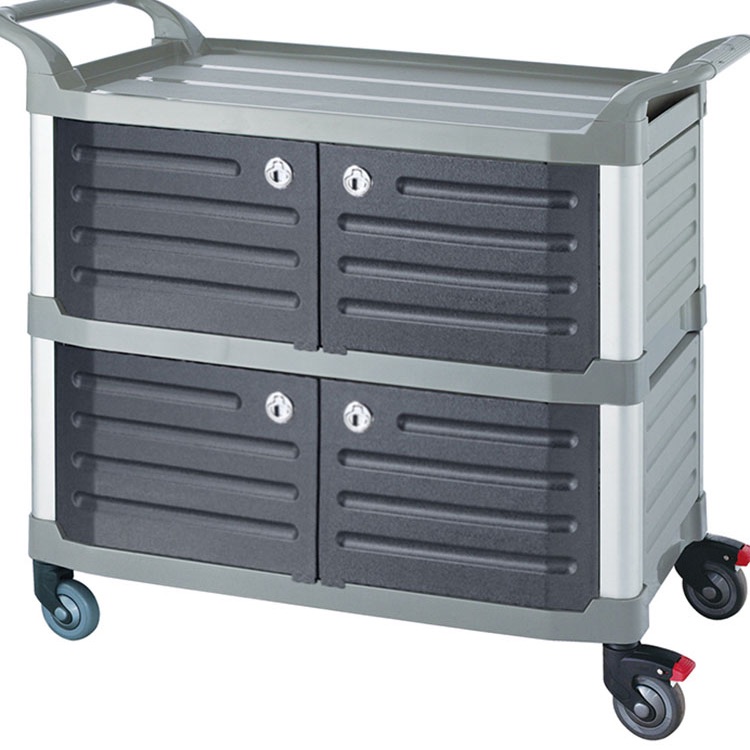
But the real win is mechanical: a sliding door room service trolley opens laterally, which means staff can reach plated meals, cutlery, beverage setups, and amenity items without creating a door arc that competes with room-entry choreography, passing guests, or elevator traffic. The Facility Project Solutions covered room service cart with sliding doors makes exactly that argument, noting discreet delivery, zoned storage, and the ability to access the cabinet in tight hallways and elevators without needing extra clearance. That is not marketing fluff. That is a genuine operating advantage.
And I would take that advantage seriously on premium guest floors where silence, neatness, and visual control are part of the product.
Enclosure changes guest perception more than operators admit
Guests read signals.
An enclosed room service cart tells the corridor a different story than an open shelf unit. It says controlled service, protected food, cleaner lines, less chaos. An open room service cart, even a good one, too often says “mid-service backstage spillover.” That may be fine in a resort wing with heavy breakfast volume and forgiving traffic. It is less fine outside a suite selling at a four-figure nightly rate.
This is why I like pairing a sliding-door discussion with the site’s own room service trolleys collection. It gives the buyer a clean comparison set: compact corridor cart, enclosed sliding-door cart, tray-rack cart, and stainless-shelf cart. That is how the decision should be framed. Format against workflow. Not shiny object against shiny object.
The part nobody likes: sliding doors are not the universal winner
Speed still wins.
If a property is doing high-frequency, standardized meal drops, especially breakfast-heavy runs or semi-batch service where tray identification speed matters more than concealment, a tray-rack format can beat a sliding-door room service cart outright. The hotel food delivery trolley with tray racks exists for a reason: rack-level staging is fast, visible, and efficient. Likewise, the room service trolley with stainless shelves makes sense where easy wipe-down access and rapid restocking matter more than hiding the payload.
So here is my unpopular opinion. Enclosed is not automatically premium. Sometimes enclosed is just slower. Sometimes it is harder to reload. Sometimes it turns a simple breakfast run into a choreography exercise nobody asked for.
Why pretend otherwise?
And there is another issue. Staff strain is real. A 2024 systematic review with meta-analysis on hotel housekeepers and cleaners found low-back pain prevalence at 53.9%, shoulders at 41.4%, and wrists/hands at 40.1%. Yes, that study is focused on housekeepers, not room service attendants alone. I still think the lesson transfers. Hotels push, pull, bend, reach, and repeat. Equipment choice is not décor. It is exposure management.
That is also why I pay attention to California Title 8, Section 3345, which explicitly treats loading, unloading, pushing, and pulling carts as part of hotel housekeeping risk control. No, it is not a room-service-only rule. I know. But it reinforces the point I wish more owners accepted: wheeled hotel equipment belongs in the safety conversation, not just the purchasing spreadsheet.
The comparison upscale buyers should actually use
What each room service cart format does well
Buying question
Sliding-door room service trolley
Open-shelf room service trolley
Tray-rack food delivery trolley
Visual discretion in guest corridors
Excellent
Weak to moderate
Weak
Access in tight hallways and elevator lobbies
Strong, because there is no door swing
Good, but contents remain exposed
Moderate, depends on width and rack depth
Speed of loading and unloading
Moderate
Fast
Fastest for standardized plated runs
Guest-facing appearance on premium floors
Strong
Inconsistent
Functional, not elegant
Protection of trays and amenities from corridor contact
Strong
Limited
Moderate
Best fit
Upscale hotels, suites, executive floors, VIP service
The industry likes false binaries. Sliding doors versus open shelves. Premium versus practical. I don’t buy it. I buy alignment. If your property is selling privacy, calm, and a controlled guest corridor, the enclosed room service cart is usually the better choice. If your operation is selling speed and throughput, it may not be.
The spec sheet I would hand procurement
Measure first.
I would start with live-route measurement, not catalog width, because a room service trolley is never just its body width. It is the body, the handles, the casters, the bumper line, the operator stance, and the way the cart behaves once it stops outside Room 1412. That is why the compact room service cart for corridors matters as an internal comparison; it frames the real issue properly: tight turns, elevator access, divided storage, non-marking casters, and bumper protection.
Then I would ask five ugly questions.
First, does the sliding door clear the working zone without turning the room threshold into a traffic knot? Second, does the enclosed body actually improve presentation, or does it just slow replenishment? Third, are the casters quiet on both hard floor and carpet transition? Fourth, can staff wipe the thing down fast between shifts? Fifth, if the hotel plans multi-property rollout, does the supplier have a real OEM/ODM hotel equipment program or are we about to standardize a spec that cannot stay consistent across batches?
That last one matters more than people admit. One property can live with a compromised cart. Twelve properties cannot.
My rule of thumb
I would choose a sliding door room service trolley for an upscale hotel when at least four conditions are true: the cart is guest-facing, corridor geometry is tight, visual discretion matters, staff are serving premium room categories, and the property wants a calmer service image than an open rack can deliver. If those boxes are not checked, I would not force it.
And for teams thinking beyond room service alone, the internal logic should connect. A hotel that is obsessing over corridor behavior should also read the site’s guide to choosing a slim housekeeping cart for narrow hotel corridors, because the same operational truth appears again: the corridor is the real buyer.
FAQs
Are sliding-door room service trolleys better for upscale hotels?
A sliding-door room service trolley is an enclosed hotel room service trolley that uses lateral-opening panels instead of swinging doors, and it is better for upscale hotels when service happens in guest-facing corridors, elevator lobbies, and suite thresholds where discretion, clearance control, and polished presentation matter more than maximum loading speed. I would use one on premium floors without hesitation. I would not use it everywhere just because it looks expensive.
What is the difference between an enclosed room service cart and an open room service cart?
An enclosed room service cart hides trays, amenities, and serviceware behind panels or doors, while an open room service cart exposes those items for faster access, easier restocking, and quicker visual identification during service runs, making the first better for discretion and the second better for raw operational speed. The first protects the guest impression. The second usually protects labor minutes.
How should you choose a room service trolley for upscale hotels?
The best room service trolley for hotels should be chosen by measuring corridor clearance, elevator fit, turning behavior, service volume, noise control, wipe-down speed, and guest-facing visibility, because an upscale hotel room service trolley succeeds only when it matches the route, staffing model, and brand expectation of the property using it. I start with the route. I trust the route more than the brochure.
What width should a luxury hotel room service trolley target in narrow corridors?
A luxury hotel room service trolley should be specified to preserve comfortable working clearance relative to corridor traffic, room-door choreography, and accessible-route expectations, not merely to fit through the opening once, because live operating width includes the cart body, handles, bumpers, projections, and staff body position during service access. I would stay well clear of any spec that forces the property to flirt with minimum-clearance behavior.
Are tray-rack trolleys better than sliding-door room service trolleys?
A tray-rack room service trolley is better than a sliding-door room service trolley when the hotel prioritizes high-volume plated delivery, fast tray identification, and quick loading cycles over concealment, visual quiet, and premium corridor presentation, which is why breakfast-heavy or standardized delivery operations often prefer rack-based designs. They are faster. They are also less forgiving in guest-facing luxury environments.