Share your requirements and target market. We’ll suggest the right configuration, sampling path, and production plan.
During business hours, We can usually provide a preliminary quote within two hours.
: workflow-based setups to improve efficiency and keep corridors tidy
: easier bag changes and maintenance, built for daily facility use
: 1–3 stream options with clear icon/label systems to reduce contamination
: materials, finishes, branding & packaging locked for consistent reorders
Your info is used only for quoting and communication.
How to Improve Room Turnover with Better Housekeeping Cart Design
Most hotels blame slow room turnover on labor. I don’t. I blame bad systems, and the housekeeping cart is usually the ugliest part of the system. Here’s how better housekeeping cart design cuts wasted motion, protects staff, and makes room attendant cart setup faster without turning the corridor into a scrapyard.
Table of Contents
The dirty little secret behind slow room turnover
Bad carts bleed.
When a room attendant loses ten seconds at the elevator, fifteen seconds at the linen shelf, another twenty because the bag frame catches a guestroom door, and then repeats that nonsense forty or fifty times in a shift, you do not have a labor problem so much as a design problem wearing a labor costume. Why do so many operators still pretend otherwise?
I’ll say the blunt part. Most hotel leaders still talk about room turnover efficiency as if it lives in SOP binders and pep talks, even though the June 2024 AHLA staffing survey said 76% of surveyed hotels were facing staffing shortages, 13% said they were severely understaffed, and 50% ranked housekeeping as their top hiring need; that is exactly when every avoidable cart movement starts costing real money.
And the physical cost is not some abstract HR talking point. A 2024 PubMed-indexed systematic review found the three most affected body areas among hotel housekeepers and cleaners were the low back at 53.9%, shoulders at 41.4%, and wrists or hands at 40.1%, which is a hard reminder that bad housekeeping cart design does not just slow the room turn, it shifts force into the worker’s body.
The labor math executives keep dodging
Numbers matter.
The U.S. Bureau of Labor Statistics counted 836,230 maids and housekeeping cleaners in May 2023, with 397,640 of them in traveler accommodation alone, where the mean hourly wage was $16.28; that is a huge labor base doing repetitive, physically demanding work, and it tells me the “just work faster” school of management is still one of hospitality’s dumbest habits.
Then came the labor reality check. In September 2024, Reuters reported that hotel workers said management was often asking three staff members to do the work of four, a line that lands because everybody in this business already knows what happens next: shortcuts, rushed resets, messy carts, corridor clutter, and rooms that look “finished” but never quite feel right. That sound familiar?
My opinion is simple. If labor is tight, the housekeeping cart stops being a supply wagon and starts being a productivity instrument. Treat it like a catalog accessory and you deserve the slow turns you get.
What regulation already tells you, if you bother to read it
Codes remember.
California Title 8, Section 3345 is not subtle: it exists to control the risk of musculoskeletal injuries and disorders to hotel housekeepers, and its definition of “control measures” explicitly includes tools, equipment, devices, work practices, and administrative controls, which means equipment choices are not decorative procurement decisions but part of hazard control. How many ownership groups are still buying carts as if none of that exists?
The safety logic is broader than California. The CDC/NIOSH hotel worker guidance frames hotel work as exposure to real physical hazards, while the Canadian Centre for Occupational Health and Safety states that hand carts save effort compared with carrying loads but still create overexertion hazards when pushing, pulling, and maneuvering are poorly managed. So yes, a housekeeping cart helps. But a badly designed one simply relocates the strain.
And corridor math matters too. The U.S. Access Board’s ADA guidance says accessible routes need a continuous clear width of at least 36 inches, can narrow to 32 inches only at short pinch points, and need more clearance at 180-degree turns around obstructions; I do not use that as a cart-width sales pitch, but I absolutely use it as a warning against bloated cart profiles, sloppy parking, and side bags that pretend not to exist.
The housekeeping cart design choices that actually move the clock
Narrow profile wins more often than oversized capacity
Small beats stupid.
I keep seeing hotels buy a giant hotel housekeeping cart because the team hates refill trips, then spend the next year pretending not to notice that the cart parks badly, turns slowly, clips baseboards, and blocks line of sight in guest corridors. Why buy more onboard inventory if the cart itself becomes hallway traffic?
That is why I would route readers first to the housekeeping cart collection and, when corridor width is the real pain point, directly into the site’s slim housekeeping cart for narrow hotel corridors article; the site architecture itself is telling you the right sequence: fit first, then storage logic, then procurement.
Zoned shelving beats “more shelves”
Organization decides speed.
A useful housekeeping cart design follows the order of work: high-frequency consumables on top, linen at the fastest safe reach zone, guest amenities separated from chemicals, and dirty flow kept off the clean side, because attendants do not lose time only on walking, they lose it on hesitation, rehandling, and visual search. Isn’t that the part most spec sheets politely ignore?
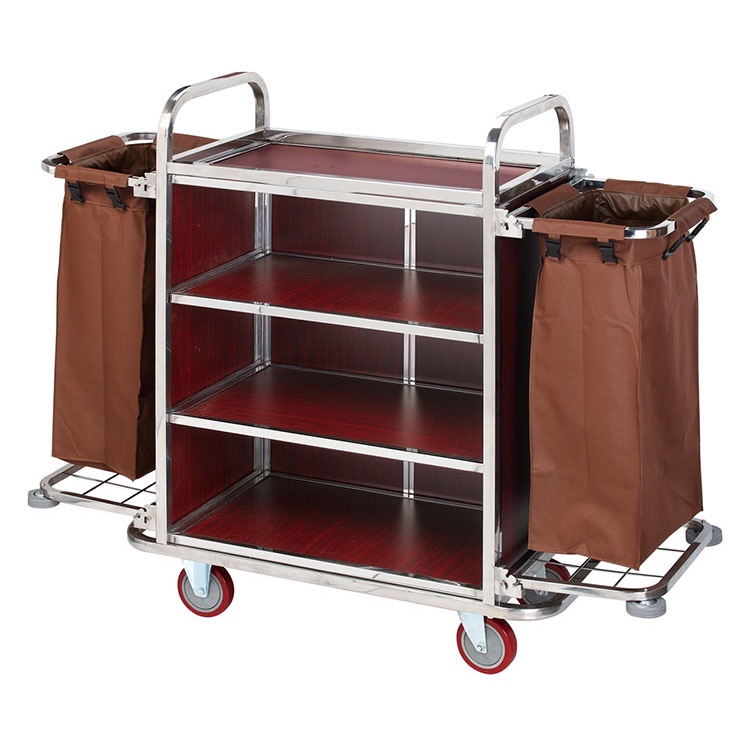
Facility Project Solutions makes that logic easiest to illustrate with the compact maid cart with linen storage, which emphasizes dedicated linen storage, zoned compartments, adjustable shelving, non-marking casters, and bumpers, all features that line up with faster hotel room turnover rather than generic janitorial clutter.
Clean and dirty flow must split early
Mixed flow kills pace.
The fastest room attendant cart setup is not the one carrying the most stuff; it is the one that prevents soiled linen, waste, fresh terry, amenities, PPE, and chemicals from fighting for the same cubic foot of space while the attendant is trying to reset a room under time pressure. Why do teams still tolerate that mess?
That is exactly where a hotel housekeeping cart with integrated bag holder earns its keep, because the separate bag zone keeps dirty material away from clean stock and reduces the dumb little crossovers that slow room turnover efficiency one reach at a time.
Guest-facing floors need concealment, not just carrying volume
Optics matter too.
I think many operators underestimate how much a messy open cart damages perceived quality, especially on premium floors, mixed-use corridors, and extended-stay assets where guests see housekeeping activity more often and for longer durations; a cart is not just a tool, it is stagecraft. Harsh? Maybe. Wrong? Not really.
That is the argument for a housekeeping cart with lockable cabinet doors: controlled visibility, adjustable storage, smoother routing through elevators and hallways, and less loose stock staring back at the guest like a back-of-house mistake that wandered upstairs.
Standardization beats one-off buying
Spec control scales.
Once a hotel group has more than one asset, cart buying stops being a product decision and becomes a systems decision, because inconsistent wheel quality, shelf heights, bag placement, bumper depth, and finish durability all create training drag, ordering confusion, and site-to-site variation that supervisors end up absorbing with extra labor. Why keep paying for inconsistency twice?
That is why the final internal link should point to the OEM/ODM hotel equipment program, where the site shifts from product talk into repeatable spec control, rollout support, materials, branding, and property-wide standardization. That is not just better internal linking. It is cleaner buying logic.
The comparison I would hand to procurement
Here is the version I would actually use in a buyer meeting.
Cart type
Best fit
What it improves
What usually goes wrong
My take
Compact housekeeping cart
Narrow corridors, smaller guest floors, frequent elevator turns
Cleaner presentation, hidden chemicals, better control of amenities
Operators complain about slower access because they never reorganized top-deck stock
Best for brand-sensitive operations
Large multi-shelf trolley
Long routes, resort wings, high-volume departure days
Fewer refill trips, more onboard inventory
Corridor drag, poor elevator behavior, door-frame damage, ugly parking
Often overbought
Custom OEM cart spec
Multi-property groups standardizing workflow
Repeatability, training consistency, procurement control
Teams customize features without first mapping room-turn sequence
Worth it when portfolio scale is real
The mistake I see most is buying for carrying capacity instead of buying for movement, because the seconds that kill room turnover are usually hidden in turns, reaches, bag interference, and restocking friction, not in the dramatic stuff managers like to talk about on conference calls.
The room attendant cart setup I would standardize
Make it boring.
A good room attendant cart setup should be so predictable that a new hire can find towels, pillow protectors, trash liners, quaternary ammonium cleaner bottles, microfiber cloths, gloves, PPE, and replacement guest amenities without rotating the cart into a logic puzzle. Isn’t that the whole point of standard work?
My default housekeeping cart organization would look like this:
Top deck: amenity refills, high-frequency paper items, gloves, disinfecting wipes, guest-facing touch-up items
Upper shelf: bath towels, hand towels, washcloths, pillowcases, fitted sheets by par level
Dirty-flow zone: bag-holder or isolated lower section for soiled linen and trash liners
Closed or low-visibility storage: chemicals, backup stock, SDS-sensitive items, extra PPE
That setup mirrors the pace of real room work: enter, strip, sort, wipe, remake, replenish, final check. Not glamorous. Very effective.
Stop asking how to stock a housekeeping cart until you fix the cart itself
Sequence beats volume.
The popular question is “how to stock a housekeeping cart,” but I think that question often arrives too early, because bad geometry makes perfect stocking useless; if the shelf depth hides the second row, the caster drag is terrible, the push handle sits at the wrong height, or the bag frame widens the live profile at every door, better stocking alone will not rescue the shift. Why pretend it will?
So my order of operations is this: first choose the right footprint, second define shelf zones by room-turn sequence, third split clean and dirty flow, fourth control visibility on guest floors, fifth standardize replenish levels, and only then write the stocking SOP. That is how better housekeeping cart design improves hotel room turnover without turning the workflow into management folklore.
FAQs
What is a housekeeping cart?
A housekeeping cart is a mobile hotel service workstation designed to carry linens, amenities, cleaning tools, waste collection, and replenishment stock in a layout that supports room attendants moving efficiently from room to room while keeping clean items, dirty flow, and guest-facing presentation under control.
In plain English, it is not a trolley with shelves. It is the moving backbone of the room-turn system. When it is designed badly, attendants waste motion. When it is designed well, the cart quietly edits dead time out of the shift.
How does housekeeping cart design improve room turnover?
Housekeeping cart design improves room turnover by reducing push force, search time, rehandling, refill trips, corridor obstruction, and dirty-clean crossover, which lets attendants complete stripping, cleaning, remaking, and replenishment in a steadier sequence with fewer interruptions and less physical strain during each room cycle.
I would put it even more bluntly: the cart decides whether the attendant works in a straight line or in a series of tiny recoveries. The clock notices. So does payroll.
What is the best housekeeping cart for hotels?
The best housekeeping cart for hotels is the one whose width, shelf zoning, bag placement, storage visibility, caster performance, and bumper protection match the building’s corridor geometry, room mix, staffing level, and guest-facing standards rather than simply offering the biggest carrying capacity or the longest feature list.
For many properties, that means a compact or bag-holder format beats a huge trolley. For premium floors, lockable doors are often worth the trade. For portfolio operators, standardized OEM specs usually win.
How should you stock a housekeeping cart?
You should stock a housekeeping cart by arranging inventory in the exact order of room-turn use, placing high-frequency consumables at top reach, fresh linen in the fastest-access shelf zone, guest amenities in visible grouped modules, soiled-linen or trash collection in an isolated dirty-flow zone, and chemicals in controlled, low-visibility storage.
That is the answer-engine version. My version is harsher: stop stuffing carts like suitcases. Stock for sequence, not for anxiety.
What features matter most in hotel housekeeping cart design?
The most important features in hotel housekeeping cart design are a disciplined working width, smooth non-marking casters, protective bumpers, zoned shelving, adjustable storage, dirty-clean separation, stable steering, and, on guest-facing floors, concealment or lockable storage that keeps supplies organized without advertising operational mess to guests.
If I had to rank them, I would put movement first, organization second, and finish aesthetics third. Pretty carts that move badly are expensive lies.