Share your requirements and target market. We’ll suggest the right configuration, sampling path, and production plan.
During business hours, We can usually provide a preliminary quote within two hours.
: workflow-based setups to improve efficiency and keep corridors tidy
: easier bag changes and maintenance, built for daily facility use
: 1–3 stream options with clear icon/label systems to reduce contamination
: materials, finishes, branding & packaging locked for consistent reorders
Your info is used only for quoting and communication.
How to Size a Housekeeping Cart for Elevators, Doorways, and Turns
Most hotels buy for capacity and pay for friction. This guide shows how to measure a housekeeping cart for elevators and doorways, avoid bad turns, and choose a layout that protects labor time instead of wasting it.
Most buyers guess.
And that is exactly how a “good-looking” cart turns into a daily nuisance: it kisses elevator jambs, stalls at guestroom doors, swings wide on corners, and quietly burns staff time in 20-second chunks that procurement teams never bothered to price out. Why are hotels still buying shelf count instead of live footprint?
I’m blunt about this because the labor math is already bad enough. In AHLA’s June 2024 staffing survey, 76% of surveyed hotels said they were dealing with staffing shortages and 79% still could not fill open jobs; Reuters reported on September 2, 2024 that 10,000 U.S. hotel workers struck while fighting over pay, workloads, and staffing cuts; and the U.S. Bureau of Labor Statistics put traveler-accommodation employment for maids and housekeeping cleaners at 397,640 in May 2023, with a mean hourly wage of $16.28. Bad housekeeping cart dimensions are not a tiny spec error in that environment. They are recurring operating waste.
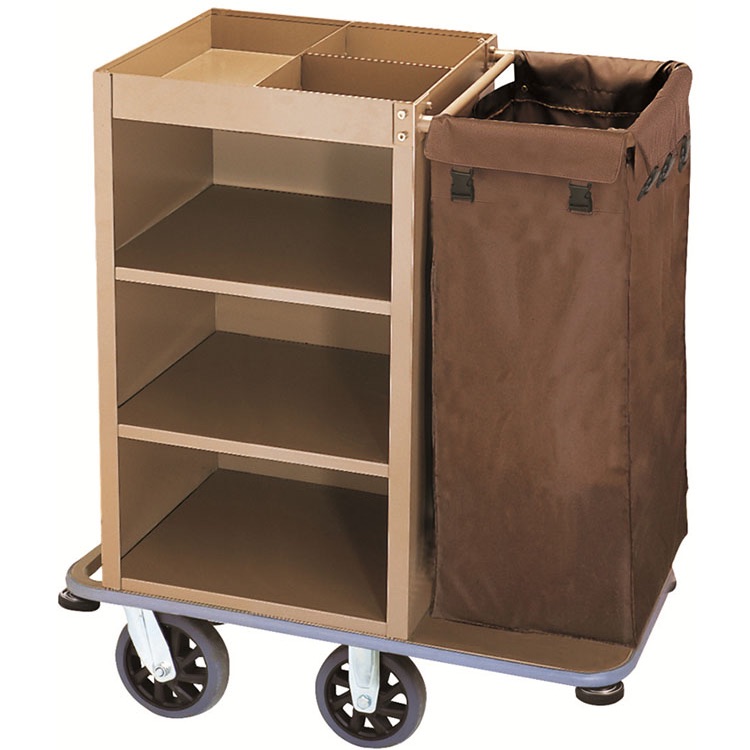
I have seen this too many times. Buyers obsess over catalog width, then ignore the loaded side bag, bumper overhang, handle projection, and the awkward body angle a room attendant needs when the cart is half parked, half blocking, and half twisted at a doorway. That “30-inch” cart suddenly behaves like a rolling wall. Sound familiar?
Table of Contents
The brochure width is a lie
Brochure width matters less than working width.
What I care about is the live profile of the cart in motion and at rest, because the cart does not move through a hotel as a naked frame. It moves with linen onboard, chemicals in place, side bags hanging, bumpers proud, and a human being pushing from an angle. So my rule is simple:
Live footprint = frame width + bumper overhang + bag/frame projection + handle projection + operator hand clearance
That is the number that decides housekeeping cart elevator fit. That is the number that decides housekeeping cart doorway clearance. And that is the number that exposes whether your “best housekeeping cart for narrow hallways” is actually slim, or just marketed that way.
The official floor lines are not generous. The U.S. Access Board’s ADA route guidance says accessible routes need 36 inches of continuous clear width, can drop to 32 inches only at short points such as doorways, and require more space at 180-degree turns around narrow obstructions; the same guidance says door openings must provide 32 inches of clear width minimum, or 36 inches when the opening is more than 24 inches deep. For elevators, the Access Board’s elevator guidance lays out minimum car dimensions such as 36-inch clear doors with car layouts like 68 by 51 inches, 54 by 80 inches, or 60 by 60 inches depending on configuration. These are legal minimums, not comfortable operating targets.
My three-pass sizing method for housekeeping cart dimensions
I do not start with capacity.
I start with the route, because the route is where procurement fantasies go to die, and the route is brutally concrete: elevator door, cab, corridor pinch point, guestroom door swing, corner turn, parked position, repeat. Why buy blind when the sequence is that obvious?
Pass 1: Measure elevator fit before you measure storage
An elevator is not just a door opening. It is a sequence: approach angle, threshold crossing, door dwell time, cab depth, and the operator’s ability to enter without rotating the cart into a wall strike.
The CDC/NIOSH hotel worker tip sheet from March 2023 tells hotel workers to ask for assistance when passing through narrow spaces such as entering or leaving an elevator. That line exists for a reason. Add California’s Title 8, Section 3345, which explicitly treats loading, unloading, pushing, and pulling linen carts as housekeeping tasks inside a musculoskeletal injury prevention rule, and the message is pretty clear: a tight elevator entry is not a design footnote. It is a risk point.
My buying rule is harsher than most vendors will like: the loaded cart should clear the smallest elevator opening on its route with at least 3 to 4 inches of total forgiveness, not theoretical zero-clearance heroics. If the cart only fits when it is empty, square, and being handled by your best attendant on her best day, it does not fit.
Pass 2: Measure doorway clearance as a real maneuver, not a static gap
Doorways lie too.
A housekeeping cart can clear a doorway on paper and still fail in real life because deep jambs, closers, latch-side maneuvering space, bag swing, and operator stance all change the move. The Access Board’s door guidance is exacting for a reason: the clear opening is measured with the door open 90 degrees, and deeper openings demand more width. That should tell you everything about how unforgiving threshold geometry can be.
My advice: do not size to the minimum opening. Size to the opening plus the way the attendant actually restocks from the cart. If a room attendant has to crab sideways to pull linen, your hotel housekeeping cart dimensions are already wrong.
Pass 3: Turns decide whether the cart behaves or bullies
Corners expose bad specs.
A cart that looks slim in a straight line can turn like a refrigerator once the bag holder kicks out, the rear caster drifts, and the push handle forces the operator into a wider arc. That is why housekeeping cart turning radius is not a catalog ornament. It is an operating cost.
The Access Board says a 180-degree turn around an element narrower than 48 inches requires 42 inches approaching, 48 inches at the turn, and 42 inches leaving, unless you have 60 inches at the turn. That is the closest thing you will get to a polite official warning that tight turns punish lazy sizing.
My rule is even simpler: run a loaded U-turn test, not an empty spin test. Empty carts flatter weak designs. Loaded carts tell the truth.
The numbers I would actually put in the spec sheet
These are the reference dimensions and operating checks I would use for a housekeeping cart size guide. The legal measurements come from the Access Board’s route, door, and elevator guidance, and the narrow-space handling warning comes from CDC/NIOSH.
Checkpoint
Reference floor line
My procurement rule
Red flag
Elevator door opening
36 in clear opening is common in ADA elevator references; some centered-door layouts require 42 in
Keep the loaded working width at least 3–4 in below the smallest elevator opening used on the route
The bumper clears but the bag frame clips the jamb
Elevator cab interior
Common ADA minimum layouts include 68 x 51 in, 54 x 80 in, or 60 x 60 in depending on configuration
Mock the full entry path and final parked angle inside the cab, not just the threshold
Attendant must rotate the cart twice to close the doors
Continuous route width
36 in minimum continuous width
Do not let a parked cart force guests or staff into pinch-point behavior
Guests or staff have to turn sideways to pass
Doorway opening
32 in minimum clear opening; 36 in if opening depth exceeds 24 in
Measure the actual opening at 90 degrees, then subtract for bag swing and hand clearance
The frame fits, but the side load hangs up
180-degree turn
42 in approach, 48 in at turn, 42 in exit; 60 in at turn can solve the problem
Run a loaded turn test at the ugliest corner on the floor
Multi-point turn required
Passing space in narrow routes
60 x 60 in passing spaces at intervals when routes are under 60 in wide
Coordinate staging zones, not just cart width
Two carts meet and one has to back out
Here is the hard truth I wish more owners would hear: generic janitorial cart dimensions are often useless in hospitality. A janitorial cart for an office tower is not living outside Room 1218 while guests drag roller bags past it. Hotel geometry is meaner. Public visibility is harsher. The consequences are more immediate.
The internal-link path that actually makes sense on Facility Project Solutions
I checked the site.
And I would not turn this article into a dead-end blog post with one limp CTA at the bottom, because the site already has the raw material for a clean buyer journey if you stop thinking like a catalog and start thinking like an operator. Why waste that structure?
I would also say this without sugarcoating it: the site’s product story is strongest when it talks about movement first. The minute a vendor leads with “more shelves” before “cleaner turns,” I assume they have never watched a real floor at 11:15 a.m.
What separates a smart hotel spec from a dumb one
Small difference. Big cost.
A smart spec measures the cart loaded, measures the doorway with the door fully open, measures the elevator with the smallest service route in mind, and tests a real turn at the worst corner on the floor. A dumb spec copies a PDF number into a spreadsheet and hopes the operator will compensate. Which one sounds more familiar to your last purchase?
I would also write one sentence into the RFQ that most vendors hate: “Overall quoted dimensions must reflect operational width under normal load, including bumpers, bag holder, and accessory projections.” That one line kills a lot of nonsense.
And yes, I would ask for a sample. The Facility Project Solutions OEM/ODM page is right to emphasize fit, flow, and handling before scale production, because this is exactly where expensive mistakes should die early, in a mock corridor and a real elevator, not after rollout.
FAQs
What is the right housekeeping cart width for an elevator?
The right housekeeping cart width for an elevator is the cart’s fully loaded working width, including bumpers, bag frame, and hand-clearance points, sized to pass through the elevator’s clear door opening and still enter the cab without scraping jambs, twisting the operator’s torso, or forcing repeated corrections at the threshold.
I would never buy to the elevator’s legal minimum alone. I want a few inches of forgiveness because attendants do not operate carts in laboratory conditions, and elevator entries are where fake “slim” claims usually collapse.
How much doorway clearance should a housekeeping cart leave?
A safe doorway allowance is the difference between the doorway’s real clear opening and the cart’s real working width, and for hotel use I treat that gap as maneuvering insurance, because a cart that technically fits can still fail once door depth, closer force, and bag-frame swing enter the scene.
My bias is simple: if the cart clears only when everything goes perfectly, it is too big. Hotels need control, not drama.
What is housekeeping cart turning radius in practical terms?
Housekeeping cart turning radius is the minimum space the loaded cart needs to reverse direction or clear a corner without a multi-point maneuver, and in hotels it is shaped less by wheel marketing than by side-bag projection, handle sweep, caster trail, parked depth, and operator stance.
I trust loaded corner tests more than sales sheets. A smooth empty demo proves almost nothing.
Is a slim cart always better than a larger cart?
A slim cart is better only when its narrower profile still preserves clean-dirty separation, linen volume, and sane restocking frequency, because a cart that is tiny but under-capacitated simply moves the waste from corridor blockage to extra closet trips and slower room turns.
That is why I compare hotel housekeeping cart dimensions against workflow, not against vanity words like “compact” or “premium.”
How do I measure a housekeeping cart for elevators and doorways?
The correct way to measure a housekeeping cart for elevators and doorways is to record the loaded cart’s widest operational points, then compare them against the smallest elevator opening, cab geometry, doorway clear opening, and worst turning condition on the route the attendant actually uses during a shift.
Measure the cart full. Measure the door open. Measure the ugliest turn. Everything else is sales theater.
Your next move
Do this tomorrow.
Walk one real guest floor with a tape, a floor plan, and your current cart. Record five numbers only: smallest elevator opening, smallest cab layout, narrowest doorway clear opening, worst corner turn, and parked depth outside a room. Then compare those numbers against the cart’s loaded housekeeping cart dimensions, not the vendor’s clean-frame width.