Share your requirements and target market. We’ll suggest the right configuration, sampling path, and production plan.
During business hours, We can usually provide a preliminary quote within two hours.
: workflow-based setups to improve efficiency and keep corridors tidy
: easier bag changes and maintenance, built for daily facility use
: 1–3 stream options with clear icon/label systems to reduce contamination
: materials, finishes, branding & packaging locked for consistent reorders
Your info is used only for quoting and communication.
Laundry and Linen Cart Buying Guide: Foldable or Fixed?
Most buyers compare a foldable laundry cart and a fixed laundry cart like they are choosing a finish. They are not. They are choosing a labor system, a storage strategy, and, in healthcare, a contamination-control tool. This guide breaks the choice down the way operators actually live it.
Table of Contents
Most buyers start in the wrong place
Start here.
A laundry cart is not just a bin on wheels; it is a moving labor decision that affects push force, parking footprint, dirty-clean separation, service-closet crowding, wall damage, and the number of bad motions your staff repeats all day, every day, usually while management keeps talking about “efficiency” as if the word itself does the lifting. Why do buyers still shop this category like they are buying furniture?
The 2024 numbers are not subtle. The June 2024 AHLA staffing survey found that 76% of surveyed hotels reported staffing shortages, 79% still could not fill open jobs, and housekeeping was the top hiring need for 50% of properties. At the same time, the BLS 2024 injury table put hotels except casino hotels and motels at 3.9 total recordable cases per 100 full-time workers, while the BLS May 2024 occupation chart showed traveler accommodation still employing 417,160 maids and housekeeping cleaners. That is the real frame for any commercial laundry cart decision: labor is tight, injury exposure is real, and the wrong cart makes both worse.
So my view is blunt. A foldable laundry cart is a storage answer. A fixed laundry cart is a control answer. Treat them as interchangeable and you will buy badly.
Foldable or fixed is really a route question
Route first.
I have watched too many teams compare frame styles before they map corridor width, elevator behavior, staging space, route length, dirty-stream handling, and whether the cart spends more time moving, parked, or being cleaned; that is backwards, and the site architecture at Facility Project Solutions already hints at the better way to think because its laundry and linen cart collection separates collapsible, sorting, double-bag, and hamper formats instead of pretending one silhouette solves every operation. Isn’t that the first sign this is a workflow purchase, not a catalog purchase?
When a foldable laundry cart wins
Space decides.
A foldable laundry cart makes the most sense when the building is starved for parked storage, the route is relatively controlled, the loads are moderate rather than abusive, and the cart needs to disappear between shifts instead of occupying permanent square footage like a stubborn piece of back-of-house real estate that nobody has the courage to challenge. That is exactly why a page like the site’s foldable linen collection cart works for this article: it frames fold-flat storage, corridor turns, elevator transfers, and service-closet discipline as operating advantages, not cosmetic features. Pair that with the site’s adjacent guide on how to choose a slim housekeeping cart for narrow hotel corridors, and the logic becomes obvious: foldable is strongest when storage pressure and corridor friction are the real enemies.
In hotels, serviced apartments, and mixed-use properties, that matters more than buyers admit. A foldable laundry cart can be staged by floor, collapsed after peak turnover, and stored without turning every service room into a junk museum. That is not glamorous. It is profitable.
When a fixed laundry cart should win, decisively
Control matters.
A fixed laundry cart should beat a foldable one when loads are heavier, routes are longer, handling is rougher, sanitation is stricter, or clean-dirty separation needs to survive contact with real life rather than just look neat in a brochure, because rigidity, stability, and predictable handling usually matter more than clever storage once volume and contamination pressure rise. Who really wants a collapsible frame to be the weak link on a wet, dirty, high-frequency route?
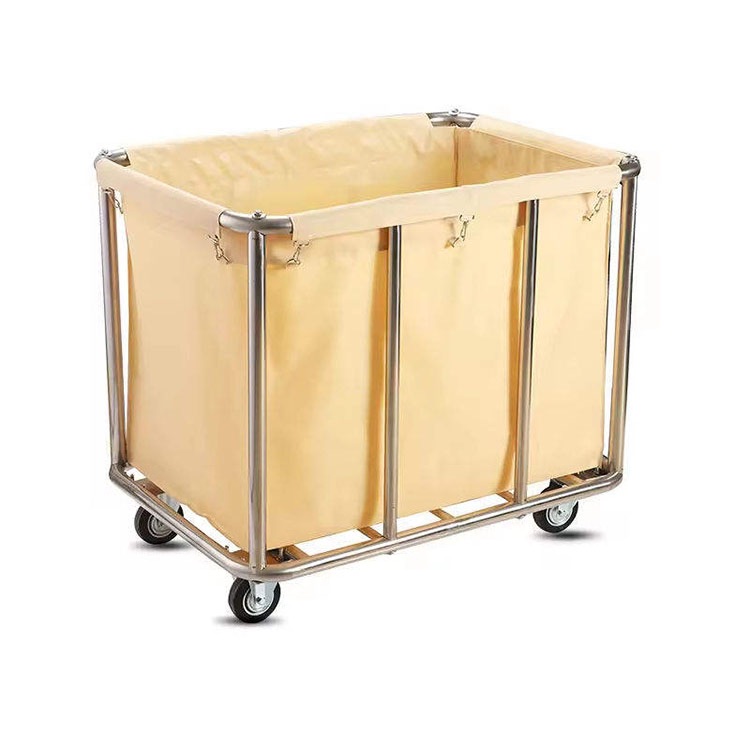
The healthcare angle is where buyers get exposed. In March 2024, the CDC’s linen and laundry management guidance said clean linens should be transported on designated carts or in designated containers that are cleaned at least daily. And the CDC’s January 2024 infection-control guidance for laundry and bedding says heavily contaminated textiles can carry bacterial loads of 10^6–10^8 CFU per 100 cm² of fabric. That is why I would lean hard toward fixed-frame options such as a double-bag laundry cart for housekeeping when separation matters, or a steel-frame hotel linen hamper trolley when route stability matters. In high-volume healthcare or commercial laundry settings, fixed usually wins because the cart is not merely storing linen; it is preserving process discipline.
The comparison that actually matters
Pretty simple.
The right comparison is not “Which laundry cart looks better?” It is “Which one breaks down slower under my real route, real staff pressure, and real sanitation routine?” Why do so many procurement sheets still avoid that question?
Buying factor
Foldable laundry cart
Fixed laundry cart
My take
Parked footprint
Smaller when collapsed
Permanent footprint
Foldable wins where storage is scarce
Frame rigidity
Lower
Higher
Fixed wins on long, heavy, repetitive routes
Dirty-clean separation
Good only if the design is disciplined
Usually stronger, especially with dual-bag or rigid-frame setups
Fixed has the edge when SOPs matter
Corridor staging
Better for intermittent use and floor-by-floor staging
Better for continuous rolling use
Depends on how often the cart sits parked
Elevator and corner handling
Good when lightly to moderately loaded
More predictable when heavily loaded
Fixed is safer under heavier loads
Sanitation workflow
Can work, but hinges on design quality and material choice
Easier to standardize in tougher-use environments
Fixed usually wins in healthcare and central laundry
A 2024 PubMed-indexed systematic review found musculoskeletal disorders all over hotel housekeeping and cleaning work, with low-back pain at 53.9%, shoulder pain at 41.4%, and wrist/hand pain at 40.1%. That should kill the lazy habit of treating a rolling laundry cart as a neutral object, because it is not neutral once it starts adding force, bad reach, repeated stops, and dirty workarounds to a route that is already physically ugly. Are buyers designing for the operator, or are they just outsourcing strain to the operator’s spine?
The legal signal is just as plain. California’s still-active Title 8, Section 3345 explicitly treats loading, unloading, pushing, and pulling linen carts as hotel housekeeping tasks inside a musculoskeletal injury prevention rule. I would not call that trivia. I would call it a warning shot. The industry already has the evidence, the injury pattern, and in at least one major jurisdiction, the regulatory language. So no, foldable versus fixed is not a “preference” decision. It is ergonomics, risk control, and operating discipline wearing procurement clothes.
And here is the hard truth I wish more vendors admitted: the best laundry cart is often the one that carries less but flows better. Oversized capacity sells. Controlled motion saves people.
The internal-link spine this article should use
Do not wander.
I would not publish this H1 and then dump readers into a generic contact form, because that is how weak content teams mistake traffic for intent; I would move the reader through a clean commercial path that mirrors how real buyers think, starting broad with the laundry and linen cart collection, narrowing to the foldable linen collection cart when storage is the pain point, shifting to the double-bag laundry cart for housekeeping when separation is the pain point, moving to the steel-frame hotel linen hamper trolley when fixed-frame stability is the priority, reinforcing corridor logic with the slim housekeeping cart guide, and closing with the OEM/ODM hotel cart program when the buyer is ready to standardize specs across multiple properties. Why send a serious buyer anywhere else?
That internal chain works because it respects intent progression: category first, use-case second, product fit third, procurement standardization last. I trust that sequence. I do not trust random “related products” modules to do the job for me.
FAQs
What is the difference between a foldable laundry cart and a fixed laundry cart?
A foldable laundry cart uses a collapsible frame or knock-down bag support to reduce parked footprint between shifts, while a fixed laundry cart uses a rigid frame that trades storage efficiency for higher load stability, cleaner route discipline, and better performance under repeated heavy-duty use. In plain English, foldable is built to disappear; fixed is built to endure. Use the first when storage is the pain point, and the second when volume, force, or sanitation discipline is the pain point.
Which laundry cart is better for hotels with tight back-of-house storage?
Hotels with tight back-of-house storage usually need a foldable laundry cart because the main advantage is not speed but parked efficiency: the cart can disappear between turns, free up service-closet real estate, and let properties stage more units by floor without permanently surrendering corridor-adjacent space. I would still reject flimsy designs. Space-saving only counts if the cart remains stable enough to roll cleanly through hallways and elevators without turning into a wobbling nuisance.
When should hospitals or healthcare laundries avoid foldable carts?
Hospitals and healthcare laundries should avoid lightweight foldable carts when routes involve contaminated textiles, long pushes, frequent sanitation cycles, or heavy wet loads, because infection-control protocols favor designated, easily cleaned transport equipment and the operation usually benefits more from frame rigidity than from collapsibility. This is where buyers need to stop acting romantic about versatility. In healthcare, a cart is part of the control system, and fixed-frame discipline usually beats clever storage.
How do I choose the best laundry cart capacity?
The best laundry cart capacity is the smallest working volume that completes one standard route without forcing overflow, dirty-clean mixing, or extra return trips, because oversized carts often look efficient in procurement spreadsheets while quietly increasing push force, parked obstruction, wall strikes, and staff fatigue. I would spec capacity only after mapping route length, refill cadence, elevator use, and dirty-stream separation. Bigger is not smarter. Bigger is often just lazier math.
Your next move
Choose by route.
Then choose by storage, sanitation, and staff strain, in that order, because this is where a serious laundry cart buying guide parts company with generic vendor fluff: foldable usually wins when parked footprint is the enemy, fixed usually wins when handling discipline is the enemy, and any buyer who ignores labor reality will eventually pay for that mistake in damage, fatigue, slower turns, or contamination sloppiness. The cleanest next step is to move readers through the exact internal path above and reserve the OEM/ODM hotel cart program for the moment they are ready to standardize dimensions, materials, and operating logic across more than one property.