Share your requirements and target market. We’ll suggest the right configuration, sampling path, and production plan.
During business hours, We can usually provide a preliminary quote within two hours.
: workflow-based setups to improve efficiency and keep corridors tidy
: easier bag changes and maintenance, built for daily facility use
: 1–3 stream options with clear icon/label systems to reduce contamination
: materials, finishes, branding & packaging locked for consistent reorders
Your info is used only for quoting and communication.
Most hotels size carts badly because they buy by catalog photo, not by floor workflow. This guide shows how to size a hotel housekeeping cart and linen cart fleet by room count, with hard rules for 100-room, 200-room, and 300-room properties.
Most hotels oversize.
I say that because the industry still confuses “more onboard capacity” with “more efficient operation,” even though the real operating penalty usually shows up somewhere uglier: slower turns at elevator thresholds, wider swing in guest corridors, heavier push force, more wall strikes, and attendants wasting paid minutes managing the cart instead of the room. Why are we still buying carts like hallway sculpture?
The data is not subtle. In the U.S. Bureau of Labor Statistics 2023 injury table, Hotels (except casino hotels) and motels, NAICS 72111, posted an incidence rate of 4.1, above the 3.9 rate for traveler accommodation overall; meanwhile, a 2024 systematic review found musculoskeletal disorders among hotel housekeepers and cleaners were heavily concentrated in the low back (53.9%), shoulders (41.4%), and wrists/hands (40.1%). That is exactly why cart sizing is not a procurement detail. It is an operations and injury-risk decision.
And labor is still thin. The American Hotel & Lodging Association said in February 2024 that 67% of surveyed hotels were experiencing staffing shortages and 48% named housekeeping as the top hiring need; by September 2024, Reuters reported 10,000 U.S. hotel workers striking across eight cities, with the union arguing that hotels were running leaner staffs and pushing workers harder. So, no, I do not buy the lazy idea that one oversized cart will “solve” a staffing problem. It usually just hides a routing problem.
Table of Contents
Room count matters, but route physics matters more
Start with room count.
But never stop there, because a 120-room roadside select-service asset with short corridors and a tight refill closet behaves nothing like a 120-room resort wing with oversized bath linen, longer travel paths, and more visible guest-floor service. Same room count. Different cart math. Isn’t that the part buyers keep dodging?
Here is the hard rule I use: room count gives you the starting divisor, while floorplate, service standard, room mix, linen par, and replenishment frequency tell you whether to push the divisor up or down. That means your first decision is not “Which hotel housekeeping cart looks right?” It is “How many rooms does one room attendant cart actually have to support before it becomes a drag on labor?”
My planning model is blunt:
Limited-service / select-service hotels: 1 active hotel housekeeping cart per 60 to 80 rooms
Full-service / upscale hotels: 1 active hotel housekeeping cart per 45 to 60 rooms
Extended-stay / resort / high-linen properties: 1 active hotel housekeeping cart per 35 to 50 rooms
Soiled-linen or laundry carts: 1 dedicated laundry and linen cart per 75 to 120 rooms, depending on how often carts are cleared and whether clean/dirty flow is split
Backup / overflow carts: 1 reserve cart for every 2 to 3 active carts
That is my model, not holy scripture. But it is a better model than the nonsense I still see, which is one cart per floor because “that’s how we’ve always done it.”
The sizing matrix I would actually trust
Specs first.
Below is the room-count matrix I would use before signing any PO for a hotel housekeeping trolley, a linen collection fleet, or a custom rollout.
Property Size
Active Guest-Floor Housekeeping Carts
Dedicated Laundry & Linen Carts
Backup / Overflow Units
My Read
1–50 rooms
1
1 small or collapsible unit
0–1
Fine for boutique and low-travel layouts if service closet access is close
51–100 rooms
2
1 double-bag or 1 standard + 1 collapsible overflow
1
This is where under-sizing starts to hurt because refill trips multiply fast
101–150 rooms
2–3
2
1
Good range for split shifts, mixed room types, and cleaner dirty-flow separation
151–250 rooms
3–5
2–3
1–2
Standardize by floor bank, not by vanity “one size fits all” buying
251–400 rooms
5–7
3–4
2
At this level, route length and elevator congestion matter almost as much as room count
400+ rooms
Zone by tower / wing / service core
Zone by laundry route and collection frequency
2+
Stop buying by room count alone; this becomes a logistics problem
The hard truth? The biggest mistake is not buying too few carts. It is buying the wrong mix of carts. A property may need fewer full hotel housekeeping carts and more dedicated soiled-linen support, especially when attendants are rehandling dirty towels, wet bath mats, or bulky king-sheet sets mid-route.
How many linen carts for 100 rooms? Here is the honest answer
Two carts. Usually.
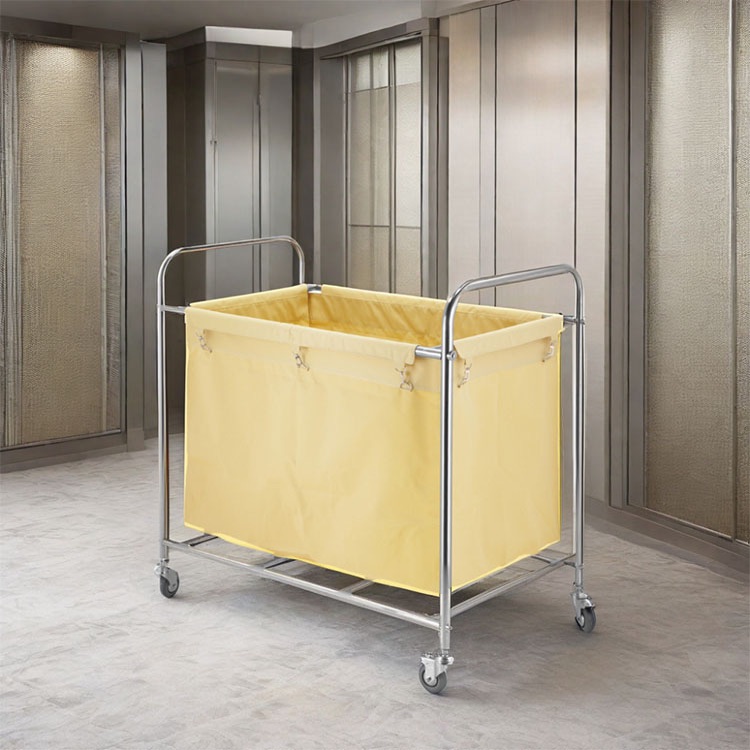
For a 100-room hotel, my default starting point is 2 active guest-floor housekeeping carts, 1 dedicated double-bag laundry cart, and 1 foldable overflow linen unit if the property has meaningful checkout peaks, shallow elevators, or service closets that are badly placed. Can you run leaner? Sure. Should you? Usually not.
Here is why I land there. One active cart for every 50 rooms gives you breathing room without turning the cart into a moving warehouse. Then I separate dirty flow from clean supply flow because once attendants start hanging sacks off the side of a maid cart, the system is already breaking down. That is why a double-bag laundry cart for housekeeping and a collapsible linen collection cart with casters make more sense than pretending one overloaded unit can do everything. Facility Project Solutions’ product pages consistently emphasize corridor-friendly steering, non-marking casters, wipe-clean construction, and bag separation, which is exactly the right operational logic for a 100-room property trying to avoid messy clean-versus-soiled crossover.
If the hotel is extended-stay, I would tighten the divisor and move faster toward a compartmentalized setup. The site’s own housekeeping cart setups for extended-stay hotels argues for a dedicated linen zone, amenity zone, small trash or soiled-linen point, and controlled chemical storage on sub-120-room assets, and I agree with that completely. Extended-stay room mix punishes sloppy cart design because kitchenette trash, longer-stay guest patterns, and refill complexity compound faster than buyers expect.
Why static room quotas break cart sizing
Quotas lie.
A 14-room day with mostly stayovers is not the same as a 14-room day with eight departures, oversized bath inventories, and a bad elevator stack, yet hotel managers still talk about cart sizing as if “rooms per shift” were the only number worth respecting. How many bad decisions has that shortcut created?
The labor-law signal is already there. In April 2024, Bloomberg Law reported that a D.C. federal appeals court affirmed an NLRB order against Hilton Anchorage after renovations made rooms harder to clean while the hotel kept the same room-cleaning quota and unilaterally increased housekeeper workload. I would not treat that as a quirky legal footnote. I would treat it as a warning label on every static room-count formula in the business.
That is why I size carts against peak serviced-room complexity, not raw key count. My adjustment factors are simple:
Add capacity pressure for checkout-heavy days
Add capacity pressure for suite or extended-stay mix
Add capacity pressure for bulky linen standards
Reduce onboard capacity when corridors are narrow and replenishment closets are close
Add dirty-flow support when waste, wet linen, or food-adjacent trash changes the route
This is also where internal linking should do actual work instead of decorative SEO work. If the reader is fighting width and turning radius, send them to how to choose a slim housekeeping cart for narrow hotel corridors. If the reader is doing multi-property standardization, move them toward an OEM hotel service cart with shelves or a broader configuration conversation, not straight into a single SKU. If the reader is still obsessed with purchase price, push them to housekeeping cart total cost of ownership before they waste a year buying fake savings. Facility Project Solutions’ own articles and product pages consistently frame the discussion around corridor width, elevator turns, shelf zoning, bag separation, bumpers, and service-life logic, which is the right buyer journey for this topic.
The room-count traps nobody wants to admit
Oversized carts hurt.
They hurt because they turn a room attendant cart into a bad substitute for a floor stockroom, and once that happens, everything slows down: turning radius, elevator entry, parking position, restocking discipline, and even guest perception in corridor-facing service. Why do buyers act surprised when a bigger cart behaves like a bigger cart?
Undersized carts hurt too, of course. But they usually hurt in a more visible way: repeated closet returns, amenity shortages, and attendants improvising with side bags, stacked linen, or unsecured chemical bottles. My opinion is simple. If I have to choose, I would rather run a slightly smaller guest-floor cart plus a dedicated linen support unit than a giant all-in-one monster that behaves badly in public areas.
And that opinion lines up with where the injury and staffing evidence points. A 2024 systematic review tied hotel housekeeping work to very high rates of low-back, shoulder, and wrist-hand pain, while Reuters’ 2024 reporting on U.S. hotel strikes captured the union argument that management was often asking three staff members to do the work of four. In that environment, cart friction is not a side issue. It is payroll burn with wheels.
FAQs
What is the right hotel housekeeping cart capacity by room count?
Hotel housekeeping cart capacity by room count is the number of active guest-floor carts, soiled-linen carts, and backup units a property needs to service its peak daily room mix without overloading attendants, blocking corridors, or forcing constant refill trips from service closets and laundry.
I would start with one active cart per 60 to 80 rooms in select-service, 45 to 60 in full-service, and 35 to 50 in extended-stay or resort operations, then adjust for floorplate, room mix, and closet distance.
How many linen carts should a 100-room hotel have?
A 100-room hotel should usually operate with one dedicated laundry and linen cart, one overflow or collapsible backup, and two active guest-floor housekeeping carts, because the real bottleneck is rarely raw room count alone; it is checkout concentration, dirty-flow separation, and refill distance during peak service windows.
If the property has tight service closets and light daily linen movement, one primary linen cart can work; if it has bulky suites, frequent departures, or weak back-of-house layout, one cart is usually too lean.
What is the difference between a housekeeping cart and a laundry or linen cart?
A housekeeping cart is a guest-floor service unit designed to carry clean linen, amenities, chemicals, and small tools for room turnover, while a laundry or linen cart is a support unit built mainly for collecting, separating, transporting, or staging soiled and bulk textile loads.
I do not like mixing those jobs unless the property is very small, because once clean and dirty flow share the same overloaded cart, labor slows down and SOP discipline starts slipping.
Should hotels standardize one cart model across every property?
Hotels should not standardize one cart model across every property unless corridor width, elevator geometry, room mix, linen par, and replenishment logic are materially similar, because a cart that works in an 80-room select-service box can become a labor drag inside a resort wing or extended-stay building.
Standardize the spec logic, yes. Standardize the exact silhouette blindly, no.
Your next move
Audit one route.
Take one real attendant, one real shift, and one real cart. Time the refill trips. Count the wall contacts. Measure elevator hesitation, linen rehandling, and dirty-flow improvisation. Then compare that mess against your room count, not the brochure language. That is how you size a hotel housekeeping cart fleet like an operator instead of a catalog shopper.