Share your requirements and target market. We’ll suggest the right configuration, sampling path, and production plan.
During business hours, We can usually provide a preliminary quote within two hours.
: workflow-based setups to improve efficiency and keep corridors tidy
: easier bag changes and maintenance, built for daily facility use
: 1–3 stream options with clear icon/label systems to reduce contamination
: materials, finishes, branding & packaging locked for consistent reorders
Your info is used only for quoting and communication.
Most buyers treat hotel luggage cart bumpers like a decorative add-on. I don’t. In guest-facing corridors, they are usually a cheap sacrificial layer that protects walls, door frames, elevator jambs, and the cart itself. The catch is simple: the bumper only pays when the route, caster spec, and cart width make sense together.
Mostly, yes.
When a luggage cart is rolling through polished lobby stone, painted corridor corners, elevator jambs, guestroom landings, and narrow turn radii instead of a rough concrete service zone, the bumper stops being a “feature” and starts acting like a sacrificial perimeter part that absorbs the stupid little impacts hotels suffer every single day, the ones nobody budgets for cleanly but everybody ends up paying for anyway.
Why do buyers still treat it like trim?
I’ll say the quiet part out loud: there is almost no public 2024 study that isolates “bumper vs. no bumper” on bellman carts, so anyone pretending to have a clean academic ROI formula is selling you theater. What we do have is the adjacent evidence that serious operators actually use: route-clearance rules, material-handling guidance, hospitality injury data, and hotel demand data that tells you how hard those carts are likely to be worked. According to the U.S. Bureau of Labor Statistics, accommodation and food services posted a 2024 incidence rate of 2.6 cases per 100 full-time workers nationally, and California’s 2024 BLS state table shows 4.0 for the same sector. That does not prove bumpers alone cut injuries. It does prove this is not a low-friction, zero-risk operating environment.
Table of Contents
The hard truth: bumpers are buying protection, not prestige
I’ve seen this before.
Procurement teams will argue for a $40 or $80 line-item savings, then ignore the fact that OSHA says mechanically handled routes need safe clearances through doorways, turns, aisles, and passage points, and that loads should be controlled so pushing force stays reasonable. That is the practical frame for hotel luggage cart bumpers: they are there because real buildings are full of tight geometry, rushed staff movement, and imperfect loads. OSHA’s materials-handling rule is blunt about clearances, and OSHA’s pushing and pulling guidance is blunt about force, visibility, wheel condition, and keeping pushing force under 50 pounds where possible. So no, a bumper does not fix a bad cart. But it does reduce the cost of normal human contact in a building that was never designed for perfect movement.
And the geometry matters more than most catalog copy admits. The U.S. Access Board’s ADA standards require 32 inches minimum clear door width in standard conditions, with 36 inches needed for deeper openings and 36-inch accessible-route width as the baseline, with narrower segments allowed only in limited conditions. That is where I get opinionated: I would rather buy a narrower, properly wheeled cart without a bloated bumper than a shiny wrap-around bumper luggage cart that fights every door and elevator on the property. Width kills more buying decisions than finish ever will.
Why the “worth it” answer changed in 2024
Traffic changed.
In February 2024, CBRE’s hotel forecast projected 3.0% RevPAR growth, 45 basis points of occupancy improvement, and 2.3% ADR growth, with urban and airport locations expected to benefit from stronger group and inbound international demand. More arrivals, more group business, more bag turns, more elevator cycles. That matters because bumper ROI is not abstract; it improves as cart touches per day rise. A bumper that looks optional on a sleepy 60-key roadside property starts looking cheap on a high-turn, guest-facing operation with compressed check-in windows.
That is why I don’t answer “Are luggage carts with bumpers worth it?” with a blanket yes. I answer it with a building question: how many tight turns, how many finished surfaces, how many bag cycles, how many staff handoffs, how many elevator thresholds, how much guest visibility?
What the site itself gets right about the buying logic
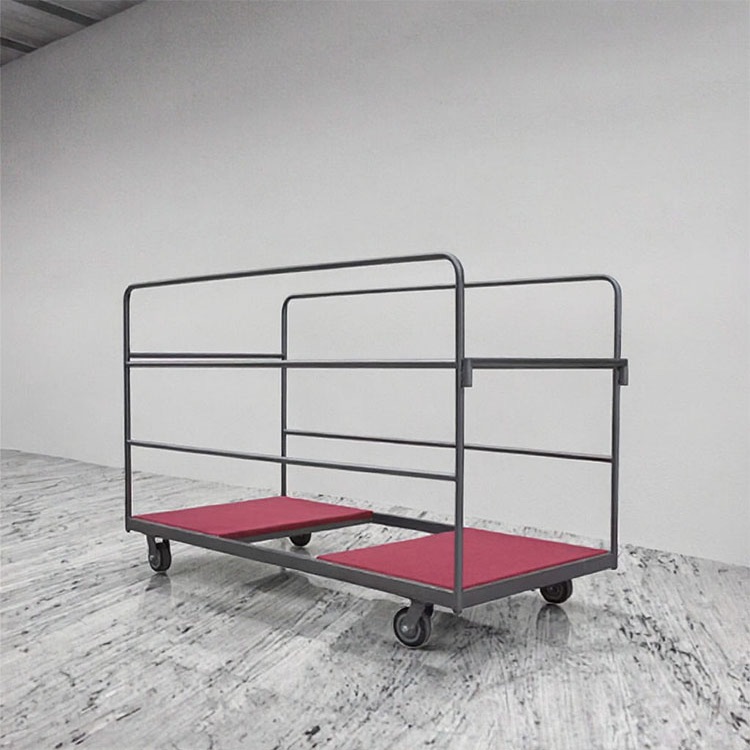
Facility Project Solutions is actually more coherent than most B2B catalog sites. Its hotel luggage trolley collection currently organizes the category into four obvious front-of-house use cases: a brass hanging-bar unit, a heavy-duty carpeted deck model, an OEM birdcage model with bumper, and a stainless unit with rails. That is smart merchandising because the cart choice is really a route-and-use-case choice, not a chrome choice.
The strongest internal page for this topic is the OEM Birdcage Hotel Luggage Cart with Bumper. The copy explicitly frames the cart around a wrap-around bumper, non-marking casters, and movement through corridors and elevators, and it says the bumper helps reduce contact damage to walls and doorways. That is exactly how a bellman cart with bumper should be sold: not as a luxury flourish, but as route protection.
The comparison becomes sharper when you read that page against the Heavy Duty Bellman Luggage Cart, Carpeted Deck page. That model leans harder into load steadiness, carpeted deck control, and front-of-house baggage flow, while also noting that perimeter-bumper options are common on hospitality carts. In plain English: one page is selling damage mitigation and guest-route contact control; the other is selling load stability first. That distinction is useful, and it is the kind of distinction buyers usually miss.
I’d also point readers to the site’s own guide on how to choose heavy-duty luggage carts for resorts, because it makes the right unfashionable point: load rating, caster behavior, bumpers, rails, and route logic matter more than finish. And the companion article on slim housekeeping carts for narrow hotel corridors reinforces the same operational truth from a different angle: corridor width and elevator maneuverability decide whether a cart works in real life.
Where a bumper luggage cart really earns its keep
Walls remember.
If your property has finished drywall corners, decorative millwork, stone skirting, elevator surrounds, or branded front-of-house finishes, hotel luggage cart bumpers are usually worth the spend because they shift small repeated impacts away from the building envelope and onto a replaceable contact edge. Nobody throws a party when a bumper absorbs a hit. That is the point.
And guest optics matter more than operators admit. A cart that taps softly, tracks predictably, and avoids leaving black marks does not just protect the building; it keeps the arrival sequence looking controlled. I don’t buy the soft-focus nonsense about “elevating guest experience” in every category. But here, yes, presentation is operational. A clattering, wall-kissing cart in a premium lobby makes the whole property look cheaper than it is.
A quick buying table I’d actually hand procurement
Operating reality
What matters most
Cart without bumper
Luggage cart with bumpers
My verdict
Luxury hotel with finished corridors and elevator jambs
Surface protection, noise control, guest optics
Higher cosmetic damage exposure
Better sacrificial protection at contact points
Worth it
Resort or convention hotel with heavy group arrivals
Repeated turns, bag volume, staff speed
Damage compounds fast under peak load
Usually pays back through fewer scuffs and cleaner routing
Worth it
Extended-stay or serviced apartment with moderate traffic
Corridor width, maneuverability, mixed bag sizes
Can work if routes are wide and surfaces are forgiving
Useful if the bumper does not add bad width
Usually worth it
Back-of-house-only service route with wide clearances
Load control, caster quality, easy cleaning
Often fine
Limited extra value
Usually not worth it
Small property with narrow doors and tiny elevators
Overall cart width, turning radius
Narrower frame may outperform
Worth it only if the bumper design stays route-friendly
It depends
When bumpers are not worth it
Sometimes, no.
If the cart lives almost entirely in service corridors, on forgiving surfaces, with wide clearances, and with low daily trip counts, I would not overspend for a bumper-first spec. I would put the money into better caster quality, a believable load rating, quieter wheels, and easier replacement parts. Bad wheels will ruin a cart faster than missing bumpers. That is my view, and I’m not budging.
The second reason to say no is even more important: when the bumper is badly designed. A thick, cheap, badly mounted luggage cart bumper guard that adds awkward width, traps dirt, or peels after a quarter is not protection; it is decorative failure. I have very little patience for spec sheets that say “anti-collision” and then tell you nothing about replaceability, attachment method, or how the cart behaves at a 90-degree turn into an elevator.
The third reason is simple misuse. If your staff overloads the deck, can’t see over the load, and has to muscle the cart around blind corners, the bumper becomes a bandage on a process problem. OSHA is clear about visibility, pushing force, and wheel condition. The bumper helps. It does not absolve.
How to choose a luggage cart with bumpers without buying the wrong one
Measure first.
I would start with the route audit, not the product page: guest entrance, lobby turn, elevator threshold, elevator car width, room-corridor pinch point, and back-of-house crossover. Then I’d compare those measurements against the cart’s true outside width, not the flattering front-view photo. Sound obvious? Hotels still mess this up constantly.
The checklist I trust
1. Confirm the route width against ADA-style pinch points. If you are dealing with 32-inch clear openings or tight maneuvering clearances, bumper bulk can turn a smart buy into a daily nuisance.
2. Demand a real load story. If the supplier cannot explain rated capacity, stable operating load, and what happens on thresholds or ramps, walk away. OSHA’s position on rated-capacity thinking is not ambiguous.
3. Treat casters as a first-order spec. Non-marking wheels, predictable tracking, replacement availability, and decent size matter more than finish. A bellman cart with bumper and bad wheels is still a bad cart.
5. Buy for replacement logic. A long-life cart program only makes sense if the wear parts are serviceable. Facility Project Solutions’ sustainability page pushes the right general idea: longer-life, repairable carts beat constant replacement. That is not just good PR; it is usually better purchasing.
FAQs
Are luggage carts with bumpers worth it?
A luggage cart with bumpers is worth it when the cart regularly moves through guest-facing corridors, elevators, door frames, and finished lobby surfaces, because the bumper works as a sacrificial contact layer that helps reduce cosmetic building damage, cart scuffs, and uncontrolled impact during tight turns or rushed arrivals.
My own answer is sharper: if the cart touches finished guest areas all day, I usually approve the bumper. If it lives in back-of-house, I usually don’t.
What is a bumper luggage cart?
A bumper luggage cart is a hotel baggage cart fitted with a protective perimeter strip, ring, or wrap-around contact edge designed to absorb low-speed collisions with walls, door jambs, elevators, millwork, and sometimes the cart itself, while preserving maneuverability and maintaining a cleaner guest-facing appearance.
The better versions are route-aware. The worse versions are width-adders with marketing copy.
How to choose a luggage cart with bumpers?
To choose a luggage cart with bumpers, compare the cart’s total outside width, bumper design, caster spec, rated capacity, and replaceability against your property’s actual door widths, corridor turns, elevator clearances, bag volume, and surface-finish sensitivity, then buy the model that solves the route problem rather than the one with the fanciest frame.
Are bellman carts with bumpers better than standard luggage trolleys?
A bellman cart with bumper is better than a standard luggage trolley when the hotel needs front-of-house presentation, controlled movement through guest areas, and more protection against repeated wall or doorway contact, while a plain trolley can be better when the route is wider, rougher, less visible, and more load-focused than appearance-focused.
I would never call one category universally better. I would call one better for a specific building.
What are the best luggage carts with bumpers for hotels?
The best luggage carts with bumpers for hotels are the ones whose outside width, wheel behavior, bumper coverage, and load profile match the property’s real circulation path, with wrap-around bumper designs generally fitting high-finish guest areas and simpler deck-focused designs fitting heavier, more utilitarian baggage workflows.
That is the adult answer. The childish answer is picking the shiniest one.
Your Next Step
Do the route audit, then buy.
Measure the narrowest door. Measure the elevator. Count the real bag volume during peak check-in. Decide whether your problem is surface damage, staff control, load stability, or guest optics. Then compare the OEM Birdcage Hotel Luggage Cart with Bumper, the Heavy Duty Bellman Luggage Cart, Carpeted Deck, and the broader hotel luggage trolley category like a procurement matrix, not a shopping gallery. If you already know your dimensions and traffic profile, send them directly to the OEM/ODM engineers here and ask for the cart width, bumper spec, caster spec, and lead time in one shot.