Share your requirements and target market. We’ll suggest the right configuration, sampling path, and production plan.
During business hours, We can usually provide a preliminary quote within two hours.
: workflow-based setups to improve efficiency and keep corridors tidy
: easier bag changes and maintenance, built for daily facility use
: 1–3 stream options with clear icon/label systems to reduce contamination
: materials, finishes, branding & packaging locked for consistent reorders
Your info is used only for quoting and communication.
How to Size a Hotel Luggage Cart for Elevators and Lobby Traffic
Most hotels buy luggage carts backward. I’d size the cart from the elevator door outward, then pressure-test it against lobby surges, staff strain, and the ugly truth about guest-route bottlenecks.
Table of Contents
Pretty carts get stuck
Pretty carts jam.
I’ve watched operators obsess over brass finish, hanging bars, and whether the frame “feels luxury,” while ignoring the one thing that decides whether the cart works on day two instead of just looking expensive on opening day: the route, the door, the turn, the parked footprint, and the ugly little drift that happens when a loaded cart enters an elevator at speed. Why buy a front-desk trophy if it turns the elevator into a choke point?
The hard limit is geometry, not taste. The U.S. Access Board says accessible routes need 36 inches of continuous clear width, reducible to 32 inches only at short pinch points, and its elevator guidance shows the standard 36-inch clear door opening in accessible configurations; OSHA also says where mechanical handling equipment is used, employers need safe clearances through doorways, aisles, and turns. That is why I treat oversized hotel luggage cart dimensions as an operations mistake first and a style decision second. See the U.S. Access Board’s accessible route guidance, the elevator guidance, and OSHA 1910.176.
My rule is blunt. On guest-facing routes that rely on 36-inch elevator doors and tight lobby approaches, I usually cap overall cart width at about 30 to 31 inches, because operators need real buffer for hands, bumper compression, caster wander, and guests who never stand where they should. That number is my buying rule, not a code line, but it is grounded in the route clearances the federal guidance lays out.
Measure the route, not the brochure
Specs lie.
Or more precisely, brochures tell the clean version of reality, while actual hotels give you elevator sill transitions, soft carpet drag, bronze door frames, marble corners, bell-desk clutter, and check-in surges that compress fifteen minutes of movement into ninety ugly seconds. So what should you measure before you even compare bellman cart dimensions?
Start with the elevator door and the cab, then work backward
I start at the elevator because that is where buying mistakes become public. Measure the clear door opening fully open, then the interior width, interior depth, distance from the back wall to the control panel, and how much usable standing room remains when one staff member is inside with the cart. If the cart fits only on paper, it does not fit.
The Access Board’s elevator guide is not subtle here: accessible elevator doors in standard configurations need a 36-inch clear width, and the car requirements are tight enough that a bloated frame or wide bumper profile can turn entry into a repeated three-point maneuver. That is why “luggage cart for elevators” is not a niche phrase; it is the actual buying problem. Access Board elevator guidance lays out the door and car logic.
Then measure the lobby pinch points people forget
The cart does not live in the elevator. It lives in the messy path between porte-cochère, bell desk, check-in queue, seating cluster, and elevator bank. I want the narrowest point, the sharpest turn, the parked footprint near the desk, and the real queue shape at 3:00 p.m., not the fantasy floor plan from the design presentation.
Traffic spikes are not theory. TSA said it expected more than 32 million travelers during the June 27 to July 8, 2024 Independence Day period, up 5.4% over 2023, and Reuters later reported 17 million passengers for the 2024 Labor Day stretch, the busiest on record for that travel window. Airport hotels, convention hotels, and leisure properties feel those waves as compressed lobby bursts, which means hotel luggage cart size has to be tested against crowding, not just storage. Read the TSA June 2024 release and the Reuters Labor Day travel report.
Do not ignore wheel behavior
Casters decide more than buyers admit.
A cart that is nominally “narrow enough” can still behave like a wide cart if cheap wheels chatter on stone, bind on carpet, or track badly over thresholds, because the operator compensates with wider hand position and slower, sloppier entries into doors and elevators. Why do so many teams still buy luggage carts as if wheel material were a decorative afterthought?
I am skeptical of any spec sheet that gives you finish first and wheel details second. In hotels with mixed surfaces, I usually want commercial non-marking casters in the 5-inch to 6-inch class, because small wheels make a decent frame feel clumsy fast. That buying logic lines up with how Facility Project Solutions frames maneuverability, non-marking wheels, bumpers, and elevator use across its cart content.
My working hotel luggage cart dimensions by building type
This is the part buyers actually need.
The table below is my operating recommendation, not a law book. I’m deriving it from ADA route and elevator clearances, OSHA’s doorway-and-turn logic, and the route-first product framing already visible across Facility Project Solutions’ luggage and service cart pages.
Property type
Recommended overall cart width
Recommended deck footprint
Height target
What I’d do
Urban boutique with one guest elevator
28–30 in
39–42 in x 22–24 in
68–72 in
Keep it tight, quiet, and bumper-heavy; protect wall finishes and avoid queue blockage
Midscale or full-service hotel with wider elevator bank
30–31 in
42–48 in x 24–26 in
70–74 in
This is the sweet spot for most hotel luggage cart dimensions
Resort with service elevators and group arrivals
30–32 in on service routes; 28–30 in on guest routes
48 in x 24–28 in
70–74 in
I’d often buy two cart types instead of forcing one model into every route
Luxury property handling garment bags and premium arrivals
29–31 in
42–48 in x 24–26 in plus hanging capacity
70–74 in
Use the garment bar only if the route is proven and the frame stays controllable
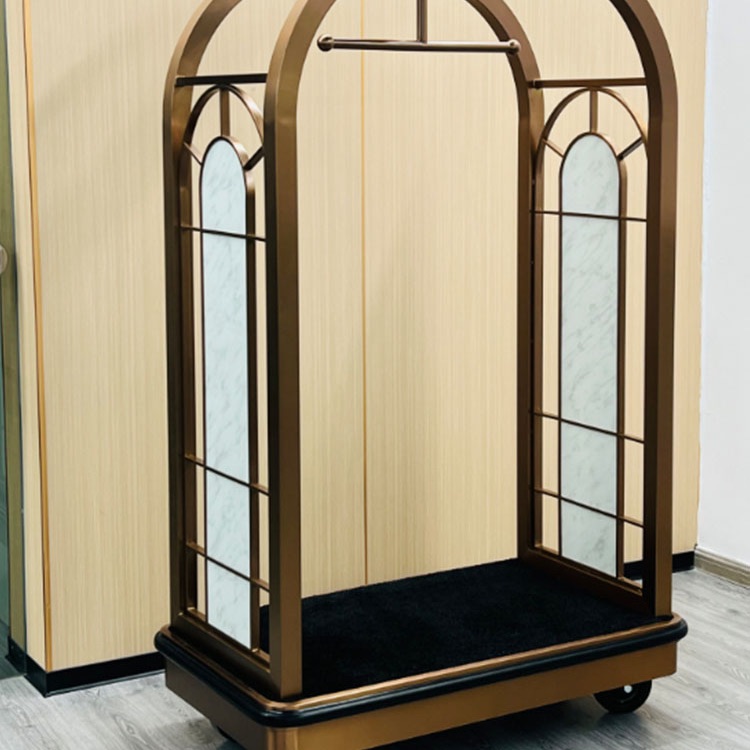
Here is the hard truth I wish more procurement teams would say out loud: one “best hotel luggage cart size for elevators” rarely exists across an entire property. A wedding-heavy resort, a compact airport hotel, and a high-design urban boutique do not deserve the same cart, and pretending they do is how you end up with a brass birdcage that photographs beautifully and performs like a shopping mall prop.
Lobby traffic is a timing problem, not a width problem
Crowds change math.
A cart that feels fine at 11:00 a.m. can become dead weight at 4:15 p.m. when rideshare drops, airline crews, early check-ins, and conference arrivals stack in front of the same elevator core, because the issue is no longer isolated width but stop-start handling, parking discipline, and whether the cart can be staged without killing guest sightlines. Isn’t that the part most “how to size a hotel luggage cart” guides politely avoid?
I also care about staff strain more than many hotel owners do, because the bill arrives whether they respect it or not. BLS reports leisure and hospitality had a 2024 total recordable injury-and-illness rate of 2.8 cases per 100 full-time workers, and across private industry there were 568,150 days-away-from-work cases involving sprains, strains, and tears, with a median 8 days away from work. Oversized carts, unstable loads, and bad turning behavior are not harmless annoyances; they are wear-and-tear systems. Read the BLS leisure and hospitality industry profile and BLS latest injury numbers.
And yes, accessibility pressure is real. Reuters covered the 2023 Supreme Court fight in Acheson Hotels v. Laufer, a case about hotel accessibility disclosures rather than bell carts, but the lesson is the same one I keep repeating: hotels get judged on access, and teams that normalize tight, obstructive, guest-route planning are training themselves into expensive habits.
The internal links I’d actually build on Facility Project Solutions
This site already gives you the cluster.
I would absolutely route authority from this article into the hotel luggage trolley collection because it works as the category hub, then into the heavy-duty luggage cart buyer’s guide for resorts because it already talks load rating, caster choice, bumper protection, and route logic rather than empty style language. That is the right commercial-intent spine for a post targeting hotel luggage cart dimensions.
If I were tightening this cluster even further, I’d use anchor text that sounds like a buyer, not a spreadsheet. Phrases like “hotel luggage trolley options,” “heavy-duty bellman cart buying guide,” “corridor-friendly service cart design,” and “custom hotel cart with bumper protection” read naturally and still pull their SEO weight. Facility Project Solutions is already halfway there because its product and blog pages consistently frame carts around corridors, elevators, bumpers, and surface protection.
FAQs
What are standard hotel luggage cart dimensions?
Standard hotel luggage cart dimensions usually land in a band of roughly 39 to 48 inches long, 22 to 28 inches deep at the deck, and about 68 to 74 inches high overall, but the correct buying decision depends on route width, elevator depth, and arrival volume. I would treat those numbers as a starting band, not a safe answer by themselves, because accessible routes and elevator entries can make an average-size cart function like an oversized one.
How much clearance should a luggage cart have for elevators?
A hotel luggage cart should leave real operating clearance inside and outside the elevator, which in practice means respecting 36-inch accessible-route logic, 36-inch door openings in standard ADA elevator configurations, and enough side margin for hands, bumpers, and wheel drift rather than trying to squeeze through at catalog width. My own buying rule is to avoid carts that leave almost no daylight on either side, because that margin disappears the moment the load shifts or the operator enters at an angle.
What is the best hotel luggage cart size for elevators?
The best hotel luggage cart size for elevators is usually the narrowest cart that still carries your real bag mix without repeated rehandling, which for many guest-facing routes means an overall width around 28 to 31 inches and a deck sized for two to four large suitcases plus soft bags. I would rather see a hotel buy two route-specific carts than one oversized “do-everything” model that slows every trip and scrapes every jamb.
Are brass bellman carts better than stainless steel luggage trolleys?
Brass bellman carts are better for visual theater and garment handling, while stainless steel luggage trolleys are usually better for wipe-down speed, corrosion resistance, and lower-maintenance daily abuse, so the winner depends on route conditions and brand positioning rather than simple prestige. I would choose brass only when the arrival ritual matters enough to justify the upkeep; otherwise, 304 stainless is the more honest material.
How many luggage carts does a 200-room hotel need?
A 200-room hotel typically needs enough luggage carts to cover its arrival peaks, building spread, and elevator pattern, which often means starting with two to four front-of-house units and then pressure-testing that number against actual check-in compression, group business, and whether service elevators can absorb overflow. I would not finalize the count until I had watched one ugly Friday arrival wave in person, because spreadsheets understate lobby friction every time.
Your next move
Measure first.
If this were my property, I would walk the exact guest route with a tape measure, log the tightest door and turn, note every lobby pinch point, and then shortlist carts only after I knew the real width ceiling, deck need, finish tolerance, and parking space near the bell desk. Then I would compare those findings against the hotel luggage trolley collection, use the heavy-duty luggage cart buyer’s guide to pressure-test load rating and caster spec, and keep the corridor-focused service cart pages nearby as a reminder that route behavior beats showroom shine every single time.