Share your requirements and target market. We’ll suggest the right configuration, sampling path, and production plan.
During business hours, We can usually provide a preliminary quote within two hours.
: workflow-based setups to improve efficiency and keep corridors tidy
: easier bag changes and maintenance, built for daily facility use
: 1–3 stream options with clear icon/label systems to reduce contamination
: materials, finishes, branding & packaging locked for consistent reorders
Your info is used only for quoting and communication.
Most “custom” hotel luggage cart offers are cosmetic. I break down what real OEM customization looks like, which options actually pay back, and how serious buyers should evaluate a hotel bellman cart before signing a PO.
Table of Contents
The pretty-cart scam buyers keep funding
This is operations.
In May 2024, AHLA’s staffing survey said 76% of surveyed hotels were facing staffing shortages, and respondents were trying to fill an average of seven jobs per property; then, during Labor Day 2024, Reuters reported that more than 10,000 hotel workers struck across 25 hotels in nine U.S. cities, with disruptions hitting services including housekeeping. When labor is tight and arrivals still need to move fast, why are so many buyers still treating a hotel luggage cart like lobby jewelry?
I have watched this happen too many times. A supplier swaps finish color, adds a logo badge, maybe changes the deck carpet, and suddenly the quote says “OEM hotel luggage cart” as if engineering happened. It didn’t. That is dress-up. Real OEM work changes how the cart behaves in a building, how it survives year three, and how much payroll it quietly burns every shift.
Looks sharp.
But sharp is cheap talk when the cart chatters over elevator sills, clips painted jambs, drifts on polished stone, or forces a bell team to re-stack soft bags because the deck geometry was never thought through. Should a buyer pay luxury money for a cart that still behaves like a warehouse dolly in a tuxedo?
What real OEM customization for a hotel luggage cart actually includes
Start with route physics, not finish chips
Buy for movement.
Facility Project Solutions’ own OEM/ODM services page gets one thing right: the spec should begin with corridor widths, elevator turns, load targets, cleaning routines, and noise expectations, while the site’s broader hotel luggage trolley collection frames options by use case rather than by glamour shot. That is the right sequence, and I trust suppliers more when they ask for route photos before they ask for logo files.
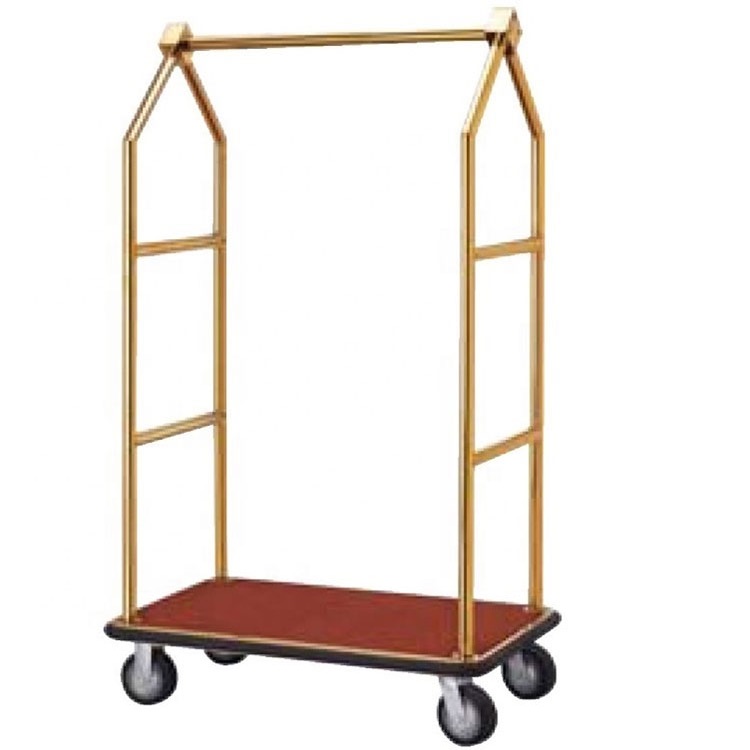
The hard truth is boring. An actual custom hotel luggage cart program should let the buyer define frame width, deck length, deck surface, hanging-bar layout, caster diameter, wheel compound, bumper depth, rail shape, finish system, branding method, packaging marks, and spare-parts policy. If the so-called bellman cart manufacturer cannot discuss axle, wheel, and bumper options in the first serious call, you are not in an OEM conversation. You are in a decoration conversation.
Wheels decide more than buyers admit
Bad wheels tax labor.
OSHA’s pushing and pulling guidance warns that improperly functioning wheels make moving transport devices harder than necessary and can increase stress on arms, backs, and legs, while OSHA’s housekeeping ergonomics guidance says workers face strain and sprain risk from ergonomic hazards. I care more about 5-inch or 6-inch commercial casters in PU or TPR, bearing quality, and predictable tracking than I do about whether the tube finish looks “premium” on a sales PDF. Why do buyers still sign off on finish before they sign off on force?
That is why I would push readers from the site’s guide on how to choose heavy-duty luggage carts for resorts before I would send them straight to a quote form. The guide correctly centers load rating, bumper protection, casters, and route conditions, which is far closer to how serious operators think than the usual “gold or silver?” nonsense.
Width, turning behavior, and bumper depth are not side notes
Walls remember.
The U.S. Access Board says accessible routes require a 36-inch continuous clear width, reducible to 32 inches only at short pinch points such as doorways, and Reuters reported in June 2024 that hotel supply growth was under 1% versus a 30-year average of 2.5%, with operators chasing conversions because new construction financing was tight. That combination matters: more hotel operators are solving operational problems inside older buildings, tighter corridors, and imperfect elevator banks. Do you really think a stock-width hotel baggage trolley is going to behave the same way in a fresh convention hotel and a converted office asset?
So yes, I want the OEM conversation to cover frame width, bumper projection, rail overhang, door approach angle, and sill transition behavior. A hotel bellman cart that fits the showroom but fights the route is not customized. It is mis-specified.
The OEM options that actually move the numbers
Labor is expensive.
The Bureau of Labor Statistics put total employer compensation in leisure and hospitality at $19.90 per hour in December 2024, with service occupations at $18.00, and BLS wage data for May 2024 put maids and housekeeping cleaners at an annual mean wage of $36,180. Add BLS’s 2024 leisure-and-hospitality injury rate of 2.8 recordable cases per 100 full-time workers and 284 fatalities, and the point becomes painfully simple: mobility, exertion, and collision risk are not soft variables. They are operating cost.
Based on OSHA guidance, BLS labor and injury data, the Access Board’s clearance rules, and the site’s own OEM and product cluster, this is the matrix I would actually use when evaluating custom hotel luggage cart options. It is a synthesis, yes. But it is the kind of synthesis buyers need before they get seduced by brass plating.
OEM option
What it really fixes
Best-fit property type
What lazy suppliers get wrong
My view
5–6 inch commercial casters in PU or TPR
Reduces push force, chatter, drift, and route friction
Resorts, long corridors, mixed floor surfaces
Cheap wheels that flatten, squeal, or track badly
Fund this first
Wrap-around bumper system
Cuts wall, elevator, and millwork damage
Luxury hotels, conversions, urban towers
Thin bumper rings that are cosmetic only
Usually non-negotiable
Carpeted or anti-slip deck surface
Improves bag stability and cuts re-handling
High-volume arrivals, family resorts, group business
Fixed carpet inserts that age badly and cannot be replaced
Supports brand theatre and front-drive presentation
Heritage, luxury, ceremonial arrivals
Finish selected before mechanical spec is finished
Last decision, not first
Logo plates, laser marks, or brand panels
Standardizes portfolio appearance
Multi-property programs
Cheap graphics that peel or date fast
Worth it only after route spec is locked
Carton marks and spare-parts standard
Simplifies rollouts and repeat orders
Hotel groups and regional programs
No parts map, no wheel SKU, no bumper replacement logic
Quietly one of the smartest OEM asks
Where buyers get burned, and what I would ask before approval
Ask harder.
I do not care if the quote says “best hotel luggage cart.” That phrase is marketing sugar. I care whether the supplier can show a real load target, a parts list, wheel spec, bumper material, approved sample path, and repeat-order control. If not, the custom hotel luggage cart is only custom until the first replacement order shows up different.
I also want buyers to stop pricing these units like static furniture. Facility Project Solutions already has a useful internal path here: start with the hotel luggage trolley collection, move into the buying guide on how to choose heavy-duty luggage carts for resorts, then force the finance conversation with how to calculate housekeeping cart total cost of ownership. That is a smarter internal journey than sending every reader straight from category page to inquiry form, because it qualifies the buyer and raises the spec vocabulary before sales gets involved.
My own filter is ruthless. If a bellman cart manufacturer cannot explain which wheel works on polished stone versus broadloom, what bumper depth does to total width, how a hanging bar changes loading behavior, and which wear parts are field-replaceable, I assume the factory is selling finish theatre. And finish theatre is expensive.
For buyers who need broader fleet consistency, the site’s custom hotel carts category is the right adjacent link because luggage carts rarely live alone; they sit inside a family of front-of-house and back-of-house equipment that procurement teams eventually want to standardize. That is how real OEM programs scale: not by one pretty unit, but by shared rules for mobility, finish, labeling, and reorder discipline.
FAQs
What are OEM custom options for a hotel luggage cart?
OEM custom options for a hotel luggage cart are buyer-defined changes to the cart’s size, mobility package, deck surface, bumper system, finish, branding, and spare-parts standard so the unit fits a hotel’s route widths, guest-service style, cleaning routine, and repeat-order requirements across one property or an entire portfolio.
That is the real definition. In practice, I would expect discussion around caster diameter, wheel material, frame width, hanging-bar need, bumper depth, deck insert type, branding durability, sample approval, and parts continuity. Anything less is surface-level customization.
How do I choose a hotel luggage cart?
To choose a hotel luggage cart, start by matching the cart to the building and workload: corridor width, elevator depth, surface mix, average bag volume, garment-bag frequency, finish expectations, and replacement-part strategy should come before color, ornament, or brochure photography because route fit and labor control decide long-term value.
I would never start with metal color. I would start with route photos, door clearances, floor surfaces, arrival peaks, and who is actually pushing the unit during compressed check-in windows. That is how to choose a hotel luggage cart without getting fooled.
Are brass bellman carts better than stainless steel luggage trolleys?
Brass bellman carts are better when the hotel sells ceremony, arrival theatre, and garment handling, while stainless steel luggage trolleys are better when the property values wipe-down speed, corrosion resistance, and a cleaner operational look; the better cart is the one that fits the property’s route, service mix, and upkeep discipline.
I have no religion on brass versus stainless. Brass-look finish can be exactly right in a luxury arrival sequence, but if the property is humid, hard on finishes, or obsessed with sanitation speed, stainless often wins the argument very quickly.
What is the best hotel luggage cart for luxury hotels?
The best hotel luggage cart for luxury hotels is usually a bumper-protected, quiet-rolling, finish-consistent cart with controlled turning behavior, stable load containment, and replaceable wear parts, because luxury operations pay more for wall damage, noise, awkward guest-facing handling, and finish drift than they do for basic hardware.
That is why I dislike “luxury” being reduced to brass color. In a real luxury hotel, noise, glide, line-of-travel control, and finish consistency matter more than ornamental flourishes that look good on day one and sloppy on day 400.
What should I ask a bellman cart manufacturer before ordering?
The questions to ask a bellman cart manufacturer are the ones that expose operational truth: what is the real load target, which caster package fits my surfaces, what total width includes bumpers and rails, what parts are replaceable, how is the sample approved, and how will repeat orders stay consistent.
I would also ask for packaging marks, spare wheel and bumper part numbers, and a written explanation of how the supplier will keep finish and geometry aligned across future batches. Reorders are where weak OEM promises usually fall apart.
Your next move
Send the ugly details.
If you want a hotel luggage cart quote that means anything, send route widths, elevator opening dimensions, door thresholds, surface mix, average bag count, garment-bag frequency, target finish, logo files, rollout quantity, and the spare-parts level you expect; then use the site’s request pricing, samples, or a custom OEM/ODM proposal page alongside the core OEM/ODM services page so the discussion starts with engineering, samples, and repeat-order control instead of empty style talk. Why waste another week asking for a pretty quote when what you actually need is a route-tested spec?