Share your requirements and target market. We’ll suggest the right configuration, sampling path, and production plan.
During business hours, We can usually provide a preliminary quote within two hours.
: workflow-based setups to improve efficiency and keep corridors tidy
: easier bag changes and maintenance, built for daily facility use
: 1–3 stream options with clear icon/label systems to reduce contamination
: materials, finishes, branding & packaging locked for consistent reorders
Your info is used only for quoting and communication.
Why Hotel Groups Need a Standard Housekeeping Cart Spec Library
Most hotel groups do not have a cart problem. They have a spec-control problem. I’m arguing for a standard housekeeping cart spec library because inconsistent cart dimensions, bag-holder layouts, caster choices, and door formats create hidden labor drag, safety exposure, and ugly reorders.
Most groups improvise.
They compare photos, chase unit price, and pretend a hotel housekeeping cart is a simple commodity, even though the wrong cart quietly adds wasted steps, corridor scuffs, awkward replenishment, and inconsistent training across every property that inherits the mistake. Why are smart operators still buying carts like they are buying spare hangers?
I’ll be blunt. A standard housekeeping cart spec library is not procurement theater. It is operating discipline. And in 2024, the industry gave operators every reason to stop guessing: in AHLA’s February 2024 staffing survey, 67% of hotels reported a staffing shortage, 72% still had unfilled openings, and housekeeping was the top hiring need for 48% of respondents; by June 2024, that rose to 76%, with 79% still unable to fill open roles and housekeeping again the number-one gap at 50%. Then September arrived, and Reuters reported roughly 10,000 U.S. hotel workers striking across multiple cities over wages, fair staffing, workloads, and the reversal of COVID-era cuts. That is the backdrop. So no, I do not buy the lazy argument that cart specifications are a minor detail. Read the numbers, then try saying that with a straight face. AHLA February 2024 staffing survey, AHLA June 2024 staffing survey, and Reuters’ September 2024 strike report tell the story plainly.
Table of Contents
The real problem is not the cart
It is the inconsistency.
One hotel buys a slim maid cart. Another buys a housekeeping trolley with a bag frame hanging too far into the corridor. A third adds lockable doors because one GM hates visible chemicals. A fourth reorders “the same model” and gets different casters, a different handle height, and a different bumper profile because the supplier changed the SKU package. What exactly did the brand standardize there?
But once you manage more than a handful of hotels, a hotel housekeeping cart stops being a product and starts being a workflow container: linen, terry, amenities, PPE, trash, soiled linen, quaternary ammonium disinfectants, microfiber, and replacement stock all need a physical logic, not just shelf space. If the logic changes by property, the labor penalty changes by property too. Why would any hotel group choose that kind of chaos on purpose?
What I would standardize first
I would not start with finish color. I would start with failure points.
Spec Area
What too many hotel groups do
What a standard spec library should lock
Housekeeping cart dimensions
Buy by brochure width only
Define total working profile: body width, bumper overhang, bag-holder projection, handle projection, and parked footprint
Shelf logic
Accept fixed shelves
Standardize adjustable shelf ranges by room type and refill cadence
Clean/dirty separation
Treat bag holders as optional
Set approved bag-frame layouts for soiled linen or waste separation
Corridor protection
Hope attendants “drive carefully”
Specify non-marking casters, bumper material, and corner protection
Security
Add doors only after complaints
Define where lockable cabinet doors are required by floor type or brand tier
Materials and finish
Mix resin, laminate, and metal without rules
Set approved materials, easy-clean surfaces, and replacement part compatibility
Reorder control
Rebuy from memory
Assign internal spec codes, revision dates, and approved alternates
Training
Train by property habit
Train to one standard stocking map and one service sequence
The corridor piece matters more than many buyers want to admit. The ADA’s 2010 design standards require a 36-inch minimum clear width, with 32 inches allowed only at a point for up to 24 inches; and California’s Title 8, Section 3345 specifically treats hotel housekeeping under a musculoskeletal injury-prevention rule aimed at reducing risk in lodging operations. Put differently, your housekeeping cart dimensions are not just a purchasing detail. They touch circulation, strain, and compliance exposure. 2010 ADA Standards and California Title 8 Section 3345 are worth reading before anybody signs another PO.
The hard truth about “best hotel housekeeping cart”
There is no universal best.
The best hotel housekeeping cart for a 95-room extended-stay asset with tight elevator lips and kitchenette waste is not the best standard housekeeping cart for a resort tower, and it definitely is not the best maid cart for a premium guest-facing corridor where exposed amenities look sloppy and exposed chemicals look reckless. Why do buyers still ask for one winner instead of one controlled family of approved specs?
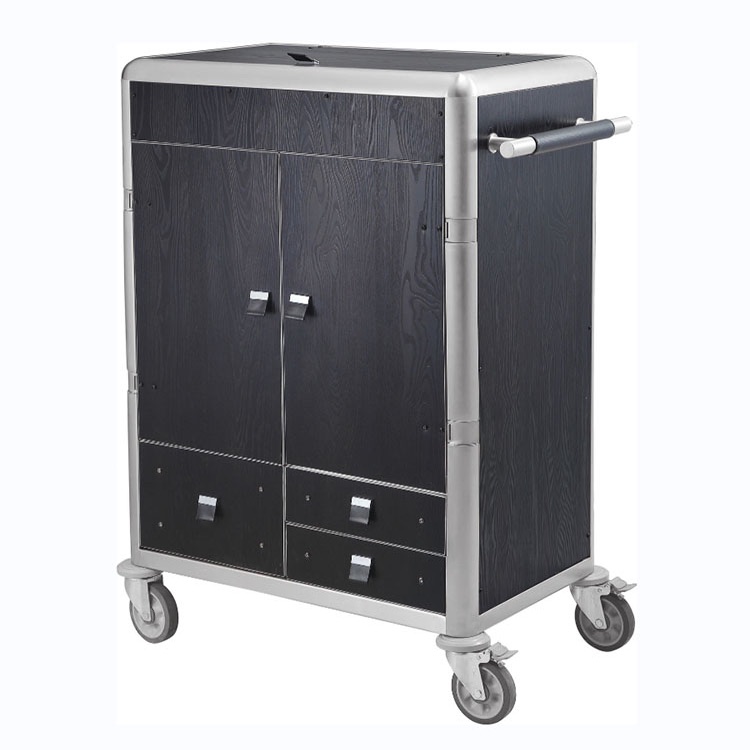
This is where the internal content on the site already gives you the answer. The extended-stay cart setups article frames the problem correctly: setup follows operating pattern, not catalog ego. The compact maid cart with linen storage emphasizes zoned compartments, adjustable shelving, non-marking casters, and protective bumpers for corridors and elevators. The bag-holder model makes the hygiene argument by separating soiled flow from clean inventory. The lockable-door model makes the presentation and access-control case on guest floors. I would keep all four in the same spec family, with approved use cases, rather than forcing one cart to fail in four different ways.
The hidden P&L damage nobody likes to quantify
Minutes compound.
The U.S. Bureau of Labor Statistics counted 422,760 maids and housekeeping cleaners in accommodation in 2024, with a mean annual wage of $35,800 and a mean hourly wage of $17.21. That is a huge labor base doing repetitive physical work inside an industry that also posted a 2024 injury-and-illness rate of 2.3 cases per 100 full-time workers for accommodation overall. So when I see operators shrug at a badly chosen housekeeping trolley, I see somebody ignoring a multiplying function: bad dimensions, bad wheel package, bad bag geometry, bad storage logic, repeated thousands of times. Isn’t that the definition of preventable cost? BLS accommodation data is not subtle about it.
And labor pressure makes the mistake worse, not better. In AHLA’s February 2024 survey, respondents were trying to fill an average of nine positions per property; in the May 2024 survey released in June, hotels were still trying to fill an average of seven openings per property while reporting a worse overall staffing picture. That means many hotels are asking thinner teams to move faster through the same buildings. Under those conditions, a sloppy housekeeping cart specification is not neutral. It is a force multiplier for fatigue and inconsistency. AHLA’s February 2024 survey and June 2024 survey make that point without even meaning to.
I have a strong opinion here. Too many hotel groups obsess over room prototypes, mock-up bathrooms, and brand scent programs while leaving back-of-house and guest-floor service equipment to local improvisation. That is backwards. Guests may never compliment your caster compound, but they absolutely notice blocked corridors, dented wall corners, exposed chemical bottles, messy linen staging, and attendants fighting the cart in front of Room 1408. Service optics are built out of boring objects. That is the part people hate hearing.
What a hotel group spec library should actually contain
Not a mood board.
A real spec library for housekeeping cart specifications should include exact housekeeping cart dimensions by approved asset type, caster diameter and wheel material, bumper style, shelf adjustability range, bag-holder type, cabinet-door option, handle height, safe-load guidance, finish and cleanability standard, and replacement-part coding. And yes, carton labeling and rollout documentation belong in there too. Because what good is a spec if Site 11 cannot receive, identify, and reorder it cleanly?
Facility Project Solutions already hints at that procurement-first logic. Its homepage explicitly positions the offering around a “spec library” for multi-site reorders, and the OEM/ODM page pitches standardization across properties with predictable rollout support. I would use that angle hard, because it matches the H1 perfectly and because it is one of the few parts of the pitch that speaks the language sophisticated buyers actually use. Facility Project Solutions homepage and the OEM/ODM services page are doing the right thing when they talk about locked specs, repeatability, and rollout control.
The minimum viable approval stack
I would require three approval layers before a cart enters the brand library.
Operations signs off on workflow. Housekeeping signs off on stocking logic and real corridor behavior. Procurement signs off on reorder discipline, alternate control, and documentation. Anything less is how hotel groups end up with a “standard” that was never tested where the cart actually lives. Isn’t that how bad standards are born?
FAQs
What is a housekeeping cart spec library?
A housekeeping cart spec library is a controlled set of approved dimensions, materials, caster packages, storage layouts, bag-holder options, and security features that a hotel group uses to buy, deploy, replace, and train against the same equipment logic across multiple properties. I would treat it as a live operating document, not a forgotten PDF, because the point is repeatable field behavior, not pretty formatting.
What should hotel housekeeping cart specifications include?
Hotel housekeeping cart specifications should define overall working width, shelf adjustability, clean-versus-dirty separation, bag-frame geometry, caster type, bumper package, handle height, door or lock requirements, finish durability, and replacement-part coding so procurement, operations, and housekeeping leaders are all buying the same operating tool. If the spec does not tell a buyer how the cart behaves in a corridor, it is not finished.
How often should hotel groups update housekeeping cart dimensions and specs?
Hotel groups should update housekeeping cart dimensions and specifications whenever a brand standard changes, a corridor-clearance issue appears, a housekeeping task mix shifts, or a major reorder cycle begins, because the right review trigger is operational change, not an arbitrary annual calendar reminder. I would also reopen the spec when a property type changes from transient to extended-stay logic, or when local rules raise new safety expectations under standards such as California’s Section 3345.
Is a lockable maid cart better than an open housekeeping trolley?
A lockable maid cart is better than an open housekeeping trolley when guest-facing corridors, premium floors, mixed-use circulation, or chemical-control concerns make concealment and access control more valuable than split-second retrieval speed, but open formats still win on some back-of-house or low-visibility routes. My bias is simple: if guests regularly see the cart, I usually want the tighter visual discipline of lockable doors.