Share your requirements and target market. We’ll suggest the right configuration, sampling path, and production plan.
During business hours, We can usually provide a preliminary quote within two hours.
: workflow-based setups to improve efficiency and keep corridors tidy
: easier bag changes and maintenance, built for daily facility use
: 1–3 stream options with clear icon/label systems to reduce contamination
: materials, finishes, branding & packaging locked for consistent reorders
Your info is used only for quoting and communication.
Why Premium Hotels Care About Luggage Cart Details
I’ve watched hospitality buyers overpay for shine and underbuy for control. The hard truth is simple: a premium hotel luggage cart earns its keep through wheels, bumpers, deck stability, width, and finish logic—not decorative ego.
Table of Contents
The cart tells guests what kind of hotel this is
Small object. But a hotel luggage cart sits at the exact point where premium hospitality becomes physical, visible, and easy to judge, and that matters more now because guests are paying more and watching service quality more closely; J.D. Power said U.S. hotel ADR hit $158.45 in May 2024, the second-highest month ever, and travelers’ sense of value depends on whether the hotel actually delivers on expectations. So if the first moving thing a guest sees is a squeaking, drifting, overbright cart clipping the elevator frame, what message do you think lands first?
I don’t buy the lazy industry line that a hotel bell cart is “just equipment.” It isn’t. It is guest-facing hardware. That is why the smarter internal journey on Facility Project Solutions starts with the broad hotel luggage trolley collection and then moves into the more tactical guide to heavy-duty luggage carts for resorts, where the logic is route-first: wheels, bumpers, deck control, elevator behavior, and finish durability come before showroom vanity. That is the right order, and frankly, most suppliers get it backward.
Cheap bellman carts leak labor and maintenance money
Labor exposes everything. And when 76% of surveyed hotels said they were facing staffing shortages in June 2024, with 79% still unable to fill open jobs and housekeeping named the top hiring need by 50% of respondents, every extra reset, repeat trip, stuck wheel, and wall strike becomes more expensive because fewer people are available to absorb dumb operational friction. Why are buyers still pretending a bad bellman cart is a style issue instead of a labor issue?
And the stress is not theoretical. Reuters reported that on September 2, 2024, more than 10,000 hotel workers struck at 25 hotels in nine U.S. cities, with some properties reporting disruptions to restaurants and housekeeping during Labor Day travel. That is not a luggage-cart case study on its face. I know. But it is a very clean reminder that when staffing gets thin, premium hotels stop tolerating equipment that wastes steps, blocks routes, or creates guest-facing mess.
That is also why I like pairing the resort guide with the site’s How to Choose a Slim Housekeeping Cart for Narrow Hotel Corridors page. Premium hotels do not fail on one product. They fail when the bellman cart, housekeeping cart, room service trolley, and linen cart all fight the same elevator bank and the same corridor corners. Facility Project Solutions is unusually direct about that corridor math, and I respect that.
What the best hotel luggage cart buyers actually spec
I care about wheels more than finish. That annoys salespeople, but they are not the ones apologizing to ownership after a cheap trolley chatters across stone, drifts into millwork, or turns a simple suite arrival into a luggage pileup at the lift threshold. Here is the comparison I would hand procurement before anyone says the words “luxury look.”
Detail
What premium hotels usually want
What cheap specs get wrong
Best-fit internal link
Caster package
Non-marking casters, predictable tracking, commercial wheel size that handles stone, carpet, thresholds, and elevator transitions
Tiny hard wheels that chatter, drift, and force re-positioning
The pattern is obvious. Premium buyers are not paying for ornament; they are paying for control. And yes, the best luxury hotel luggage cart still needs to look expensive, but visual polish is the final layer, not the first filter.
A luxury hotel luggage cart should fit the building, not the mood board
The birdcage cart is for properties that cannot afford contact damage
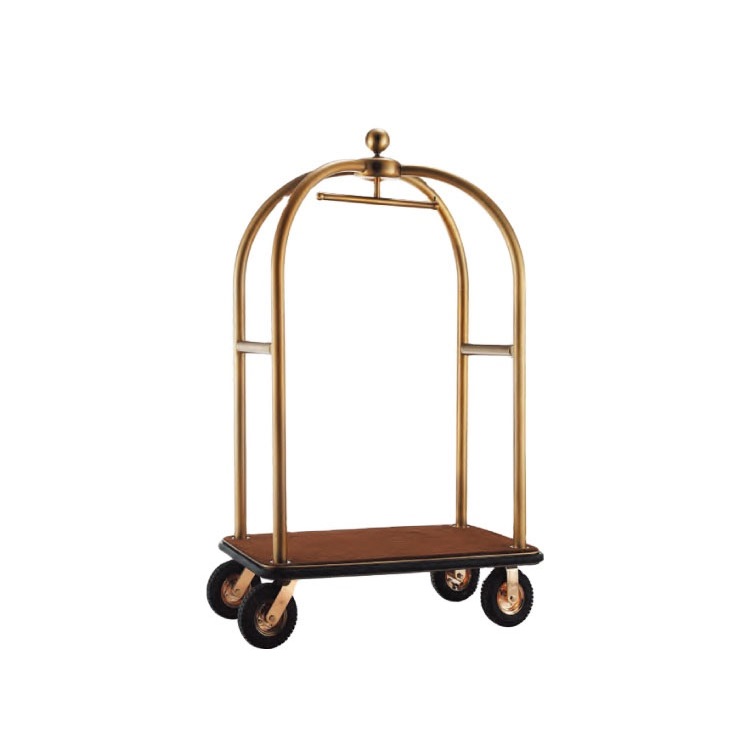
I would choose the OEM Birdcage Hotel Luggage Cart with Bumper for finished-wall luxury properties, serviced apartments, and resorts where the cost of one sloppy hit to a painted column, brass elevator edge, or stone return is more annoying than the premium paid for better protection. The wrap-around bumper is not decorative. It is insurance disguised as metal tubing.
Stainless steel is the adult choice for wipe-down speed
I would move toward the Stainless Steel Hotel Luggage Trolley with Rails when the property is coastal, humid, spa-heavy, or obsessive about visible cleanliness. Stainless says “clean,” wipes down fast, and avoids the tired look that decorative finishes get after repeated contact with wet luggage, sunscreen-coated handles, and constant sanitizing. Pretty can sell. Easy maintenance keeps selling.
Hanging bars are not old-school; they solve a real premium-service problem
If the hotel handles wedding parties, diplomatic guests, executive long-stays, or anyone who arrives with garment bags that should not look like they lost a bar fight, the Gold Brass Bellhop Luggage Cart with Hanging Bar makes operational sense. I have never understood why some buyers dismiss hanging bars as nostalgic when they solve a very modern problem: keeping formalwear separate from hard-sided luggage during fast arrivals.
Carpeted-deck bellman carts win when volume matters more than theater
The Heavy Duty Bellman Luggage Cart, Carpeted Deck is less flashy, and that is fine by me. For high-turnover city hotels, group arrivals, and properties that care about stable loading more than Instagram shine, a controlled deck and predictable steering beat ornamental tubing every time. I know that is not the glamorous answer. It is still the right one.
The boring measurements can become a legal problem fast
Measurements matter. According to the ADA’s 2010 design standards, walking surfaces that are part of an accessible route generally require 36 inches minimum clear width, and certain 180-degree turns require wider clearances such as 42 inches approaching, 48 inches at the turn, and 42 inches leaving, or 60 inches at the turn under the alternative condition. So a too-wide hotel luggage cart, or a cart parked lazily beside another service unit, can move from “annoying” to “noncompliant” faster than most managers want to admit.
This is where premium hotels separate themselves from aspirational ones. The serious operators measure the route. They check lift openings. They test thresholds. They standardize bumpers. They think about guest flow, not just procurement line items. And when they are building a portfolio standard rather than buying a one-off trolley, they usually need a supplier willing to handle specification discipline, not just ship shiny frames. That is exactly where a custom OEM/ODM proposal becomes more useful than another generic catalog PDF.
FAQs
Why do premium hotels invest more in a hotel luggage cart?
Premium hotels invest more in a hotel luggage cart because it is a front-of-house operations tool that shapes first impressions, protects labor minutes, reduces wall and elevator damage, supports guest-facing cleanliness, and influences whether expensive room rates feel justified the moment service begins.
I would put it even more bluntly: the cart is one of the first physical proofs of whether a hotel’s “premium” claim is real or just marketing varnish. With room rates elevated and guest expectations tied closely to execution, details that look minor to procurement stop looking minor to the guest.
What is the best material for a luxury hotel luggage cart?
The best material for a luxury hotel luggage cart depends on route conditions and service style: stainless steel suits wipe-down speed and humidity exposure, brass/gold suits ceremonial front-of-house presentation, and heavy-duty structural frames suit high-volume properties where stable handling matters more than decorative effect.
I lean stainless when upkeep and humidity matter, and I lean brass only when the property can maintain the look and actually benefits from the visual cue. Material choice should follow operations, not vanity.
Are birdcage luggage carts better than flat bellman carts?
Birdcage luggage carts are better when a property needs vertical organization, perimeter protection, garment handling, and a more polished arrival scene, while flat or carpeted bellman carts are better when the hotel values faster loading, simpler maintenance, and heavy suitcase throughput over visual ceremony.
That is why I dislike blanket recommendations. A birdcage luggage cart can be the best hotel luggage cart for one property and the wrong answer for another two blocks away.
How do you choose a hotel luggage cart for narrow corridors and elevators?
Choosing a hotel luggage cart for narrow corridors and elevators means measuring the real operating route, including lobby turns, lift openings, guest-floor pinch points, parked-service overlap, and any accessible paths where ADA standards generally require at least 36 inches of clear width and wider turning space in some conditions.
A hanging bar is worth it when a hotel regularly handles garment bags, wedding arrivals, VIP suites, long-stay executive guests, or any service pattern where formalwear and soft-hanging items need to stay separate from stacked luggage during transfers from lobby to elevator to room.
I would not force it into every property. But if your arrivals include dresses, jackets, and suits, skipping the bar is usually a false economy that makes expensive service look improvised.
Your Next Step
If you are standardizing for a premium property, do not start with finish swatches. Start with route conditions, staffing reality, and guest-facing wear points. Review the full hotel luggage trolley collection, compare it against the site’s guide to heavy-duty luggage carts for resorts, and then request a custom OEM/ODM proposal with your corridor widths, elevator dimensions, service mix, and finish expectations.
That is how grown-up hotel buyers do it. And yes, premium hotels care about luggage cart details because they have already learned the expensive lesson: the cart is never just a cart.